The Patients page is the table view of every patient in your agency. It runs on Material React Table, so you get search, column filters, sortable headers, density, fullscreen, column visibility, and CSV export out of the box. The action bar above the table covers Add Patient, Make Inactive, Delete, and Import CSV.
Quick answer
Open Patients from the left sidebar. The page lands on the Active tab. Click any row to open that patient's Overview. Use the five icons in the top right of the Patient List card to search, filter, change density, hide columns, or go fullscreen.
1. Open Patients and pick Active or Inactive
Click Patients in the left sidebar.
The page opens on the Active tab. The Inactive tab sits next to it for archived patients. Inactive patients stay on file for billing history, authorizations, and audit, but they don't show up in scheduling, alerts, or the Active count.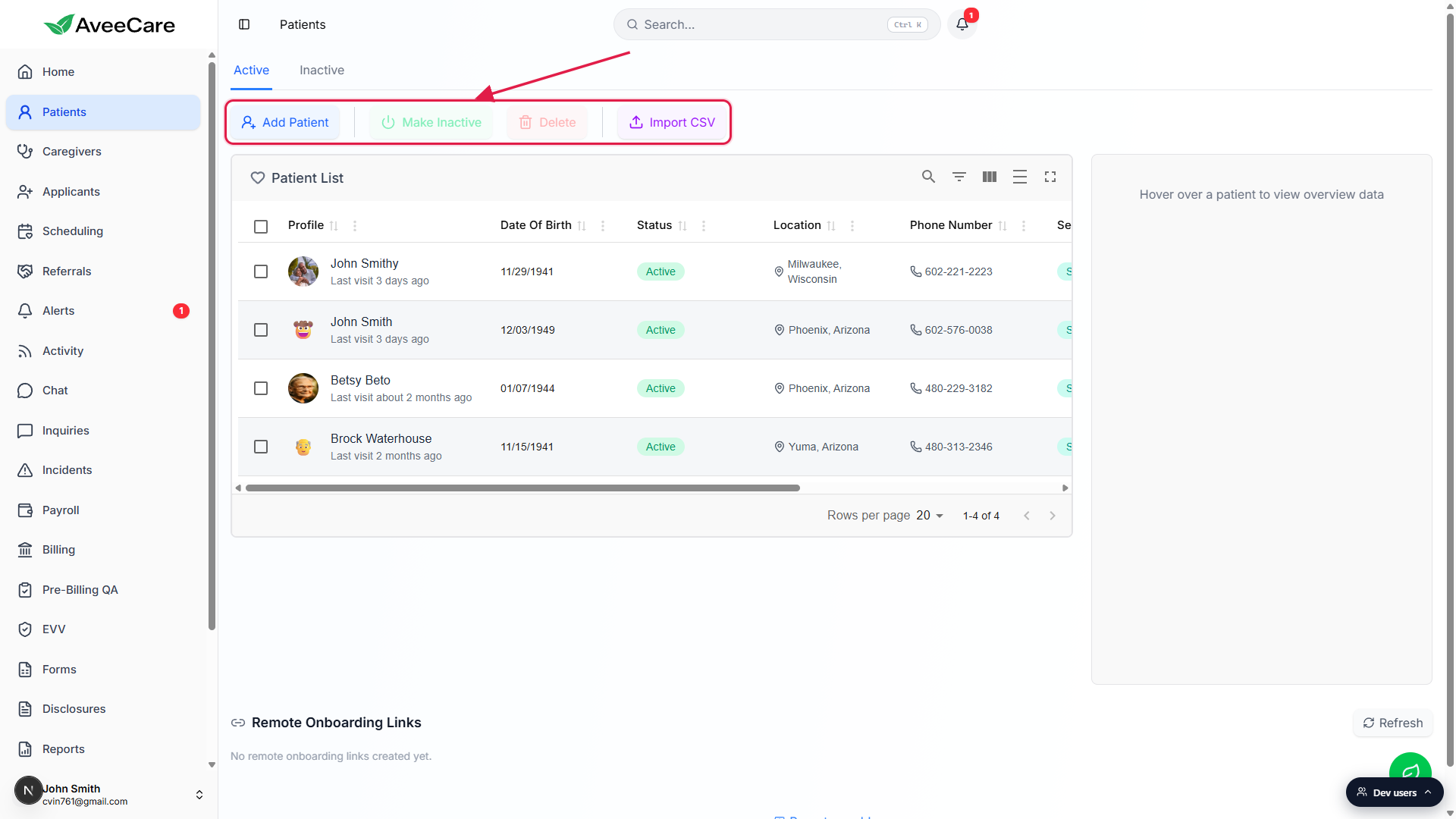
The action bar above the table has four buttons.
Add Patient opens the manual onboarding wizard. Make Inactive and Delete are bulk actions that turn on once you tick row checkboxes. Import CSV opens the bulk-import dialog for adding many patients at once.
2. Read the table columns
Default columns: Profile, Date Of Birth, Status, Location, Phone Number, Service Type, Last Visit, Next Visit.
Profile shows the patient's name, avatar, and a short last-visit hint. Status is the Active or Inactive chip. Click any column header to sort by that column. The page loads with no sort applied, so the order you see is the agency's creation order.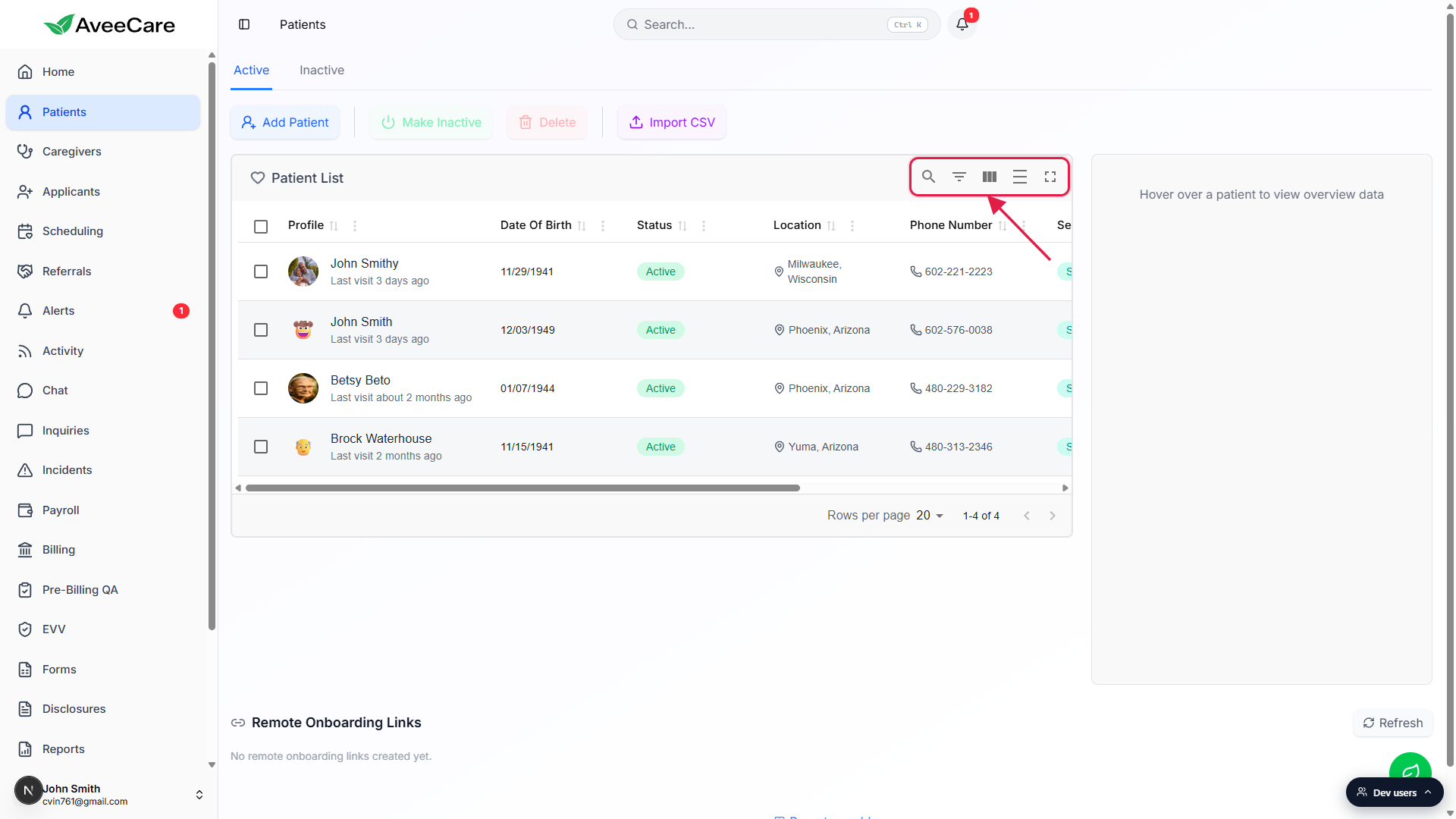
Pagination defaults to 20 rows.
The Rows per page dropdown sits in the bottom right of the table. Pick 20, 50, or 100. Use the chevrons next to it to page through.
3. Use the toolbar icons
Five icons in the top-right of the Patient List card.
Left to right: Search (magnifying glass) opens a text search across patient names. Filter (funnel) shows a per-column filter row with text, select, or date controls depending on the column. Column visibility (vertical bars) toggles which columns appear. Density (lines) cycles compact, comfortable, and spacious row heights. Fullscreen (corner brackets) expands the card to fill the browser.Search only matches names. For phone, DOB, or location, use the column filter.
Click the funnel, then type or pick a value in the input that appears under each column header. The table narrows live as you type.
4. Click a row to open the patient
Click anywhere on a patient row.
The app navigates to/patients/<name>/<id>/overview, which is the patient's Overview tab. From there you have tabs for Appointments, Forms, Files, Disclosures, Billing, ADLs, Care Goals, Medications, Allergies, Notes, Contacts, Incidents, Care Plans, Authorizations, Hospitalizations, and Progress.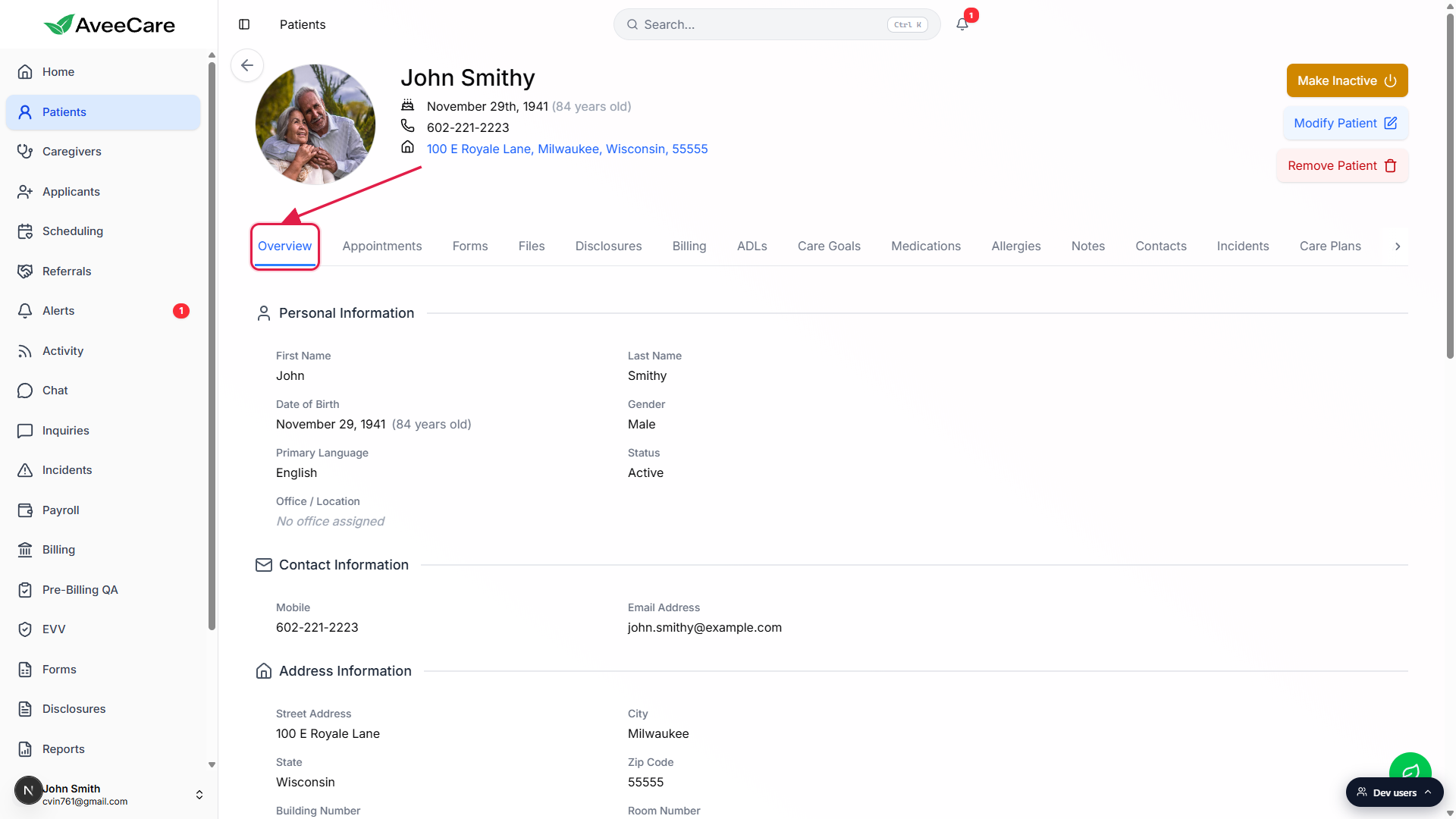
Use the right-side hover preview if you do not want to leave the list.
The empty card to the right of the table fills with that patient's overview data when you hover a row. Good for quick scanning when you are looking for someone without committing to opening the record.
5. Bulk-select to make inactive, delete, or import
Tick the checkbox at the start of each row you want to act on.
The header checkbox selects every visible row. Once at least one row is selected, the Make Inactive and Delete buttons in the action bar light up.Click Make Inactive to archive the selection, or Delete to remove it.
Make Inactive is the soft option, the patient still exists for history and audit. Delete is permanent. Use Make Inactive whenever you might want the patient back later.Click Import CSV to add many patients at once.
The Import CSV dialog accepts a spreadsheet of new patient rows. See the Bulk Patient Import article for the column format.
Common pitfalls
- Looking on the wrong tab. If a patient is missing from the Active list, click Inactive before assuming the record is gone. Inactive patients are hidden from Active, scheduling, and counts but they still exist.
- Search only matches names. The magnifying-glass search is name-only. To search by phone, date of birth, or location, click the funnel icon and use the per-column filter instead.
- Make Inactive and Delete stay greyed out until you tick a row. They are bulk actions, so they need at least one selected row. New users sometimes click them with nothing selected and assume they are broken.
- Delete is permanent. There is no undo. If you might want the patient back later, use Make Inactive.
- Column filters and search both narrow the visible rows. If a familiar patient does not appear, check whether you have a search term or a column filter still applied from earlier in the session.
Related
- Add Patient (Manual Onboarding)
- Bulk Patient Import
- Remote Onboarding (link-based)
- Patient overview tab
Frequently asked questions
/patients/<name>/<id>/overview. From there the tab strip across the top jumps you to Appointments, Forms, Billing, Care Plans, and the rest of the patient record.