A caregiver record on its own does not let the person sign in. To turn an existing caregiver record into a working login, an admin opens the Accounts page, clicks the Link Caregiver card, picks the caregiver, confirms an email, acknowledges five required legal agreements, and creates the access account. The new login lands with the Caregiver role and is only ever attached to that one caregiver record.
Quick answer
Open Accounts, click the Link Caregiver card at the top of the page, pick a caregiver from the Available Caregivers table, confirm the email twice, check the five Platform Legal Agreements, then click Create Caregiver Access Account. The login is created in Cognito with the Caregiver role and the caregiver record now shows as Linked To on the Account List.
1. Open Accounts and click the Link Caregiver card
Click Accounts in the left sidebar.
The Accounts page loads with three entry cards at the top (Create User, Link Caregiver, Link Patient), an Account List in the middle, and Audit Logs at the bottom. Each card is the entry point for one of the three roles you can create from the UI.Click the Link Caregiver card.
The card opens the Link Caregiver Access Account modal. The Create User card produces a User role login with full admin access, and the Link Patient card produces a Patient role login. Link Caregiver is the only one that attaches a login to an existing caregiver record.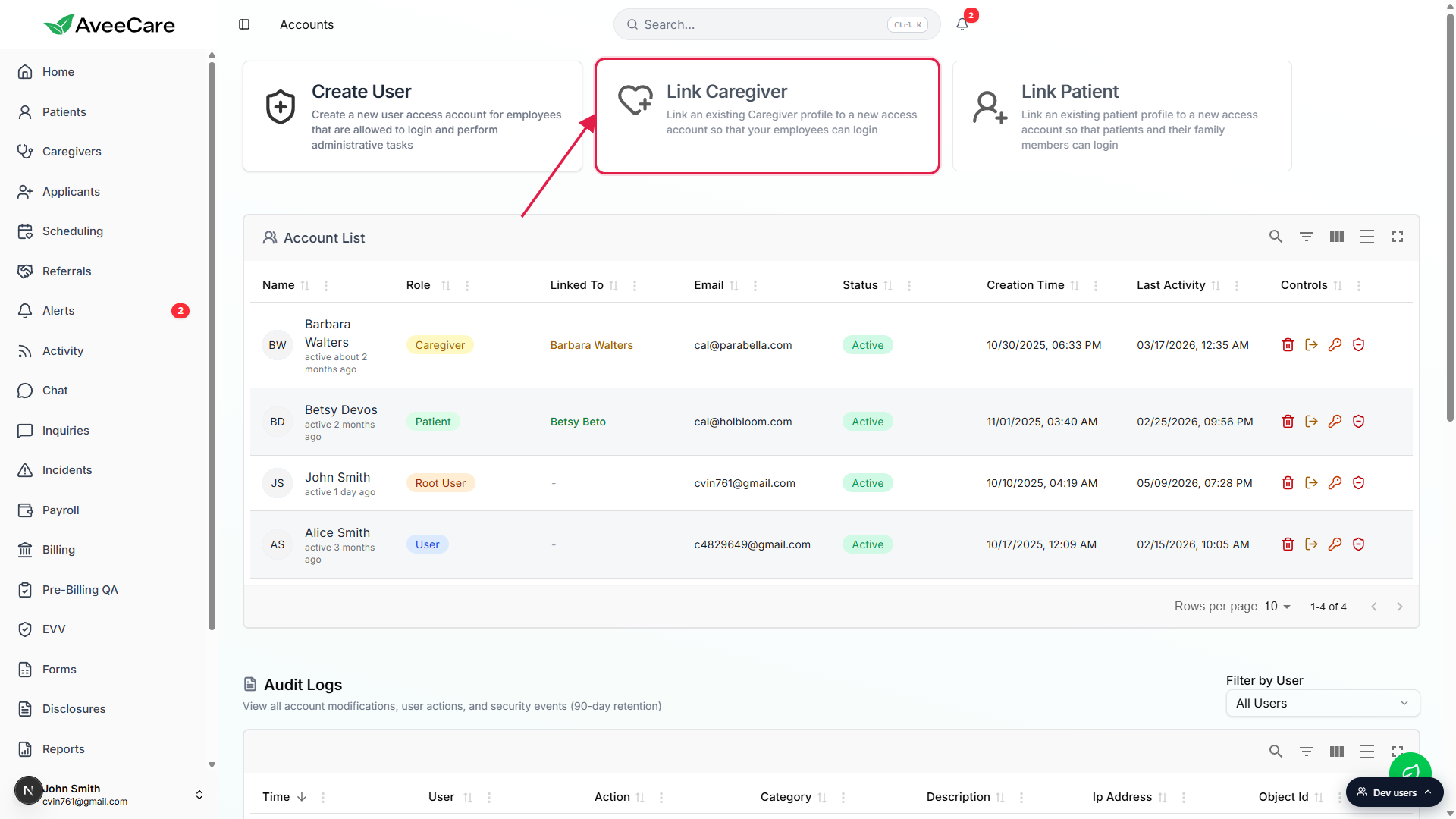
2. Pick the caregiver from the Available Caregivers list
Read the warning panel at the top of the modal.
A red You are creating a Caregiver Access Account panel spells out what the new login can do, including viewing patient records, communicating with admins and patients, and interacting with scheduling. The same panel links to the help page on User Access Accounts.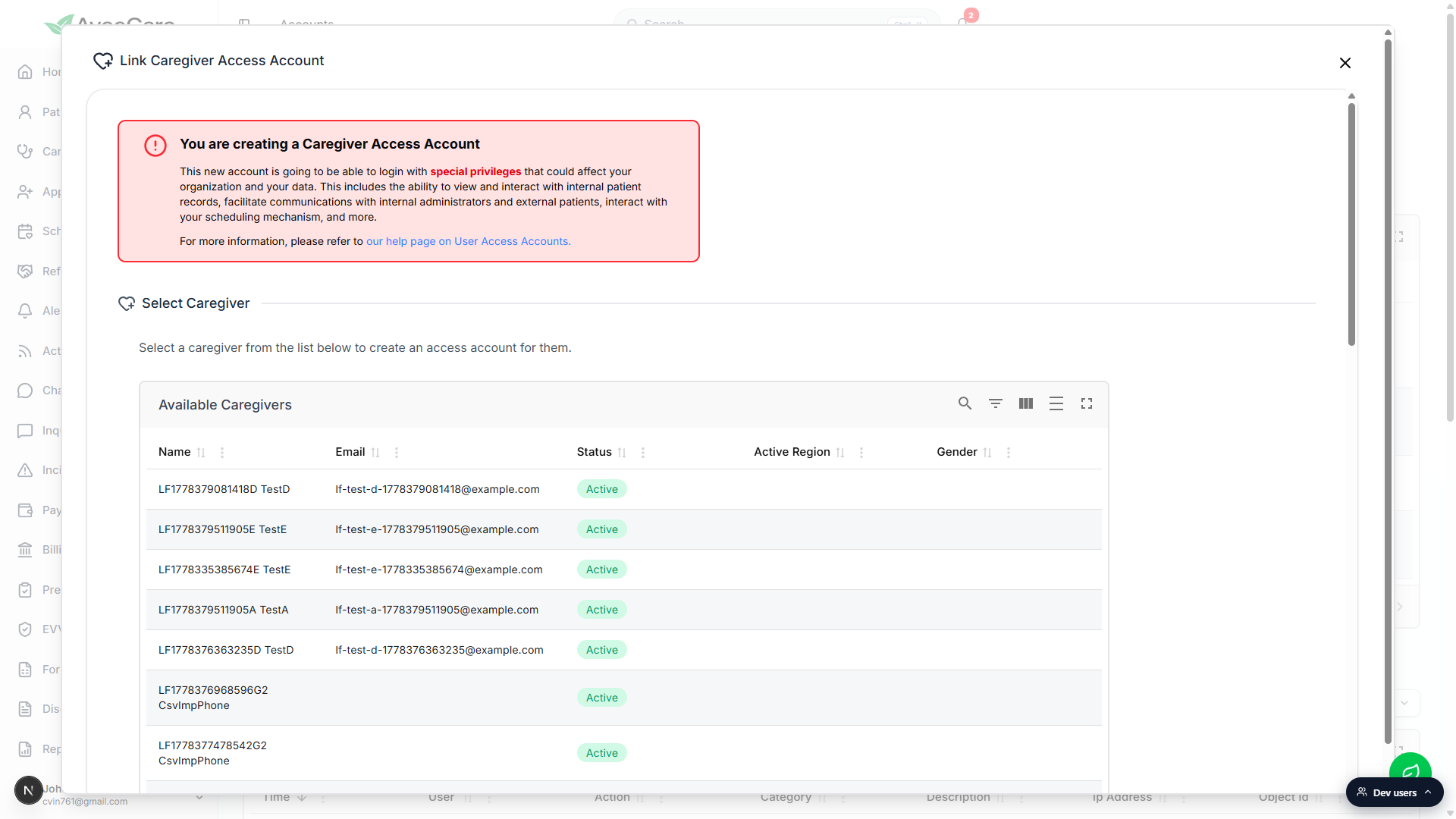
Click the row of the caregiver you want to give a login.
The Available Caregivers table shows Name, Email, Status, Active Region, and Gender for every caregiver record in the company that does not already have a login. Use the search and filter controls in the top-right of the table to narrow the list. Caregivers who already have a linked login are not listed here, so if a caregiver is missing it almost always means they already have an account.The selection drops into the Selected Caregiver field below the list.
The label changes from No caregiver selected to the caregiver name. Pick a different row to change the selection, the form will overwrite the previous choice.
3. Confirm the email the caregiver will use to sign in
Check the Email field.
AveeCare pre-fills the Email field from the caregiver record. This is the address the caregiver will use as their Cognito login, so it has to be a real inbox they can read for the temporary password and any future password resets.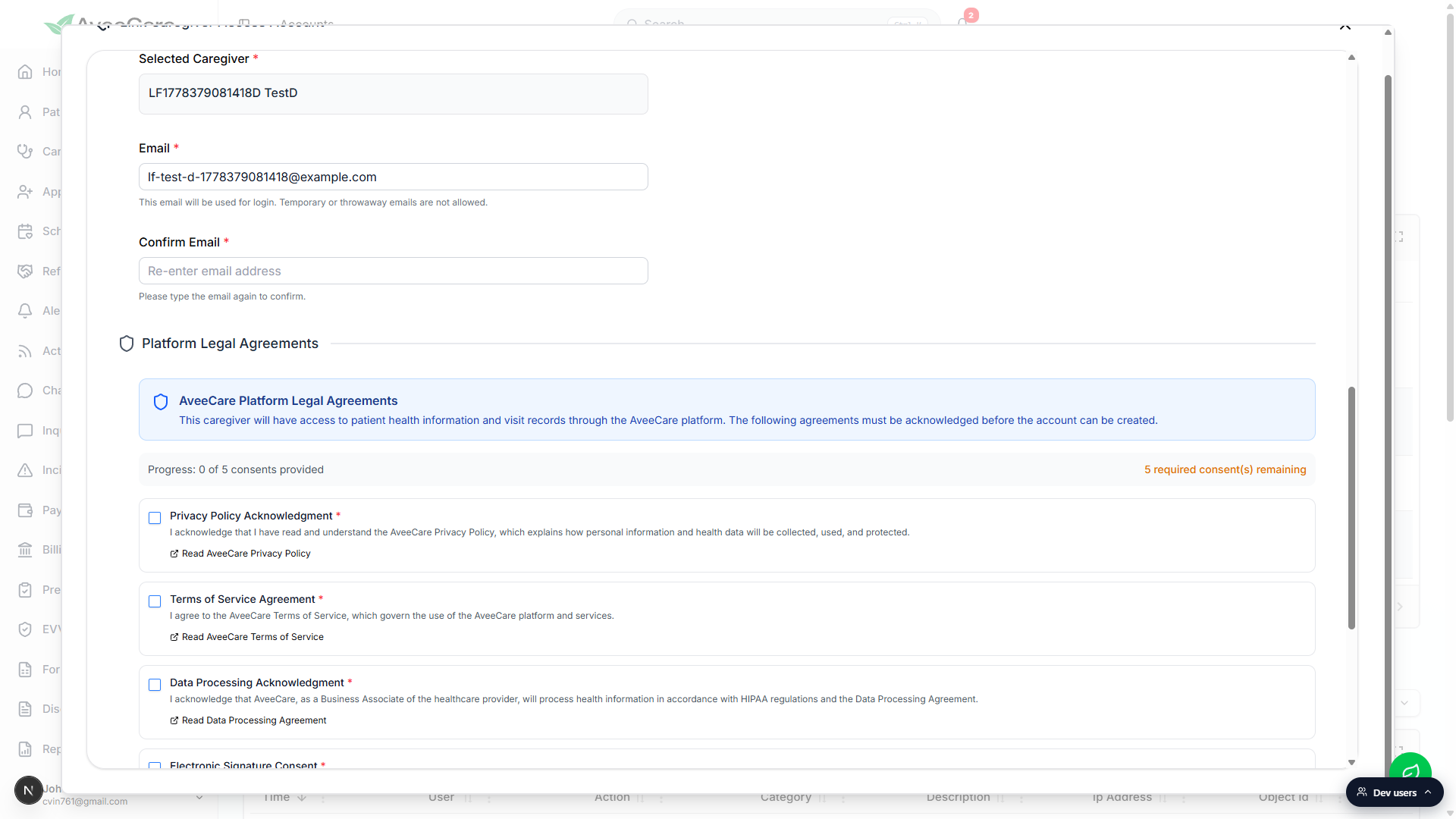
If the email is wrong, fix it on the caregiver record first.
Close this modal, open the caregiver from the Caregivers page, update their email on the profile, then come back to Accounts and click Link Caregiver again. The modal will pre-fill the corrected email. The Email field in this modal is editable, but the caregiver record is the durable source of truth, so it is better to fix it there.Type the same email into the Confirm Email field.
Both fields must match exactly. The help text under each field warns that temporary or throwaway email services are not allowed because Cognito uses the address for password recovery.
4. Acknowledge the five Platform Legal Agreements
Scroll to the Platform Legal Agreements panel.
The panel sits between the email fields and the submit button. A progress counter reads Progress: 0 of 5 consents provided and updates as boxes are checked. The submit button stays disabled until all five are checked.Check each of the five required boxes.
The five agreements are Privacy Policy Acknowledgment, Terms of Service Agreement, Data Processing Acknowledgment, Electronic Signature Consent, and AI Processing Consent. Each one has a Read link to the full document on aveecare.com. The consent is recorded with a timestamp for HIPAA, E-SIGN, and UETA compliance.Watch the progress counter hit 5 of 5.
When the last box is checked, the red warning that All required consents must be provided to create this account disappears and the submit button becomes clickable.
5. Click Create Caregiver Access Account
Click the green Create Caregiver Access Account button at the bottom.
AveeCare creates a Cognito user with the Caregiver role and attaches it to the caregiver record. The modal closes and the new login appears in the Account List with role Caregiver, status Active, and the caregiver name in the Linked To column. Cognito emails the caregiver a temporary password they use to sign in and set their own password.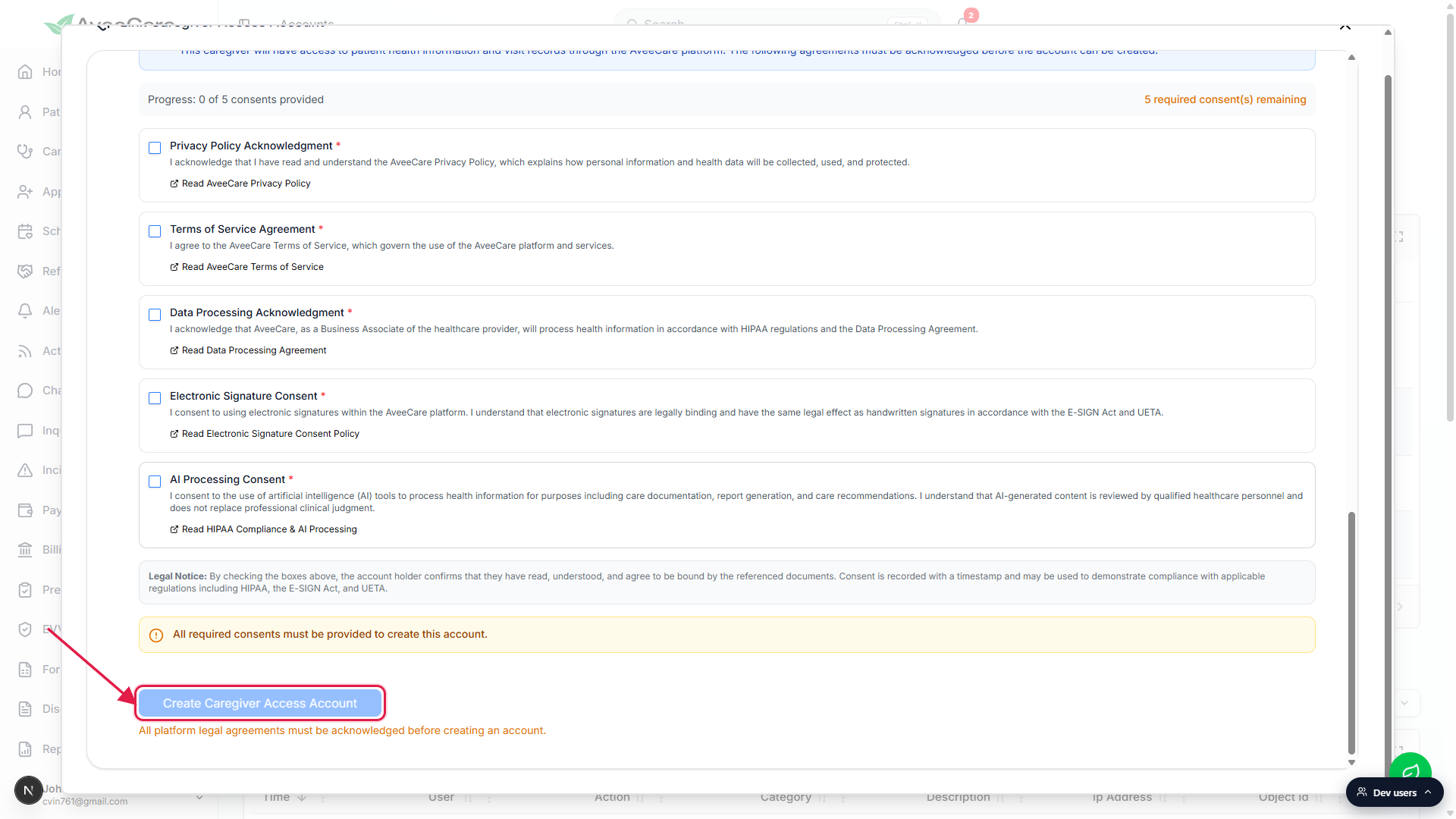
Look for the new row on the Account List below.
A successful link adds a row with the caregiver name on the left, a yellow Caregiver pill in the Role column, the caregiver name in the Linked To column, the email you just confirmed, and Active in the Status column. The caregiver record itself now shows as linked on the Caregivers page.Tell the caregiver to check their inbox.
The first sign-in uses the temporary password Cognito sent. The caregiver is forced to choose a new password on first sign-in. After that the login is good for the caregiver app and the web dashboard for that account only.
Common pitfalls
- Wrong email on the caregiver record. The modal pre-fills Email from the caregiver profile. If the address on the profile is stale, the caregiver never gets the temporary password and cannot sign in. Update the email on the caregiver profile before linking, not inside the modal, so the caregiver record stays the source of truth.
- Email already in use in Cognito. Each email maps to one Cognito account across the whole company. If the same person already has a User or Patient login on a given email, Link Caregiver on that email fails. Use a different inbox, or delete the existing login from the Account List first.
- Trying to use Create User for a caregiver who only needs to clock in. Create User produces a User role login with full administrative access. For someone who only delivers visits, always use Link Caregiver so the login is scoped to their own visits and profile.
- Forgetting the five consent boxes. The submit button stays disabled until every Platform Legal Agreement checkbox is checked. The progress counter above the boxes shows how many are left.
- Expecting the caregiver record itself to disappear. Linking only adds a Cognito login. The caregiver record stays where it is on the Caregivers page with all of its visit history, pay rates, and certifications. Deleting the login later unlinks it but does not delete the caregiver record.
- Missing caregiver in the Available Caregivers list. Caregivers that already have a linked login are filtered out. If the caregiver you want is missing, check the Account List below the entry cards, they likely already have a login row.