Live-In Caregiver Guide: Regulations, Scheduling & Best Practices
Everything agencies need to know about live-in home care arrangements in 2026. FLSA compliance, sleep time regulations, cost comparison tools, scheduling templates, and best practices for managing 24 hour home care.
In This Guide
What Is Live-In Home Care?
Live-in home care is an arrangement where a caregiver resides in the client's home for extended periods - typically 24-hour shifts - to provide continuous personal care, companionship, and household assistance. Unlike hourly care where a caregiver arrives, works their shift, and leaves, a live-in caregiver becomes a temporary member of the household.
Live-in caregiver arrangements are particularly well-suited for clients who need supervision throughout the day and night but do not require constant hands-on care. Clients with moderate dementia, fall risk, or chronic conditions that require intermittent assistance often benefit most from live-in care. The live-in caregiver model provides the security of having someone present around the clock at a significantly lower cost than 24 hour home care staffed with rotating shifts.
For agencies, live-in home care presents unique regulatory, scheduling, and management challenges. Understanding FLSA requirements for live-in caregiver pay, sleep time regulations, and state-specific rules is essential for compliance and profitability. Managing live-in rotations effectively requires the right tools -- our scheduling optimization guide covers automation strategies for complex shift patterns. For competitive compensation benchmarks, check our caregiver pay rates by state data.

Live-In Care vs Hourly Care: A Detailed Comparison
Understanding the differences between live-in care and hourly home care helps agencies and families choose the right model. Here is a side-by-side comparison.
| Factor | Live-In Care | Hourly Care (24hr) |
|---|---|---|
| Daily Cost | $200-$350/day | $480-$720/day |
| Monthly Cost | $6,000-$10,500 | $14,400-$21,600 |
| Staffing | 1 caregiver per shift | 2-3 caregivers in shifts |
| Overnight | Caregiver sleeps (available if needed) | Caregiver awake and active |
| Consistency | High - same 1-2 caregivers | Lower - 2-3 rotating staff |
| Best For | Moderate care needs, companionship | High acuity, frequent night needs |
| FLSA Overtime | May be exempt | Standard overtime rules apply |
| Room Required | Yes - private sleeping area | No |
| Meals Provided | Yes - caregiver meals included | No |
FLSA Rules for Live-In Caregivers
The Fair Labor Standards Act contains specific provisions for live-in domestic service workers that differ from standard employment rules. Understanding these live-in caregiver requirements is critical for agency compliance.
Overtime Exemption
Live-in domestic service employees may be exempt from the FLSA overtime requirement. This means the employer pays the regular rate for all hours worked, without the time-and-a-half premium for hours over 40 per week. However, the minimum wage requirement still applies for every compensable hour. Note: Some states (California, New York, others) do NOT recognize this federal exemption and require overtime for live-in workers.
Compensable Hours
Live-in caregivers must be paid for all hours they are "engaged to wait" - meaning time when they are required to be on the premises and available to work, even if not actively providing care. Free time where the caregiver can leave the premises and use time for their own purposes is generally not compensable.
Record-Keeping Requirements
Employers must maintain accurate records of all hours worked by live-in caregivers. This includes start and end times, meal breaks, sleep periods, and any interruptions to off-duty time. Failure to maintain records creates a presumption in favor of the employee in wage disputes.
Meal Period Deductions
Bona fide meal periods of 30 minutes or more may be excluded from compensable hours if the caregiver is completely relieved of duties. If the caregiver must remain available or is interrupted during meals, the time must be paid. Some states require meal breaks at specific intervals.
Sleep Time Regulations for Live-In Caregivers
Sleep time rules are among the most complex aspects of live-in home care regulations. The federal standard allows exclusion of sleep time under specific conditions, but several states have enacted stricter requirements that override federal rules.
Federal Sleep Time Rules
- Up to 8 hours of sleep time may be excluded from compensable hours
- Employee must be able to enjoy an uninterrupted sleep period
- Adequate sleeping facilities must be provided
- Agreement to exclude sleep time should be documented in writing
- If sleep is interrupted for work, interruption time must be paid
- If sleep is interrupted so frequently that continuous sleep is impossible, the entire sleep period becomes compensable
State Variations to Watch
- California: Live-in workers must receive at least 12 hours of pay per 24-hour shift under most orders
- New York: Sleep time limited to 8 hrs, but 5 hrs must be uninterrupted. Separate meal period deductions apply.
- New Jersey: Follows federal standard but with strict documentation requirements
- Massachusetts: Live-in overtime rules follow state-specific standards
- Oregon: No sleep time exclusion - all hours on premises are compensable
- Washington: HCA certification complicates live-in arrangements; strict documentation required
Live-In Care Cost Calculator
Compare the cost of live-in care versus hourly care in your state. Select your state and daily active care hours to see estimated cost differences.
Hourly Care Cost/Day
$272
at $17/hr x 16 hrs
Live-In Care Cost/Day
$290
flat daily rate
Daily Savings
$-18
-7% savings
Monthly Hourly Care Cost
$8,160
Monthly Live-In Care Cost
$8,700
Save $-540/month
Live-In Caregiver Scheduling Templates
Effective live-in care scheduling requires careful rotation planning. Select a schedule template below to see how it works, along with the pros and cons of each approach.
2-on / 2-off Rotation
Two caregivers alternate every 2 days. Provides frequent rest and consistency.
Advantages
- Frequent rest prevents burnout
- Client sees both caregivers regularly
- Easier to manage call-outs
Challenges
- More transitions for the client
- Requires strong communication between caregivers
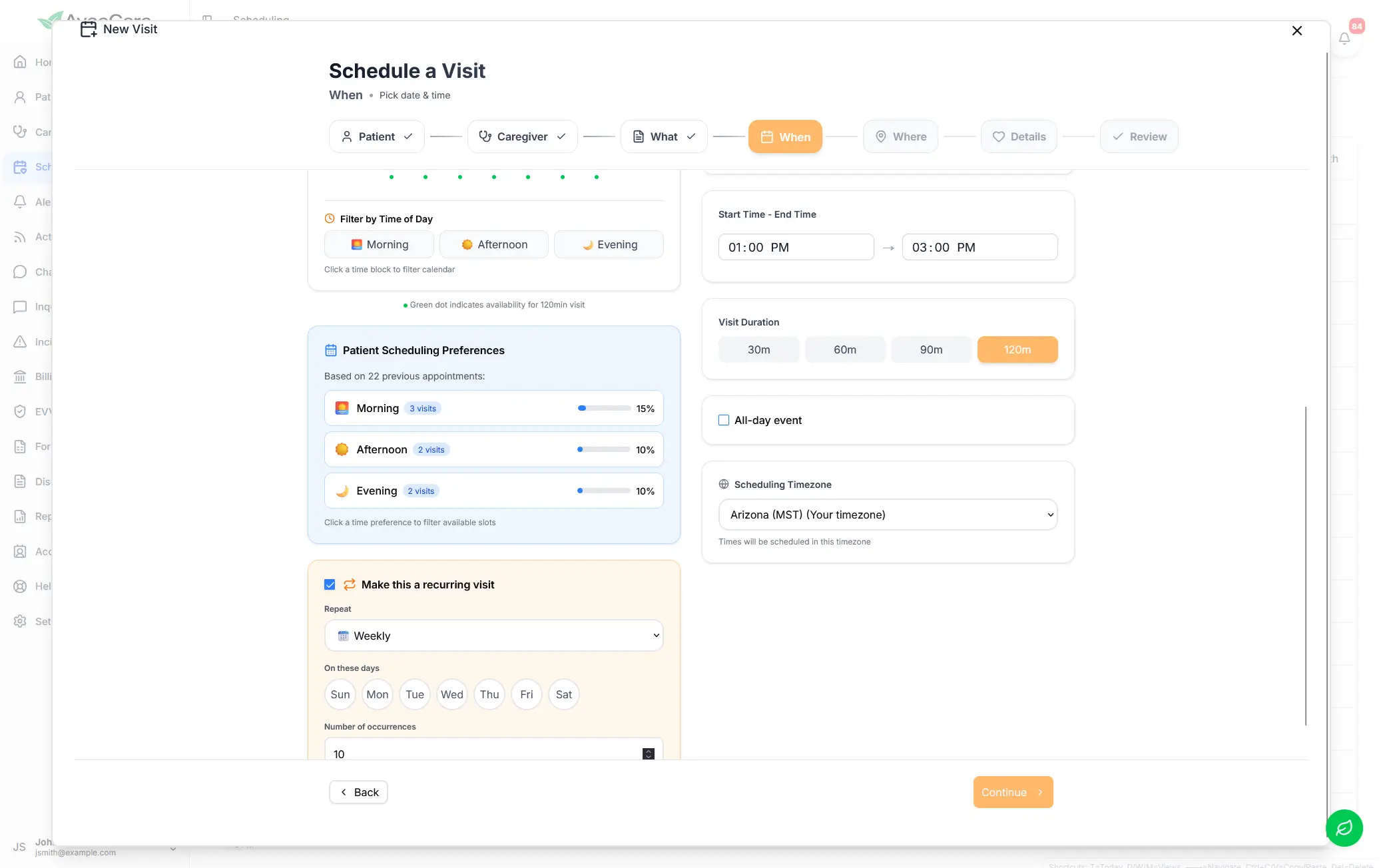
AveeCare's recurring visit scheduling simplifies complex live-in caregiver rotation management.
Assessing Client Appropriateness for Live-In Care
Not every client is a good fit for live-in home care. Conducting a thorough assessment before recommending live-in arrangements protects both the client and the caregiver.
Good Candidates for Live-In Care
- Moderate care needs with periods of independence
- Needs overnight supervision but not constant awake care
- Adequate sleeping space for the caregiver (private room)
- Comfortable sharing living space with another person
- Family support for managing the arrangement
- Stable condition that allows predictable care routines
- Home environment is safe and accessible
Better Suited for 24-Hour or Facility Care
- Frequent nighttime needs that prevent caregiver sleep
- Advanced dementia with wandering or sundowning
- Two-person assist required for transfers
- Aggressive or combative behaviors
- Complex medical needs requiring RN-level monitoring
- Home environment lacks adequate caregiver accommodations
- Family resistance to a caregiver living in the home
Selecting the Right Live-In Caregiver
Live-in caregiver selection requires more consideration than standard hourly placements. Because the caregiver will share living space with the client, compatibility in temperament, habits, and communication style matters as much as clinical qualifications.
Experience with Similar Care Needs
Prioritize caregivers who have prior live-in experience. The transition from hourly to live-in work is significant, and experienced live-in caregivers understand boundaries, self-care, and the unique rhythms of residential care.
Temperament and Compatibility
Arrange a meet-and-greet before the placement. Personality match is critical when people share a living space. Consider the client preferences for communication style, noise level, schedule, dietary habits, and cultural background.
Self-Sufficiency
Live-in caregivers work with less direct supervision. Select individuals who demonstrate good judgment, problem-solving skills, and the ability to manage their own time and well-being during off-duty hours.
Reliable Transportation
The caregiver may need a vehicle for client errands, medical appointments, and their own personal needs during time off. Verify that they have reliable transportation and a valid driver license.
Clear Boundary Understanding
The caregiver must understand the distinction between on-duty and off-duty time, including when they can leave the premises, where they may use personal phones, and how to handle off-duty interruptions.
Common Legal Pitfalls in Live-In Care Arrangements
Live-in home care arrangements carry elevated legal risk compared to standard hourly placements. Here are the most common compliance issues agencies encounter.
Failure to Track All Hours Worked
Critical RiskNot maintaining detailed time records for live-in caregivers is the most common compliance failure. If a wage claim is filed, the burden of proof shifts to the employer when records are absent. Use digital time-tracking tools to document all active work periods, breaks, and sleep time.
Assuming Federal Rules Override State Law
Critical RiskSeveral states (California, New York, Oregon, others) have stricter live-in caregiver rules than federal FLSA. Always check state-specific requirements for overtime, sleep time, and meal break rules before structuring a live-in arrangement.
No Written Sleep Time Agreement
High RiskWhile not always legally required, the absence of a written agreement regarding sleep time exclusions significantly weakens the employer position in disputes. Document sleep time expectations, facilities, and interruption protocols in writing.
Inadequate Sleeping Facilities
High RiskA couch in the living room does not qualify as adequate sleeping facilities. The caregiver needs a private space with a proper bed, reasonable quiet, and access to bathroom facilities. Failure to provide adequate facilities invalidates sleep time exclusions.
Misclassifying Employees as Independent Contractors
Critical RiskLive-in caregivers placed by agencies are almost always employees, not independent contractors, regardless of what a contract states. Misclassification exposes agencies to significant back-pay, tax, and penalty liability.
Ignoring Meal Break Requirements
High RiskSome states require specific meal and rest breaks regardless of live-in status. Not providing or documenting these breaks can result in per-shift penalties that accumulate quickly over weeks and months.
Frequently Asked Questions About Live-In Care
Live-in care involves one caregiver who stays in the client home for an extended shift (usually 24 hours) and is allowed a sleep period of 5-8 uninterrupted hours. 24-hour care involves multiple caregivers working shifts (commonly 8 or 12 hours) providing continuous awake coverage. 24-hour care costs roughly 50-60% more but ensures a fully alert caregiver is always present.
Live-in care typically costs $200-$350 per day as a flat daily rate, while hourly care at $20-$30/hour for 24 hours would cost $480-$720 per day. Live-in arrangements require providing the caregiver with a private room, meals, and adequate sleep time. Costs vary significantly by state and metropolitan area.
Under the Fair Labor Standards Act, live-in domestic workers may be exempt from overtime requirements (no time-and-a-half after 40 hours). They must still be paid minimum wage for all hours worked. Sleep time of up to 8 hours can be excluded from compensable hours if the caregiver can usually enjoy uninterrupted sleep and adequate facilities are provided. State laws may impose stricter requirements.
Under federal rules, employers and live-in employees may agree to exclude a sleep period of up to 8 hours from hours worked, provided the employee can usually enjoy uninterrupted sleep and adequate facilities are furnished. If sleep is interrupted for work, the interruption time must be compensated. States like New York and California have stricter rules.
Live-in caregivers should have state-required certifications (CNA, HHA, or PCA), CPR and First Aid, a clean background check, valid driver license, experience with the client specific care needs, and strong interpersonal skills since they share living space with the client.
Common rotation schedules include 2-on/2-off, 5-on/2-off, 7-on/7-off, and 4-on/3-off. The best schedule depends on caregiver availability, client preferences, and state labor law requirements for rest periods between shifts.
Schedule Complex Live-In Rotations Effortlessly
AveeCare's recurring visit scheduling and automated shift management makes it simple to manage live-in caregiver rotations, track hours accurately, and maintain FLSA compliance.
Disclaimer: This guide is provided for informational purposes only and does not constitute legal, regulatory, or employment advice. FLSA regulations, state labor laws, and live-in care requirements are complex and subject to change. The cost estimates in the calculator are approximate and based on industry averages - actual costs vary by location, care needs, and agency pricing. Always consult with an employment attorney and/or DOL resources before structuring live-in caregiver arrangements to ensure compliance with applicable federal and state laws.