How to Start a Home Care Agency in New York
Your complete 2026 guide to launching a home care business in New York, from LHCSA Article 36 licensing to navigating the most regulated and competitive home care market in the United States.
Published April 4, 2026 · 35 min read
TLDR — New York at a Glance
Yes — LHCSA mandatory via DOH Article 36 for all non-medical home care.
Active restrictions on new LHCSA licenses in some regions (check DOH).
NY Department of Health (DOH) — Article 36 Public Health Law
$75,000 – $200,000 (LHCSA)
$250,000 – $500,000+ (CHHA)
6 – 18 months (LHCSA) | 12 – 24 months (CHHA)
NYC: $16.50/hr | LI/Westchester: $16.00/hr | Rest: $15.50/hr
Heavily unionized (1199SEIU); largest Medicaid home care market in US
1New York Market Overview
The largest Medicaid home care market in the United States
New York is the largest Medicaid home care market in the United States, with a population of approximately 19.5 million people and one of the most mature and complex home care ecosystems anywhere. Starting a home care agency in New York means entering a market with extraordinary demand but also the most rigorous regulatory environment in the nation. The state's LHCSA licensing process under Article 36 of the Public Health Law is famously demanding, and recent moratorium restrictions on new LHCSA licenses in certain regions add further complexity. However, for those who successfully navigate these barriers, New York offers unparalleled opportunity in home care.
New York's home care demand is driven by its enormous and aging population, its unrivaled Medicaid home care spending (the highest in the nation by a wide margin), and strong private pay demand in affluent areas like Manhattan, Long Island, and Westchester. Over 3.3 million New Yorkers are 65 or older, and the state spends more on Medicaid home and community-based services than any other state. The Consumer Directed Personal Assistance Program (CDPAP), Managed Long Term Care (MLTC) plans, and the traditional LHCSA model create multiple pathways into the market for home care agencies. For a national overview of the startup process with interactive tools, see our complete guide to starting a home care agency and our state-by-state licensing requirements.
Regional Market Breakdown
New York City (5 Boroughs)
The largest and most competitive home care market in the state. Manhattan, Brooklyn, Queens, the Bronx, and Staten Island have massive demand driven by Medicaid MLTC plans and affluent private pay clients. Extremely high operating costs (rent, wages, insurance), intense competition, and LHCSA moratorium restrictions make NYC the hardest market to enter but the most lucrative.
Long Island & Westchester
Affluent suburban markets with strong private pay demand and a large senior population. Nassau and Suffolk counties on Long Island, plus Westchester County, offer high billing rates and wealthy clients willing to pay out of pocket. Competition is strong but less intense than NYC. Higher regional minimum wage ($16.00/hr).
Hudson Valley & Capital District
The Hudson Valley (Dutchess, Orange, Rockland counties) and Capital District (Albany, Schenectady, Troy) offer growing markets with lower operating costs than NYC metro. Strong mix of Medicaid and private pay demand. Albany's large state government workforce and numerous hospitals create referral opportunities.
Upstate (Buffalo, Rochester, Syracuse)
Western and Central New York offer the lowest startup costs in the state with less competition. Buffalo, Rochester, and Syracuse have large aging populations, strong healthcare infrastructure, and growing demand. Medicaid dominates the payer mix, but private pay opportunity exists in surrounding suburban areas. The minimum wage is $15.50/hr.
Why Start a Home Care Agency in New York
2LHCSA vs. CHHA in New York
Understanding New York's complex home care license types under Article 36
This is the most important decision you will make. New York has one of the most complex home care licensing structures in the nation, all governed under Article 36 of the Public Health Law but with very different license types. A Licensed Home Care Services Agency (LHCSA) provides non-medical personal care services. A Certified Home Health Agency (CHHA) provides skilled nursing, therapy, and medical services. There is also the Long Term Home Health Care Program (LTHHCP) for specialized long-term care. Each license type has different requirements, costs, and timelines.
LHCSA
Licensed Home Care Services Agency
- Personal care (bathing, dressing, grooming)
- Home health aide services
- Companion care and socialization
- Meal preparation and housekeeping
- Medication reminders (not administration)
- Respite care for family members
LHCSA license required (Article 36)
NY DOH licensing, $5,000 application fee. Moratorium may apply.
CHHA
Certified Home Health Agency
- Skilled nursing care
- Physical, occupational, and speech therapy
- Wound care, injections, IV therapy
- Medical social services
- Home health aide services (medical)
- Medication administration
CHHA certification required (Article 36)
Significantly more rigorous. Plus Medicare certification for Medicare billing.
CDPAP note: New York also operates the Consumer Directed Personal Assistance Program (CDPAP), which allows Medicaid recipients to hire and direct their own caregivers, including family members. CDPAP operates through Fiscal Intermediaries (FIs) rather than traditional agencies. If you are interested in the CDPAP/FI model, it has different requirements and regulatory considerations than LHCSA or CHHA licensing. The CDPAP landscape has undergone significant changes and consolidation in recent years.
3Business Formation in New York
Register your home care business with the Empire State
New York cost warning: New York City has a cost of living index of approximately 187.2, nearly double the national average. Even outside NYC, Long Island and Westchester are significantly above average. New York also requires LLCs to publish formation notices in two newspapers for six consecutive weeks, which costs $500 to $2,000+ depending on county (NYC is the most expensive). Factor in extremely high insurance premiums, very high wages, and the state's heavy income tax burden (4% to 10.9% state, plus NYC city income tax of 3.078% to 3.876%).
Choose Your Business Structure
Most New York home care agencies register as an LLC for liability protection and tax flexibility. A New York LLC costs $200 to file (Articles of Organization). However, New York uniquely requires all LLCs to publish a formation notice in two newspapers in the county of formation for six consecutive weeks. This "publishing requirement" costs $500 to $2,000+ (Manhattan and NYC counties are the most expensive). Corporations are also an option.
Register with the Division of Corporations (DOS)
File your Articles of Organization (LLC) or Certificate of Incorporation with the New York Department of State, Division of Corporations at dos.ny.gov. Processing times vary; expedited service is available for additional fees. You must complete the LLC publishing requirement within 120 days of formation.
NY Division of CorporationsObtain Your EIN
Apply for a free Employer Identification Number (EIN) from the IRS at irs.gov. You need this for bank accounts, payroll, tax filings, and your LHCSA application. It takes minutes to obtain online.
Register with the Department of Taxation and Finance (DTF)
Register with the New York State Department of Taxation and Finance (DTF) at tax.ny.gov. You will need to register for state income tax withholding, unemployment insurance tax, and sales tax (if applicable). New York has a progressive income tax ranging from 4% to 10.9%. If you operate in NYC, register for the additional NYC income tax (3.078% to 3.876%).
NY Dept of Taxation and FinanceRegister as an Employer with NY DOL
Register with the New York State Department of Labor (DOL) for unemployment insurance. New York requires employers to pay unemployment insurance tax. You must also set up workers' compensation and disability benefits (DBL) coverage before hiring any employees. New York is among the most employer-obligation-heavy states in the nation.
NY Department of LaborNYC-Specific Requirements
If operating in New York City, you may need additional permits from the NYC Department of Consumer and Worker Protection. NYC has its own set of regulations for businesses operating within the five boroughs, including commercial rent considerations, additional licensing requirements, and specific labor laws. The NYC minimum wage ($16.50/hr) is also higher than the rest of the state.
Open a Business Bank Account
Open a dedicated business checking account to separate personal and business finances. You will need your EIN, Articles of Organization, and proof of the LLC publishing requirement completion. Many New York banks specialize in small business and healthcare accounts.
4Licensing Requirements
New York has the most rigorous home care licensing process in the nation
LHCSA Moratorium Warning
New York State has imposed moratorium restrictions on the approval of new Licensed Home Care Services Agency (LHCSA) applications in certain regions, particularly the New York City metropolitan area. This moratorium was enacted to address concerns about fraud, overutilization, and oversaturation of home care agencies. The moratorium can change in scope and duration. Before investing time and money in an LHCSA application, you must:
- Check the current moratorium status directly with the NY Department of Health
- Determine if your planned service area is affected by any restrictions
- Consult with a healthcare attorney familiar with NY home care law
- Explore whether exceptions or alternative pathways are available
Licensed Home Care Services Agency (LHCSA) — Article 36
Under Article 36 of the New York Public Health Law, all agencies providing non-medical home care services must obtain a Licensed Home Care Services Agency (LHCSA) license from the New York State Department of Health (DOH). The LHCSA application process is one of the most rigorous in the nation and includes:
- Submit LHCSA application to NY DOH ($5,000 non-refundable application fee)
- Prepare comprehensive operational plan detailing all aspects of agency operations
- Develop full policy and procedure manual meeting DOH standards
- All owners, operators, and principals must complete CHRC background checks
- Designate qualified administrator and key personnel
- Pass DOH on-site survey and inspection
- Demonstrate financial viability and adequate insurance coverage
- Public Health and Health Planning Council (PHHPC) review and approval
CHRC Background Checks & Justice Center
New York requires Criminal History Record Checks (CHRC) for all individuals involved in the ownership, operation, and staffing of home care agencies. The NYS Justice Center for the Protection of People with Special Needs plays a central role in background screening for the home care workforce. The process includes:
- FBI fingerprint-based criminal history check
- NYS Division of Criminal Justice Services (DCJS) check
- Justice Center Staff Exclusion List (SEL) screening
- NYS Nurse Aide Registry check
- Sex Offender Registry check
Certified Home Health Agency (CHHA) — Article 36
If you plan to provide skilled nursing, physical therapy, or other medical services, you must obtain a Certified Home Health Agency (CHHA) designation from the NY Department of Health. The CHHA process is significantly more rigorous and costly than LHCSA licensing and involves:
- Certificate of Need (CON) application to DOH
- Extensive operational readiness review
- Designation of qualified administrator and clinical director (RN)
- Comprehensive quality assurance programs
- On-site survey by DOH surveyors
- Medicare certification through CMS (DOH serves as state survey agency)
Medicare Certification
Medicare certification is separate from state licensure. To bill Medicare for home health services, your CHHA must apply through CMS and pass a federal survey. The NY DOH serves as the state survey agency for CMS. New York has one of the largest Medicare beneficiary populations in the nation. Expect 3 to 6 months for the certification process after obtaining your CHHA designation. The Medicare market in New York is highly competitive and lucrative.
5Insurance Requirements
Workers' comp, DBL, and Paid Family Leave are ALL required in New York
General Liability
$4,000 - $12,000/yrCovers bodily injury and property damage claims. Recommended minimum: $1M per occurrence / $2M aggregate. New York premiums are among the highest in the nation due to the state's litigation-heavy environment.
Professional Liability (E&O)
$3,000 - $8,000/yrCovers errors, omissions, and negligence claims. Essential for any home care business in New York, where litigation rates are significantly above the national average.
Workers' Compensation
$6,000 - $20,000/yrNew York requires workers' compensation for ALL employers with even one employee. There is no minimum threshold. Coverage is required for your LHCSA license. Managed by the NY Workers' Compensation Board. New York premiums are among the highest in the nation.
Disability Benefits (DBL)
$500 - $3,000/yrNew York's Disability Benefits Law (DBL) requires all employers to provide short-term disability coverage to employees for off-the-job injuries and illnesses. You can self-insure or obtain coverage through the NYS Insurance Fund or private insurers. This is an additional NY-specific requirement not found in most states.
Paid Family Leave (PFL)
$500 - $2,000/yrNew York Paid Family Leave provides employees with partially paid leave for bonding with a child, caring for a family member with a serious health condition, or qualifying military exigency. PFL is funded through employee payroll deductions, but employers must obtain PFL coverage through their disability/workers' comp carrier.
Surety / Fidelity Bond
$500 - $2,000/yrRecommended for client trust and protection. Covers theft or dishonesty by employees. While not always legally required, many MLTC plans and referral sources expect bonded agencies.
New York requires THREE mandatory employer insurance programs. Unlike most states, New York mandates workers' compensation, Disability Benefits Law (DBL) coverage, AND Paid Family Leave (PFL) for all employers. Operating without any of these in New York is illegal. The NY Workers' Compensation Board, NYS Insurance Fund, and DOH all enforce these requirements. Combined insurance costs in New York will be significantly higher than the national average.
6Staffing and Hiring in New York
Tiered minimum wages, 1199SEIU union, and CHRC background checks
The home care workforce in New York is the most heavily unionized in the nation. 1199SEIU United Healthcare Workers East represents hundreds of thousands of home care workers across the state, making union relations a critical consideration for any new agency. New York's tiered minimum wage structure means you must track which region your caregivers work in and pay accordingly. The combination of high wages, union benefits, mandatory paid leave, and extensive background check requirements makes staffing in New York both expensive and complex, but the large and diverse workforce ensures a deep talent pool.
New York Tiered Minimum Wage (2026)
New York City
$16.50/hr
All five boroughs (Manhattan, Brooklyn, Queens, Bronx, Staten Island)
Long Island & Westchester
$16.00/hr
Nassau County, Suffolk County, and Westchester County
Rest of New York State
$15.50/hr
Hudson Valley, Capital District, Upstate NY (Buffalo, Rochester, Syracuse)
Background Checks (CHRC)
New York requires Criminal History Record Checks (CHRC) for all home care workers. This includes FBI fingerprinting, DCJS state checks, and screening against the Justice Center Staff Exclusion List (SEL). Workers cannot begin providing services until their background check is fully cleared. Budget 2 to 4 weeks for processing. The NYS Justice Center oversees reporting and investigation of abuse and neglect.
Training Requirements
Home health aides (HHAs) working for LHCSAs or CHHAs must complete the NY DOH-approved 75-hour home health aide training program, including supervised clinical hours. Personal care aides must complete 40 hours of initial training. Ongoing in-service training is required annually. New York's training standards are among the most detailed in the nation, with specific competency requirements and skills checklists.
1199SEIU and the Unionized Workforce
1199SEIU United Healthcare Workers East is the largest healthcare union in the United States, and the New York home care workforce is its stronghold. If your agency contracts with MLTC plans or serves Medicaid beneficiaries, you will very likely encounter union organizing or be expected to operate under a collective bargaining agreement. Understanding union labor relations is essential in New York:
Where to Find Caregivers in New York
Community colleges and universities statewide
Home Care Association of New York State
Caribbean, Russian, Chinese, Hispanic, Orthodox Jewish communities
Wages and Labor Laws in New York
Beyond the tiered minimum wages, most New York home care agencies pay between $18 and $25 per hour for personal care aides and $20 to $30 per hour for home health aides (higher in NYC with union wages). NYC agencies serving Medicaid clients often pay union-negotiated rates. To attract quality caregivers in this competitive market, competitive wages plus benefits are essential.
New York labor law highlights: Overtime at 1.5x after 40 hours per week. New York mandates paid sick leave (40-56 hours depending on employer size). Paid Family Leave (PFL) provides up to 12 weeks partially paid. Disability Benefits Law (DBL) provides short-term disability. Live-in caregivers have specific wage orders under the NY DOL Wage Orders. Home care agencies must carefully track hours, particularly for workers who serve multiple clients across boroughs where travel time may count as compensable time.
7Medicaid and Medicare in New York
The largest Medicaid home care market in the nation, MLTC plans, HHAeXchange EVV, and CDPAP
New York Medicaid — The Largest HCBS Market
New York has the largest Medicaid home care program in the United States, spending more on home and community-based services (HCBS) than any other state by a substantial margin. The program is administered by the NY DOH Office of Health Insurance Programs (OHIP). Most Medicaid home care in New York is delivered through Managed Long Term Care (MLTC) plans, which contract with LHCSAs to provide personal care and home health aide services to Medicaid beneficiaries. Contracting with MLTC plans is the primary pathway for agencies seeking Medicaid revenue in New York.
HHAeXchange — Electronic Visit Verification
New York uses HHAeXchange as its mandated Electronic Visit Verification (EVV) system for Medicaid-funded personal care and home health services. HHAeXchange is headquartered in New York and is deeply integrated with the state's MLTC plan infrastructure. Under the 21st Century Cures Act, EVV is required for all Medicaid-funded personal care and home health services. HHAeXchange handles:
- Clock-in/clock-out verification with GPS location tracking
- Visit documentation and care task confirmation
- Real-time integration with MLTC plan billing systems
- Compliance reporting to DOH and Medicaid
Consumer Directed Personal Assistance Program (CDPAP)
CDPAP is a unique New York Medicaid program that allows consumers to recruit, hire, train, supervise, and direct their own personal assistants, including family members (except spouses). CDPAP operates through Fiscal Intermediaries (FIs) that handle payroll, benefits, and compliance. The CDPAP landscape has undergone significant changes and consolidation in recent years, with the state restructuring how FIs operate. While CDPAP is a separate model from traditional LHCSA operations, understanding it is essential for positioning your agency in the New York market, as CDPAP serves hundreds of thousands of participants.
MLTC Plans in New York
- Managed Long Term Care (MLTC) plans manage Medicaid home care
- Major plans serve NYC metro, Long Island, and upstate
- Contracting with MLTC plans is essential for Medicaid volume
- MLTC rate negotiations determine your Medicaid reimbursement
Medicare in New York
To bill Medicare, your home health agency must be a CHHA certified by CMS. New York has one of the largest Medicare beneficiary populations in the nation. Expect 3 to 6 months for Medicare certification after obtaining your CHHA designation from DOH. The Medicare home health market in New York is highly competitive and well-established.
8Startup Cost Estimator
New York-specific startup cost breakdown (among the highest in the nation)
New York cost premium: New York City has a cost of living index of approximately 187.2, nearly double the national average. Expect to pay 70-90% more than the national average for insurance, office space, and payroll in NYC. Long Island and Westchester are 30-50% above average. Upstate regions (Buffalo, Rochester, Syracuse) are closer to the national average. The $5,000 non-refundable LHCSA application fee and the mandatory LLC publishing requirement add to your upfront costs.
Business Formation
$2,809 – $11,209Filing with NY Division of Corporations (DOS)
NY requires LLC notice published in 2 newspapers for 6 weeks (varies by county; NYC is most expensive)
Required every 2 years with DOS
NYC requires additional permits; other regions vary
Attorney review, CPA setup (very high NYC rates)
Licensing
$35,100 – $90,500Licensed Home Care Services Agency application to Department of Health
Attorney/consultant to prepare operational plan, policies, and DOH application
Criminal History Record Check for all principals through Justice Center
If offering skilled nursing/therapy services (separate from LHCSA)
Survey prep, policies, consulting (NY is extremely competitive)
Insurance (Annual)
$14,500 – $47,000$1M per occurrence / $2M aggregate (very high NY premiums)
Errors and omissions coverage
Required for ALL employers in NY (no minimum employee count)
NY Disability Benefits Law coverage required for all employers
NY PFL coverage required; partially employee-funded through payroll deductions
Recommended for client trust and protection
Office & Equipment
$7,000 – $32,500Extremely high in NYC ($4-8K/mo); significantly lower upstate ($1-2K/mo)
Laptops, smartphones, scheduling software
Desk, chairs, printer, supplies
Marketing & Initial Growth
$6,300 – $22,000Professional site with local SEO for NY market
Google Ads, social media, community outreach (hyper-competitive NYC market)
Brochures, flyers, multilingual materials for diverse communities
Working Capital (3-6 Months)
$26,000 – $80,000Very high NY wages ($18-$28/hr avg), OT, PFL, sick leave, union wages
Rent, utilities, software, transportation, HHAeXchange fees
Estimated Total Startup Cost (All Categories)
$91,709 – $283,209
Costs are estimates based on typical New York home care agency startups and vary significantly by region. NYC is at the extreme high end; Long Island and Westchester are high; Hudson Valley and Capital District are moderate; and upstate regions (Buffalo, Rochester, Syracuse) offer the lowest startup costs. The $5,000 LHCSA application fee, workers' comp, payroll, and office space are the biggest cost drivers.
9Compliance Checklist
Track your progress across all New York requirements
Business Formation
0/7Licensing
0/8Insurance
0/6Staffing
0/6Medicaid & Medicare
0/4Operations
0/5Marketing
0/410Building Your Referral Network
Key referral sources in New York for your home care agency
New York has one of the most extensive healthcare infrastructures in the world, particularly in the NYC metro area. Building relationships with major health systems, MLTC plans, the New York State Office for the Aging (NYSOFA), Area Agencies on Aging, and diverse community organizations is essential for growing your client base in this enormous market.
Major NYC Health Systems
NewYork-Presbyterian, Mount Sinai Health System, Northwell Health, NYU Langone Health, and NYC Health + Hospitals are among the largest health systems in the nation. Connect with their discharge planning departments, case managers, and social workers for referrals of patients transitioning to home care.
NYSOFA and Area Agencies on Aging
The New York State Office for the Aging (NYSOFA) and the state's network of Area Agencies on Aging (AAAs) serve as critical referral hubs connecting seniors with home care resources. These agencies manage aging services, information and referral programs, and can connect your agency with clients who need in-home assistance.
NYSOFAHCA-NYS (Industry Association)
The Home Care Association of New York State (HCA-NYS) is the leading industry trade association for home care in New York. Membership provides networking, advocacy, education, regulatory updates, and referral opportunities across the entire state.
MLTC Plans
Managed Long Term Care plans are the primary gateway to Medicaid home care clients in New York. Building strong relationships with MLTC plan care coordinators and contracting with multiple plans is essential for any agency seeking Medicaid volume. Plans serve different geographic regions and populations.
Upstate Health Systems
University of Rochester Medical Center, SUNY Upstate, Roswell Park (Buffalo), Albany Medical Center, and other upstate systems have growing home care referral needs. Less competition than NYC makes these relationships easier to establish and maintain.
Community and Cultural Organizations
New York's extraordinarily diverse population means cultural organizations are powerful referral sources. Russian-speaking communities in Brighton Beach, Chinese communities in Flushing, Caribbean communities in Brooklyn, Hispanic communities in the Bronx, and Orthodox Jewish communities in Williamsburg/Boro Park all have specific care needs and trust networks.
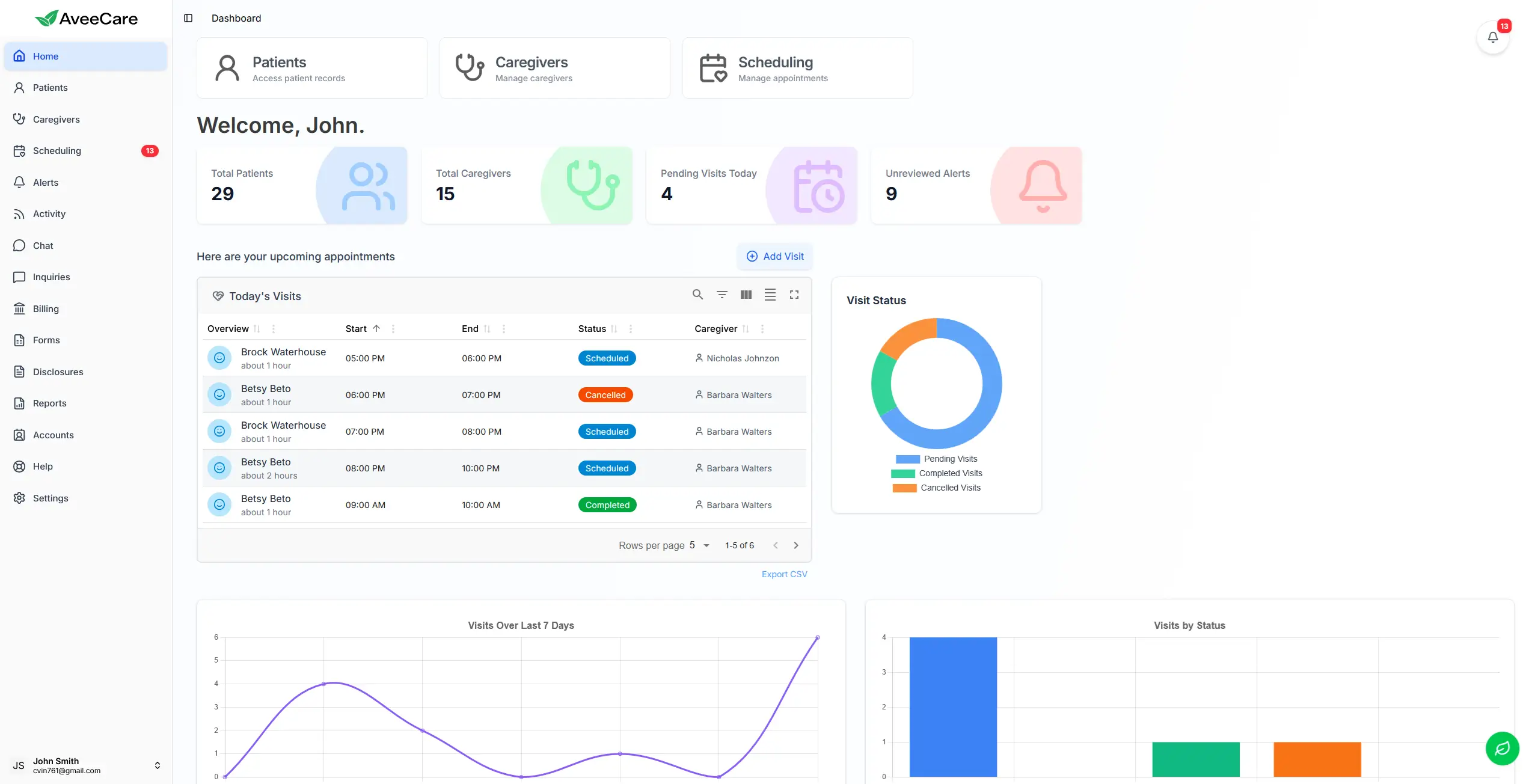
Manage your New York home care agency with AveeCare's comprehensive dashboard
Differentiation tip: In New York's hyper-competitive market, multilingual and culturally competent services are your biggest differentiators. Agencies that can serve diverse communities in their preferred languages, maintain strong MLTC plan relationships, and demonstrate reliable caregiver retention will outperform competitors. Technology-driven scheduling with automatic overtime tracking is essential for managing New York's complex labor requirements.
11Marketing & Client Acquisition
How to market your home care agency in New York's hyper-competitive landscape
Marketing a home care agency in New York requires a sophisticated, borough-by-borough and region-by-region approach. The NYC metro area is the most competitive home care market in the nation, while upstate markets offer significant opportunity with less competition. New York's extraordinary cultural diversity means that community-specific outreach is not optional -- it is essential for growth. Agencies that invest in multilingual marketing, MLTC plan relationships, and deep community engagement will build sustainable client pipelines.
NYC Borough-by-Borough Marketing Strategy
Brooklyn
The most diverse borough. Target Russian-speaking communities in Brighton Beach and Sheepshead Bay, Caribbean communities in Flatbush and Crown Heights, Chinese communities in Sunset Park, and Orthodox Jewish communities in Williamsburg and Boro Park. Each community requires culturally specific outreach in their preferred language and through trusted community channels.
Queens
The most ethnically diverse urban area in the world. Target Chinese communities in Flushing, South Asian communities in Jackson Heights, Korean communities in Flushing/Bayside, and Hispanic communities throughout. Partner with community organizations and ethnic media outlets in each neighborhood.
The Bronx
Large Hispanic (Dominican, Puerto Rican, Mexican) communities dominate the Bronx. Spanish-language marketing is essential. High Medicaid utilization creates strong MLTC plan referral opportunities. Partner with community health centers, churches, and cultural organizations. Lower competition than Manhattan or Brooklyn.
Manhattan & Staten Island
Manhattan offers premium private pay clients (Upper East Side, Upper West Side) alongside Medicaid populations. Staten Island has a growing senior population with suburban characteristics. Manhattan requires premium positioning; Staten Island is less competitive and more community-oriented.
Community-Specific Marketing
New York's cultural diversity creates unique marketing opportunities for agencies willing to invest in community-specific outreach. Each community has its own trusted channels, media outlets, and decision-making patterns for home care:
Russian-Speaking Communities (Brighton Beach, Sheepshead Bay)
Advertise in Russian-language newspapers, community radio, and on Russian social media platforms. Partner with Russian-speaking physicians and senior centers. Russian-language website pages and marketing materials are essential. Trust is built through personal referrals within the community.
Chinese Communities (Flushing, Sunset Park, Chinatown)
Advertise in Chinese-language media (World Journal, Sing Tao Daily). WeChat marketing is critical for reaching Chinese families. Partner with Chinese community centers, temples, and physician practices. Mandarin and Cantonese-speaking staff are essential differentiators.
Caribbean Communities (Flatbush, Crown Heights, East New York)
Partner with Caribbean cultural organizations, churches, and community radio. Many Caribbean families have strong multigenerational care traditions; position your services as supporting family caregivers. Creole and patois-speaking staff help build trust in Haitian and Jamaican communities.
Hispanic Communities (The Bronx, Washington Heights, Jackson Heights)
Spanish-language marketing is mandatory. Advertise in Spanish media, partner with churches (especially Catholic parishes), community health centers, and cultural organizations. Target both Dominican and Mexican communities with culturally relevant messaging. Many families prefer bilingual caregivers.
Orthodox Jewish Communities (Williamsburg, Boro Park, Crown Heights)
These communities have very specific care preferences including Shabbat-observant caregivers, kosher meal preparation, and modesty requirements. Yiddish-speaking staff are valuable in Hasidic communities. Marketing through community rabbis, synagogues, and Jewish social service organizations is most effective.
Digital Marketing Strategies
Google Business Profile
Optimize your Google Business Profile for every borough and city you serve. In NYC, create separate listings for each office location. Strong reviews (aim for 100+ with 4.7+ rating) are critical in this competitive market. Respond to every review within 24 hours.
Multilingual Google Ads
Run Google Ads in English, Spanish, Chinese, Russian, and other languages based on your service area. Target hyper-local keywords like "home care Brooklyn" or "home care Flushing." NYC CPCs are among the highest in the nation ($20-50+), so track ROI carefully and focus on high-converting neighborhoods.
SEO & Content Marketing
Build a robust website with borough-specific and city-specific landing pages. Create multilingual content about NY-specific topics like MLTC plan navigation, CDPAP eligibility, and New York caregiver rights. Local SEO targeting specific neighborhoods drives qualified traffic.
Social Media & WeChat
Facebook and Instagram for general audiences. WeChat for Chinese communities (critical in Flushing). Russian social media (VK, Odnoklassniki) for Russian-speaking communities. WhatsApp groups for Caribbean and Hispanic communities. Targeted social ads by zip code and language.
Upstate & Suburban Market Opportunity
While NYC dominates New York's home care conversation, significant opportunity exists outside the city with far less competition and lower operating costs:
Long Island & Westchester (Private Pay)
Affluent communities with high private pay willingness. Nassau, Suffolk, and Westchester families often prefer premium home care with specialized services. Less competition than NYC with similar billing rates. Build physician and hospital referral relationships.
Hudson Valley (Growing Market)
Dutchess, Orange, and Rockland counties are experiencing population growth and aging demographics. Lower costs than NYC metro with growing demand. MLTC plan presence is expanding. Excellent opportunity for new agencies.
Capital District (Albany Area)
Albany, Schenectady, and Troy have a large state government workforce aging into home care. Multiple hospitals and medical centers create referral opportunities. Lower competition and moderate costs make this an attractive market.
Western NY (Buffalo/Rochester)
Buffalo and Rochester have large aging populations with strong healthcare infrastructure. Lowest startup costs in the state. Medicaid dominates the payer mix. Less competition means easier market entry and relationship building.
MLTC Plan Partnerships for Referrals
Managed Long Term Care (MLTC) plans are the most important referral source for agencies serving Medicaid beneficiaries in New York. Building strong relationships with MLTC plan care coordinators and demonstrating reliable service delivery is essential for receiving consistent referral volume:
Contract with multiple MLTC plans to diversify your referral sources and geographic coverage.
Build personal relationships with MLTC care coordinators who assign cases to agencies they trust.
Maintain high service quality metrics (low missed visits, timely EVV compliance) to increase your plan ranking.
Healthcare Referral Relationships
New York's massive healthcare ecosystem offers abundant referral opportunities. Key relationships to build for your home care agency:
NYC Health System Discharge Planners
NewYork-Presbyterian, Mount Sinai, Northwell, NYU Langone, and NYC H+H operate dozens of hospitals across the city. Prioritize discharge planning relationships at hospitals nearest your service areas.
Physician Networks & FQHCs
Build referral relationships with geriatricians, internists, and Federally Qualified Health Centers that serve elderly populations. NYC has an extensive FQHC network serving underserved communities.
Skilled Nursing & Rehab Facilities
New York has hundreds of skilled nursing facilities. Build relationships with social workers and discharge coordinators for a steady stream of post-acute care referrals as patients transition home.
HCA-NYS Networking
The Home Care Association of New York State provides conferences, regional events, and networking opportunities. Membership connects you with other agencies, vendors, and industry leaders for partnership and referral opportunities.
Online Reputation Management
In New York's hyper-competitive market, your online reputation directly impacts client acquisition. Families and MLTC care coordinators often research agencies online before making referral or hiring decisions.
Google Reviews
Aim for 100+ reviews with a 4.7+ rating. NYC families compare multiple agencies before deciding. Respond to every review within 24 hours.
Caring.com & A Place for Mom
Maintain premium profiles on care directories. These platforms receive heavy traffic from New York families researching home care options.
Multilingual Reviews
Encourage reviews in multiple languages. Russian, Chinese, and Spanish reviews build trust in those communities where word-of-mouth drives decisions.
Marketing Channel Comparison
| Channel | Cost | Time to Results | Best For |
|---|---|---|---|
| Google Ads (Multilingual) | $$$$ | Immediate | Fast leads in competitive NYC market |
| MLTC Plan Relationships | Free | 2-4 months | Steady Medicaid referral volume |
| Community Outreach | $ | 2-4 months | Trust-building in diverse communities |
| SEO / Website | $-$$ | 4-8 months | Long-term organic visibility |
| Hospital Referrals | Free | 2-4 months | High-intent medical referrals |
| Ethnic Media Advertising | $$ | 1-2 months | Targeted community penetration |
New York Advertising Regulations
New York has strict consumer protection laws that affect home care advertising. Ensure all marketing materials accurately represent your services and licensing status. If you hold an LHCSA license, do not advertise skilled nursing or therapy services unless you also hold CHHA certification. The NY Department of Health monitors compliance with advertising standards for licensed agencies. The NYC Department of Consumer and Worker Protection has additional advertising regulations for businesses operating in the city.
New York marketing tip: Do not try to market to all of New York at once. Start with one or two boroughs or regions where you have community connections and language capabilities. Master those neighborhoods, build your reputation and reviews, then expand. In New York, depth of community penetration beats breadth of geographic coverage every time.
12Frequently Asked Questions
Common questions about starting a home care agency in New York
Yes. New York requires a Licensed Home Care Services Agency (LHCSA) license from the New York State Department of Health (DOH) under Article 36 of the Public Health Law for all non-medical personal care agencies. If you plan to provide skilled nursing or therapy, you need a Certified Home Health Agency (CHHA) designation. New York has one of the most complex and rigorous home care licensing structures in the nation, and the state has imposed moratorium restrictions on new LHCSA licenses in certain regions.
Starting a non-medical LHCSA in New York typically costs between $75,000 and $200,000, among the highest in the nation. In New York City, costs can exceed $250,000 due to extremely high rents, insurance premiums, and wages. This includes the $5,000 LHCSA application fee, consultant/attorney fees for application preparation, business formation, insurance (workers' comp, DBL, and PFL are all required), marketing, office space, and 3 to 6 months of working capital. A CHHA costs $250,000 to $500,000 or more.
New York State has imposed moratorium restrictions on the approval of new LHCSA applications in certain regions, particularly in the New York City metropolitan area. The moratorium was enacted to address concerns about fraud, overutilization, and oversaturation of home care agencies in specific markets. Prospective applicants should check directly with the NY Department of Health for the current status of the moratorium and any available exceptions for their planned service area.
New York has a tiered minimum wage structure: $16.50/hour in New York City, $16.00/hour in Long Island and Westchester County, and $15.50/hour for the rest of the state (2026 rates). However, the home care workforce in New York is heavily unionized through 1199SEIU, which negotiates wages and benefits that typically exceed these minimums. Employers must also comply with NY Paid Family Leave, mandatory sick leave, and the Disability Benefits Law.
New York uses HHAeXchange as its mandated Electronic Visit Verification (EVV) system for Medicaid-funded personal care and home health services. HHAeXchange is headquartered in New York and deeply integrated with the state's Managed Long Term Care (MLTC) plan infrastructure. Under the 21st Century Cures Act, all agencies providing Medicaid-funded personal care and home health services must use an EVV-compliant system.
Starting a non-medical LHCSA in New York typically takes 6 to 18 months, significantly longer than most states. The DOH application process involves a detailed operational plan review, policy assessment, background investigations, and an on-site survey. A CHHA takes 12 to 24 months or longer. The LHCSA moratorium in certain regions can extend timelines further. Applicants should begin preparing their operational plan, policies, and compliance documentation well before filing.
13Sources and Resources
Official New York state agency links and resources
Ready to manage your New York home care agency?
You do not need software on day one. But when you are ready, AveeCare starts at $6/client/month with no contracts, no mandatory demos, and a free trial. Scheduling with automatic overtime tracking, care plans, billing, caregiver management, real-time tracking, and alerts in one platform built for simplicity, even across New York's complex regulatory landscape.
Disclaimer
This guide is for informational purposes only and does not constitute legal, financial, or professional advice. While we strive to keep this information accurate and up to date, New York laws, regulations, fees, moratorium statuses, and requirements may change. Always verify current requirements directly with the relevant New York state agencies, including the Department of Health, before making business decisions. Consult with a qualified attorney and accountant experienced in New York home care law before starting your agency. The LHCSA moratorium status should be confirmed directly with DOH before investing in an application. AveeCare is not affiliated with the New York State Department of Health, the Division of Corporations, the Justice Center, NYSOFA, or any New York state agency. Published April 4, 2026.