How to Start a Home Care Agency in Mississippi
Your complete 2026 guide to launching a home care business in Mississippi -- from MSDH licensing and business formation to the lowest startup costs in the nation, no state income tax, DPS background checks, and building your first referral network.
Published April 4, 2026 · 25 min read
TLDR -- Mississippi at a Glance
No separate license required for non-medical in-home personal care. MSDH licenses Home Health Agencies for skilled services only. Personal Care Homes are residential facilities (different category).
Mississippi State Department of Health (MSDH), Division of Health Facilities Licensure and Certification
$15,000 – $45,000 (Non-Medical)
$80,000 – $200,000+ (Home Health)
Lowest costs in the US
3 – 6 weeks (Non-Medical) | 4 – 8 months (Home Health)
No state income tax (fully eliminated by 2026), lowest cost of living in the US, highly Medicaid-dependent population, significant rural/Delta region needs, hurricane risk on Gulf Coast
1Mississippi Market Overview
Understanding the opportunity for home care agencies in the Magnolia State
Mississippi has a population of approximately 2.9 million people and presents a distinctive and compelling opportunity for entrepreneurs looking to start a home care agency. Mississippi has the lowest cost of living in the entire United States, which translates directly to the lowest startup costs and operating expenses for new home care businesses. The state has a growing elderly population, a highly Medicaid-dependent population with the highest poverty rate in the nation, and vast rural areas with significant unmet demand for in-home care services. Starting a home care business in Mississippi means entering a market where the need is enormous and the barriers to entry are among the lowest in the country.
The Jackson metropolitan area (Hinds, Rankin, and Madison counties) is Mississippi's largest population center with roughly 580,000 residents and the most developed healthcare infrastructure in the state. The Gulf Coast region (Biloxi, Gulfport, Pascagoula, and surrounding Harrison, Hancock, and Jackson counties) is the second-largest metro area and attracts retirees and snowbirds due to its coastal lifestyle and affordable housing. Tupelo in northeast Mississippi, Hattiesburg in the Pine Belt, Meridian in east-central Mississippi, and Southaven/DeSoto County in the Memphis metro each represent distinct regional markets with their own healthcare networks and demographics. For a national overview of the startup process, see our complete guide to starting a home care agency and our state-by-state licensing requirements.
The Mississippi Delta region, stretching along the western edge of the state from Vicksburg north to Tunica, is one of the most underserved areas in the entire United States. The Delta has an aging population, extremely limited healthcare facilities, high rates of chronic disease (diabetes, heart disease, hypertension), and some of the highest poverty rates in the country. Home care agencies willing to serve Delta communities face enormous unmet demand but must plan for the logistical challenges of serving clients spread across vast rural areas.
Mississippi's large African American population (approximately 38% of the state) is a defining demographic characteristic that shapes the home care market. Building culturally competent care teams and establishing trust within African American communities is essential for any home care agency operating in Mississippi. The state's faith communities, particularly churches, play a central role in social life across all demographics and represent powerful referral and outreach channels for home care agencies.
2Home Care vs. Home Health in Mississippi
Non-medical in-home care vs. MSDH-licensed Home Health Agency vs. Personal Care Home
Key distinction in Mississippi: MSDH licenses Home Health Agencies (skilled medical services) and Personal Care Homes (residential care facilities). Non-medical in-home personal care agencies that send caregivers to clients' homes do NOT need a separate MSDH license. Do not confuse "Personal Care Home" (a residential facility license) with in-home personal care services. If you plan to provide Medicaid-funded personal care, you must enroll with the Division of Medicaid (DOM).
Non-Medical In-Home Care
No MSDH license required
- Companion care and socialization
- Homemaker services and housekeeping
- Meal preparation and nutrition
- Personal care (bathing, dressing)
- Transportation and errands
- Medication reminders (non-medical)
Fastest path to launch in MS
Business registration + county permit only.
Medicaid Personal Care
DOM Medicaid enrollment required
- Personal care (bathing, dressing)
- Grooming and hygiene assistance
- Meal preparation
- Light housekeeping
- Respite care for families
Enroll with DOM
EVV via HHAeXchange required.
Home Health Agency (HHA)
MSDH license required
- Skilled nursing care
- Physical and occupational therapy
- Speech therapy
- Medical social services
- Home health aide services
MSDH license required
Plus Medicare cert for Medicare billing.
Personal Care Home clarification: Mississippi's "Personal Care Home" license from MSDH covers residential facilities that house and care for residents. This is completely different from a non-medical in-home personal care agency that sends caregivers to clients' homes. If you are starting an in-home care agency (not a residential facility), you do not need a Personal Care Home license.
3Business Formation in Mississippi
Register your home care business with NO state income tax and among the lowest fees nationally
Choose Your Business Structure
Most Mississippi home care agencies register as an LLC (Limited Liability Company) for liability protection and tax flexibility. Mississippi LLC formation is among the most affordable in the country at approximately $50 online. You can also form a corporation, partnership, or sole proprietorship.
Register with Mississippi Secretary of State
File your Certificate of Formation with the Mississippi Secretary of State online or by mail. Mississippi requires an annual report to maintain good standing. Processing is typically completed within a few business days for online filings through the SOS business services portal.
Mississippi SOSObtain Your EIN
Apply for a free Employer Identification Number (EIN) from the IRS at irs.gov. You need this for bank accounts, payroll, and tax filings. You can get it instantly online.
Register with MS Department of Revenue (DOR)
Mississippi has fully eliminated its state income tax as of 2026. However, you still need to register with the Mississippi DOR for franchise tax and sales tax if applicable. Register for state unemployment insurance through the Mississippi Department of Employment Security (MDES). The elimination of state income tax means no state withholding for your employees, which simplifies payroll.
County and City Permits
Mississippi has 82 counties, and most counties and cities require a local business license or permit. Requirements vary by location: Hinds County (Jackson), Harrison County (Biloxi/Gulfport), DeSoto County (Southaven), Rankin County, and Forrest County (Hattiesburg) each have distinct requirements. Contact your county tax collector or city clerk for specific permit requirements.
Open a Business Bank Account
Open a dedicated business checking account to keep personal and business finances separate. Mississippi-based banks and credit unions are readily available throughout the state. You will need your EIN and formation documents.
No state income tax advantage: Mississippi fully phased out its state income tax by 2026. This is a major competitive advantage for your home care business. Your caregivers keep more of their pay without any state income tax deductions, which helps with recruitment and retention in a competitive labor market. For you as a business owner, there is no state income tax on your business income either. This makes Mississippi one of the most tax-friendly states in the nation for home care entrepreneurs.
4Licensing Requirements (MSDH)
MSDH licenses Home Health Agencies; non-medical in-home care does not need a separate state license
Non-Medical In-Home Care (No MSDH License)
Mississippi does not require a state health license from MSDH to operate a non-medical in-home personal care, companion, or homemaker agency serving private-pay clients. This makes Mississippi one of the fastest and most affordable states to launch a non-medical home care business. You need standard business registrations (Secretary of State, county permits) and should carry appropriate insurance, but you can begin serving private-pay clients without an MSDH health license. If you want to bill Mississippi Medicaid for personal care services, you must enroll as a provider with the Division of Medicaid.
- Register business with Mississippi Secretary of State
- Obtain county/city business license or permit
- Purchase liability and workers' compensation insurance (5+ employees)
- Conduct DPS background checks on all caregivers
- Verify workers against abuse registry and OIG exclusion list
Medicaid Personal Care Provider Enrollment
To provide personal care services through Mississippi Medicaid, you must enroll as a provider with the Mississippi Division of Medicaid (DOM). Personal care providers serve Medicaid beneficiaries through HCBS waiver programs including the Elderly and Disabled Waiver, IDD Waiver, and TBI Waiver. Given Mississippi's high Medicaid utilization rate and the significant population relying on Medicaid for healthcare, enrollment with DOM opens access to a large and consistent client base.
- Submit provider enrollment application to DOM
- Complete all required background checks (DPS + FBI)
- Implement EVV through HHAeXchange
- Credential with Mississippi CAN MCOs
- Develop required policies and procedures
Home Health Agency License (MSDH)
If you plan to provide skilled nursing, physical therapy, or other medical services in Mississippi, you must obtain a Home Health Agency license from the Mississippi State Department of Health (MSDH), Division of Health Facilities Licensure and Certification. This is a rigorous process with extensive clinical documentation, staffing requirements, and quality assurance standards. A licensed RN must serve as the clinical supervisor and director of nursing.
- Submit Home Health Agency license application to MSDH
- Develop clinical policies and procedures manual
- Hire qualified clinical staff (RN director required)
- Pass MSDH initial survey inspection
- If Medicare: apply for CMS Medicare certification
5Insurance Requirements
Workers' comp required for 5+ employees, hurricane coverage critical on Gulf Coast
Insurance is essential for protecting your Mississippi home care agency, your clients, and your caregivers. Mississippi insurance premiums tend to be among the lowest in the nation due to the low cost of living, but agencies operating on the Gulf Coast must factor in additional coverage for hurricane and wind damage. Mississippi requires workers' compensation insurance for employers with five or more employees.
General Liability Insurance
Protects your Mississippi home care agency from claims of bodily injury, property damage, and personal injury. A standard policy of $1 million per occurrence and $2 million aggregate is the industry baseline. Mississippi premiums are among the lowest nationally, typically $1,500 to $3,500 per year for a new agency.
Professional Liability (E&O)
Covers claims arising from errors, omissions, or negligence in the care services your agency provides. This is critical for protecting against lawsuits related to caregiver actions or inactions. Typical Mississippi costs range from $1,000 to $2,800 annually.
Workers' Compensation
Mississippi requires workers' compensation insurance for employers with five or more employees. Even if you start with fewer than five employees, it is strongly recommended to carry coverage from day one. Caregivers face risks including lifting injuries, slips, and falls. Mississippi workers' comp rates are among the most affordable in the country.
Hurricane and Wind Coverage (Gulf Coast)
If your agency operates in Harrison, Hancock, Jackson, or other Gulf Coast counties, you need wind and hurricane coverage for your office location and potentially for business interruption. The Mississippi Wind Pool (Mississippi Windstorm Underwriting Association) provides coverage in coastal areas where standard insurers may not. Hurricane season runs June through November.
Surety and Fidelity Bonds
While not always legally required for non-medical agencies in Mississippi, surety and fidelity bonds protect clients against theft or dishonesty by your caregivers. Many clients and referral partners expect bonded agencies. Costs are typically $200 to $600 annually in Mississippi.
Commercial Auto Insurance
If your agency provides transportation services or if caregivers use company vehicles, you need commercial auto insurance. Even if caregivers use personal vehicles, consider non-owned auto liability coverage. Mississippi has relatively affordable auto insurance rates compared to many states.
6Staffing Your Mississippi Agency
Federal $7.25 minimum wage, DPS background checks, WIN Job Centers, community college CNA programs
Staffing is one of the most critical challenges for home care agencies across the country, and Mississippi is no exception. Mississippi does not have a state minimum wage law, so the federal minimum wage of $7.25 per hour applies. While this keeps labor costs low on paper, competitive agencies in Mississippi typically pay $9 to $14 per hour for caregivers depending on the region, experience, and whether the client is private pay or Medicaid-funded. The no-state-income-tax advantage means your caregivers keep more of every dollar they earn, which is a meaningful recruitment tool.
DPS Background Checks
All caregivers must undergo background checks through the Mississippi Department of Public Safety (DPS), Criminal Information Center. This includes a state criminal records check and, for Medicaid providers, national FBI fingerprinting. Verify workers against the Mississippi Nurse Aide Registry, the Vulnerable Adults Act abuse registry, and the federal OIG exclusion list before hiring.
MS DPSWIN Job Centers
Mississippi operates WIN (Workforce Investment Network) Job Centers throughout the state. These centers provide free recruitment services, job posting boards, applicant screening, and workforce training programs. WIN Job Centers are especially valuable in smaller Mississippi communities where online job boards have limited reach. Post your caregiver positions at WIN Job Centers in your service area.
Community College CNA Programs
Mississippi community colleges offer affordable CNA (Certified Nursing Assistant) training programs across the state. Hinds Community College (Jackson area), Mississippi Gulf Coast Community College (Biloxi/Gulfport), Meridian Community College, and others produce a steady pipeline of trained caregivers. Build relationships with these programs for early access to graduates.
Recruitment Strategies for Mississippi
In Mississippi, word-of-mouth referrals through churches and community networks are often more effective than online job boards, especially in rural areas and the Delta. Offer referral bonuses to current caregivers, post at WIN Job Centers, connect with community college CNA programs, and partner with local churches. The no-state-income-tax advantage is a concrete selling point in recruitment.
Wage competitiveness note: While the federal minimum wage of $7.25/hour technically applies in Mississippi, paying at or near minimum wage will make it extremely difficult to recruit and retain quality caregivers. Most competitive Mississippi home care agencies pay $9 to $14/hour for non-medical caregivers and $12 to $18/hour in the Jackson metro and Gulf Coast markets. The no-state-income-tax advantage effectively increases take-home pay by several percent compared to neighboring states like Alabama, Tennessee, and Louisiana, which is a concrete recruiting advantage you should highlight.
7Medicaid & Medicare in Mississippi
Division of Medicaid (DOM), Mississippi CAN managed care, HHAeXchange EVV, HCBS waivers
Mississippi has one of the highest Medicaid utilization rates in the nation due to its significant poverty rate. Approximately one in four Mississippians is enrolled in Medicaid, making it the dominant payer for home care services in many parts of the state, especially in the Delta, rural counties, and underserved communities. Understanding Mississippi's Medicaid landscape is essential for building a sustainable home care business in the Magnolia State.
Division of Medicaid (DOM) Enrollment
The Mississippi Division of Medicaid (DOM) administers the state's Medicaid program. To provide Medicaid-funded personal care services, you must enroll as a provider with DOM. Mississippi transitioned to managed care through the Mississippi CAN (Coordinated Access Network) program, which means most Medicaid beneficiaries receive their services through managed care organizations (MCOs). You must credential with the Mississippi CAN MCOs in addition to enrolling with DOM to receive Medicaid referrals and reimbursement.
Mississippi Division of MedicaidElectronic Visit Verification (EVV)
Under the 21st Century Cures Act, all states must implement EVV for Medicaid-funded personal care and home health services. Mississippi uses HHAeXchange as its statewide EVV system. Providers can use HHAeXchange directly or select a third-party EVV vendor that integrates with HHAeXchange for data submission to the state. All personal care providers and MSDH-licensed Home Health Agencies billing Medicaid must comply with EVV requirements.
Mississippi HCBS Waivers
- Elderly and Disabled Waiver (E&D Waiver)
- Intellectual/Developmental Disabilities (IDD) Waiver
- Traumatic Brain Injury (TBI) Waiver
- Independent Living Waiver
- Personal Care Services (State Plan)
Medicare Certification
To bill Medicare, your Mississippi home health agency must first hold an MSDH Home Health Agency license, then be certified by CMS. The process involves applying through CMS, passing a federal survey, and demonstrating compliance with Medicare Conditions of Participation. Expect 3 to 6 months for the full certification process after obtaining your MSDH license. Mississippi's growing elderly population and high rates of chronic disease make Medicare certification a worthwhile investment for home health agencies.
8Startup Cost Estimator
Mississippi-specific startup costs -- the lowest in the entire United States
Business Formation
$475 – $2,025Articles of Organization with MS SOS (among lowest in US)
IRS EIN is free; registered agent optional
Varies by county (Hinds, Harrison, DeSoto, etc.)
Attorney review, CPA setup (MS rates are lower)
Medicaid Enrollment (If Applicable)
$500 – $1,900DOM Medicaid enrollment process
Personal care program compliance documentation
Insurance (Annual)
$3,900 – $10,400$1M per occurrence / $2M aggregate (MS rates among lowest)
Errors and omissions coverage
Required for 5+ employees in Mississippi
Recommended for client trust
Office & Equipment
$1,300 – $4,200Mississippi has the lowest office rents in the US
Laptops, smartphones for staff
Desk, chairs, printer, supplies
Marketing & Initial Growth
$1,500 – $5,850Professional site with local SEO
Google Ads, Facebook, local outreach
Brochures, flyers, cards
Working Capital (3-6 Months)
$5,500 – $16,500Cover payroll before revenue stabilizes (lower MS wages)
Rent, utilities, software, misc.
Estimated Total Startup Cost (Non-Medical)
$13,175 – $40,875
These are among the lowest startup costs for a home care agency anywhere in the United States. Mississippi's lowest-in-the-nation cost of living keeps office rent, insurance premiums, wages, and general operating expenses significantly below the national average. If you operate on the Gulf Coast, factor in hurricane/wind insurance. There is no state income tax to worry about for you or your employees.
9Compliance Checklist
Track your progress across all Mississippi requirements
Business Formation
0/6Licensing
0/4Insurance
0/5Staffing
0/6Medicaid & Medicare
0/3Operations
0/4Marketing
0/510Building Your Referral Network
Key referral sources in Mississippi for your home care agency
In Mississippi, personal relationships and community trust drive most referrals. The state's tight-knit communities, strong church networks, and smaller-town character mean that word-of-mouth and personal connections are often more powerful than any advertising. Building strong relationships with hospitals, physicians, aging services organizations, and faith communities across Mississippi is critical for establishing a successful home care business.
University of Mississippi Medical Center (UMMC)
UMMC in Jackson is Mississippi's only academic medical center and the state's largest hospital. Their discharge planners and case managers handle thousands of transitions from hospital to home annually. Building relationships with UMMC's care coordination teams is essential for any agency serving the Jackson metro area. UMMC also operates clinics across the state.
Baptist Health Systems
Baptist Health operates hospitals in Jackson (Baptist Medical Center), Madison, and other locations across central Mississippi. Their network of hospitals, clinics, and physician practices generates significant referral volume for home care agencies in the Jackson metro and surrounding counties.
Memorial Health System (Gulf Coast)
Memorial Hospital in Gulfport and the broader Memorial Health System serve the Mississippi Gulf Coast region. Their discharge planning teams connect patients with home care services across Harrison, Hancock, and Jackson counties. Building partnerships with Memorial is critical for agencies operating on the Gulf Coast.
Forrest General Hospital (Hattiesburg)
Forrest General Hospital is the largest hospital in the Pine Belt region and serves as the regional medical center for southeast Mississippi. Their discharge planners and case managers are key referral sources for home care agencies operating in Forrest, Lamar, Perry, and surrounding counties.
Division of Aging and Adult Services (DAAS)
DAAS, part of the Mississippi Department of Human Services (MDHS), oversees programs for older adults and adults with disabilities. DAAS coordinates with Area Agencies on Aging (AAAs) organized by planning and development districts across Mississippi's 82 counties. These agencies connect seniors with community-based services and are critical referral partners.
DAASElder Law Attorneys and Social Workers
Mississippi attorneys specializing in elder law, estate planning, and Medicaid planning frequently advise families about home care options. Hospital social workers and county aging coordinators are also consistent referral sources. The Mississippi Home Care Association can help connect you with industry peers and referral partners.
11Marketing & Client Acquisition
Mississippi-specific strategies to grow your home care business
Marketing a home care agency in Mississippi requires strategies tailored to the state's unique demographics, geography, and culture. Mississippi is a state where personal relationships, faith community connections, and word-of-mouth carry extraordinary weight. The large African American population demands culturally competent outreach, the rural Delta requires creative geographic strategies, and the Gulf Coast retiree market offers distinct opportunities. Understanding how Mississippi communities make decisions about elder care is the foundation of effective marketing in the Magnolia State.
Faith Community Partnerships
Churches are the heart of community life in Mississippi, perhaps more so than in any other state. Baptist churches dominate the landscape, but Catholic, Methodist, Pentecostal, and Church of God congregations are also important community anchors. In both Black and white communities, churches serve as social hubs, information networks, and trusted institutions where families seek guidance on caring for aging parents. Partnering with churches is the single most effective grassroots marketing strategy for home care agencies in Mississippi.
Black Church Outreach
African American churches are the most influential institutions in Mississippi's Black communities. Partner with pastors, deacon boards, and health ministries. Offer free caregiver education seminars, health screenings at church events, and sponsor fellowship meals. Building trust through Black churches opens doors that no advertising can match.
Baptist and Protestant Networks
Mississippi's white Baptist, Methodist, and Presbyterian churches have active senior ministry programs, visitation committees, and compassionate care teams. Build relationships with pastors and ministry leaders who identify homebound members needing care. Church bulletins, announcements, and fellowship halls are powerful marketing channels.
Community Health Ministries
Many Mississippi churches across all denominations have health ministry programs, parish nurses, or caring committees. Build relationships with these ministry leaders as they frequently identify members who need home care services and can make trusted referrals to your agency.
African American Community Trust-Building
With approximately 38% of Mississippi's population being African American, building trust within Black communities is not optional -- it is fundamental to your success. Historical healthcare disparities, institutional distrust, and cultural caregiving traditions mean that African American families often prefer agencies that demonstrate genuine cultural understanding and employ caregivers who share their cultural background.
Hire Diverse Caregivers
Your caregiver team should reflect the demographics of the communities you serve. In Mississippi, this means actively recruiting African American caregivers, especially in areas with large Black populations. Families are more comfortable when caregivers understand their cultural norms, food preferences, communication styles, and faith traditions.
Community Health Fair Presence
Attend and sponsor community health fairs in Black neighborhoods, at HBCUs (Jackson State, Alcorn State, Mississippi Valley State), and at community centers. These events build visibility and trust. Offer free blood pressure screenings, caregiver education materials, and information about Medicaid eligibility for home care services.
NAACP and Community Organizations
Partner with local NAACP chapters, Black civic organizations, and community leaders. These organizations serve as trusted intermediaries who can vouch for your agency's commitment to the community. Sponsoring community events and participating in civic activities builds authentic relationships.
Medicaid Enrollment Assistance
Many eligible Mississippians, particularly in rural and low-income communities, are not enrolled in Medicaid or do not know they qualify for home care services through Medicaid waivers. Offering assistance with Medicaid enrollment as part of your client intake process serves the community and builds your client base simultaneously.
Rural Delta & Small-Town Outreach
The Mississippi Delta and rural counties across the state represent enormous unmet demand for home care services. These areas have aging populations, limited healthcare infrastructure, high poverty rates, and few existing home care providers. The challenges are real -- long travel distances between clients, lower Medicaid reimbursement rates, and difficulty recruiting caregivers in remote areas -- but agencies willing to serve these communities face minimal competition and genuine community gratitude.
Delta Region Strategy
The Delta counties (Washington, Bolivar, Sunflower, Leflore, Coahoma, Tunica) have some of the highest elderly poverty rates in the nation. Partner with Delta Health Alliance, rural health clinics, Delta Council, and county Extension offices. Many families in the Delta need help navigating Medicaid enrollment to access home care benefits they are entitled to.
Small-Town Word-of-Mouth
In Mississippi's small towns, word-of-mouth is the dominant marketing channel. One satisfied family tells their church, their neighbors, and their doctor. Provide excellent care to your first few clients and the referrals will follow naturally. Sponsor local events, donate to school fundraisers, and be visible in the community.
Rural Health Clinic Partnerships
Mississippi has over 100 rural health clinics and Federally Qualified Health Centers (FQHCs) serving underserved populations. These clinics see patients who need home care daily but often have no provider to refer to. Building partnerships with rural health clinics creates a reliable referral pipeline in communities with minimal competition.
Senior Centers and County Resources
Every Mississippi county has senior centers and aging services programs coordinated through Area Agencies on Aging (AAAs). These senior centers host meals, activities, and social programs for elderly residents. Marketing your services through senior center bulletin boards, presentations, and partnerships with center directors is effective and free.
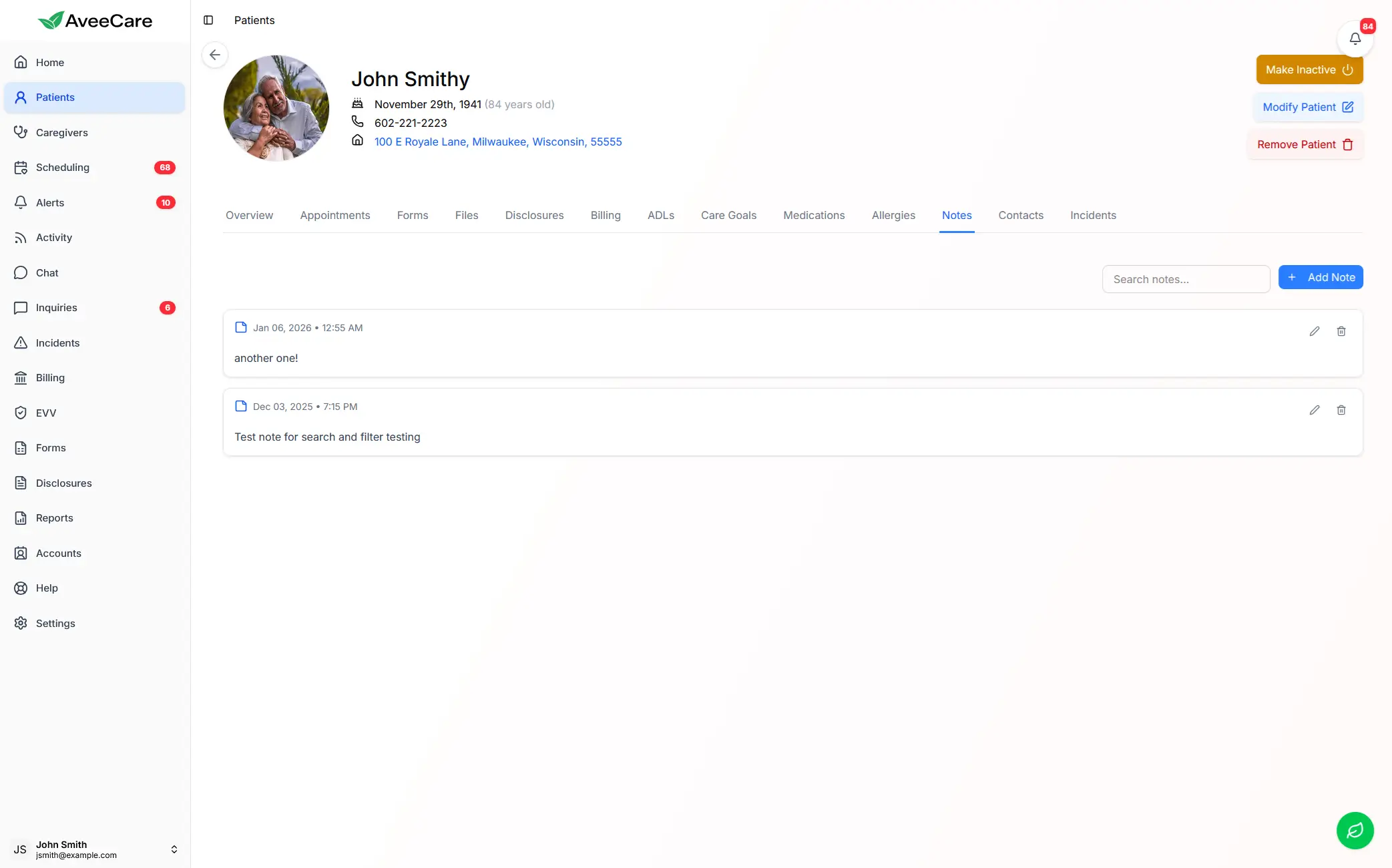
AveeCare searchable patient notes help Mississippi agencies maintain detailed care documentation across rural and urban service areas
Gulf Coast Retiree & Snowbird Marketing
Mississippi's Gulf Coast (Biloxi, Gulfport, Ocean Springs, Pass Christian, Bay St. Louis) attracts retirees and seasonal snowbirds drawn by affordable coastal living, mild winters, and the casino and entertainment industry. This market segment tends to be more private-pay oriented and less Medicaid-dependent than the rest of Mississippi, offering higher margins for home care agencies. Hurricane preparedness is a critical differentiator on the Coast.
Snowbird and Seasonal Care
Many Gulf Coast retirees spend part of the year in Mississippi and part elsewhere. Market seasonal care packages, temporary caregiver services for snowbirds during their Mississippi months, and partnerships with retirement communities in Harrison, Hancock, and Jackson counties.
Hurricane Preparedness Marketing
Hurricane season (June through November) is a critical concern for Gulf Coast families with elderly loved ones. Promote your hurricane preparedness plan, emergency communication protocols, and post-storm welfare check services. Agencies that demonstrate readiness during storm season earn trust no advertising can buy.
Retirement Community Partnerships
The Gulf Coast has numerous active adult communities, independent living facilities, and retirement neighborhoods. Build relationships with community managers, HOA boards, and resident associations. Offer free educational seminars on aging-in-place, fall prevention, and home safety.
Casino Industry Connections
The Biloxi casino industry employs thousands of workers, many of whom have aging parents or family members needing care. Market your services through casino employee wellness programs, benefits fairs, and community partnerships. The casino industry is a unique Gulf Coast channel for reaching potential client families.
Digital Marketing for Mississippi
Mississippi's population of 2.9 million is distributed across 82 counties, with concentration in the Jackson metro, Gulf Coast, DeSoto County (Memphis suburbs), Tupelo, and Hattiesburg but significant population in rural counties throughout the state. Digital marketing helps you reach families across a wide geographic area efficiently, though in-person community presence remains essential in Mississippi.
Google Business Profile
Claim and optimize your Google Business Profile for every Mississippi service area. Add photos, respond to reviews promptly, and post regular updates. This is the single most important free digital marketing tool for local visibility in Jackson, Biloxi, Tupelo, and regional markets.
Google Ads (Pay-Per-Click)
Run targeted Google Ads for keywords like "home care agency Jackson Mississippi" or "in-home caregiver Biloxi." Geo-target specific Mississippi cities and counties. Mississippi CPC costs are among the lowest in the nation, making paid search very cost-effective. Start with $300-1,000/month.
Local SEO Strategy
Build a website with city-specific landing pages for each Mississippi market you serve. Optimize for local search terms like "home care services Jackson MS" and "senior care Gulfport Mississippi." Many Mississippi families research online before calling, even in smaller towns.
Facebook Marketing
Facebook is heavily used across Mississippi, especially in rural areas and among adult children making care decisions for aging parents. Post caregiver spotlights, client testimonials, and educational content. Join local Mississippi community Facebook groups for organic reach. Facebook ads targeting adult children aged 35-55 in specific MS counties are highly effective.
Physician Relationships & Small-Town Medical Offices
In Mississippi's small towns, physician offices are often the most trusted healthcare institution. A single family doctor or internal medicine practice may serve an entire community and know every elderly patient by name. Building relationships with these physicians creates a steady referral pipeline that is particularly powerful in smaller Mississippi communities.
Small-Town Physician Offices
In Mississippi towns with populations under 10,000, the local doctor's office is often the primary gateway to home care services. Visit these practices personally, bring lunch for the staff, leave brochures, and explain how your agency can help their patients remain safely at home. Personal relationships with office managers and nurses generate consistent referrals.
Federally Qualified Health Centers (FQHCs)
Mississippi has a large network of FQHCs serving low-income and underserved populations, including many Medicaid beneficiaries eligible for home care. Build partnerships with FQHCs in both urban and rural counties for consistent Medicaid referrals. FQHC patients often need help navigating Medicaid waiver enrollment.
Marketing Channel Comparison for Mississippi
| Channel | Cost | Time to Results | Best For |
|---|---|---|---|
| Church/Faith Partnerships | Free | 1-3 months | Deep community trust across all MS regions |
| Google Ads | $ | Immediate | Quick leads in Jackson & Gulf Coast |
| SEO / Website | $ | 3-6 months | Long-term organic leads statewide |
| Facebook Ads | $ | 1-2 weeks | Rural awareness & caregiver recruiting |
| Small-Town Physician Visits | Free | 1-2 months | High-intent referrals in small communities |
| Medicaid Enrollment Assistance | Free | 2-4 months | Building Medicaid client base in underserved areas |
| Senior Center Networking | Free | 1-3 months | Connecting with elderly residents directly |
| Mississippi CAN MCO Directories | Free | Ongoing | Medicaid referrals from case managers |
Mississippi marketing tip: In Mississippi, relationships are everything. Show up in person at churches, senior centers, physician offices, and community events. In the Jackson metro, focus on hospital discharge planners, UMMC partnerships, and community health fairs. On the Gulf Coast, lean into retiree communities and hurricane preparedness messaging. In the Delta and rural counties, partner with rural health clinics and churches, and help families navigate Medicaid enrollment. Across all regions, the elimination of state income tax is a concrete advantage you can use in both caregiver recruiting and client marketing. Let word-of-mouth from excellent care carry your reputation through Mississippi's tight-knit communities.
12Frequently Asked Questions
Common questions about starting a home care agency in Mississippi
Mississippi does NOT require a separate state license for non-medical in-home personal care agencies. The Mississippi State Department of Health (MSDH) licenses Home Health Agencies that provide skilled medical services, and licenses Personal Care Homes which are residential facilities. Non-medical in-home companion care, homemaker services, and personal care agencies serving private-pay clients can generally operate with standard business registration through the Mississippi Secretary of State and local county or city permits. However, if you plan to bill Mississippi Medicaid for personal care services, you must enroll as a provider with the Mississippi Division of Medicaid (DOM). This makes Mississippi one of the fastest and most affordable states to launch a non-medical home care business.
Starting a non-medical home care agency in Mississippi typically costs between $15,000 and $45,000, making it one of the most affordable states in the nation to launch a home care business. Mississippi has the lowest cost of living in the United States, which dramatically reduces office rent, wages, insurance premiums, and general operating expenses compared to every other state. A licensed Home Health Agency with skilled services costs significantly more, typically $80,000 to $200,000 or higher due to MSDH licensing, clinical staffing requirements, and Medicare certification costs.
No. Mississippi has fully phased out its state income tax as of 2026. This is a significant advantage for home care agency owners and employees alike. There is no state income tax withholding burden on the agency, and caregivers receive higher take-home pay at every wage level. Mississippi joins a small group of states with no state income tax, making it an exceptionally business-friendly environment for new home care agencies. You will still need to register with the Mississippi Department of Revenue for franchise tax and other applicable state taxes.
Mississippi requires background checks for caregivers through the Mississippi Department of Public Safety (DPS), Criminal Information Center. This includes a state criminal records check and, for Medicaid-enrolled providers, a national criminal background check via FBI fingerprinting. Providers must also verify workers against the Mississippi Nurse Aide Registry, the Mississippi Vulnerable Adults Act abuse registry, and the federal OIG exclusion list before hiring. Background checks are critical in Mississippi given the vulnerable populations served by home care agencies.
Mississippi offers several Home and Community-Based Services (HCBS) waiver programs through the Division of Medicaid (DOM) and the Mississippi CAN managed care system. Key waivers include the Elderly and Disabled Waiver (E&D Waiver), the Intellectual and Developmental Disabilities (IDD) Waiver, and the Traumatic Brain Injury (TBI) Waiver. Mississippi also offers personal care services as a state plan benefit. Providers must enroll with DOM and credential with Mississippi CAN managed care organizations to bill for Medicaid-funded home care services. Mississippi uses HHAeXchange as its statewide EVV system.
Starting a non-medical home care agency serving private-pay clients in Mississippi can be accomplished in 3 to 6 weeks, since no separate state health license is required for non-medical in-home care. Enrolling as a Medicaid personal care provider with the Division of Medicaid adds 2 to 4 months for application processing and credentialing with Mississippi CAN MCOs. A licensed Home Health Agency typically takes 4 to 8 months or more, especially if pursuing Medicare certification. Building a client base and referral network in Mississippi typically takes an additional 3 to 6 months after launch.
13Sources and Resources
Official Mississippi state agency links and resources
Ready to manage your Mississippi home care agency?
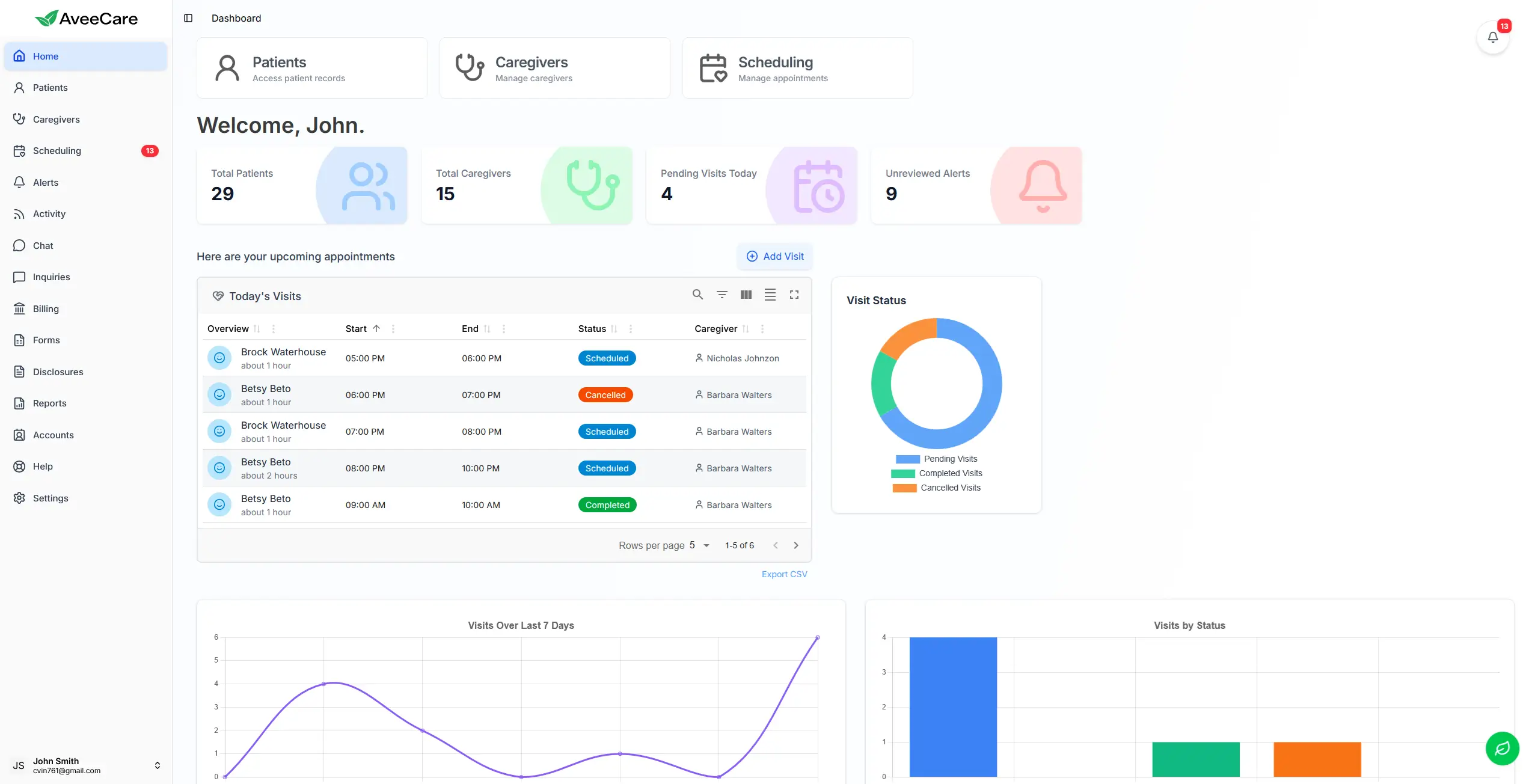
You do not need software on day one. But when you are ready, AveeCare starts at $6/client/month with no contracts, no mandatory demos, and a free trial. Scheduling, care plans, billing, caregiver management, and real-time alerts in one platform built for simplicity, whether you serve Jackson, the Gulf Coast, Tupelo, the Delta, or rural Mississippi counties.
Disclaimer
This guide is for informational purposes only and does not constitute legal, financial, or professional advice. While we strive to keep this information accurate and up to date, Mississippi laws, regulations, fees, and requirements may change. Always verify current requirements directly with the relevant Mississippi state agencies, including the Mississippi State Department of Health (MSDH), Mississippi Secretary of State, Mississippi Division of Medicaid (DOM), Mississippi Department of Public Safety (DPS), and the Division of Aging and Adult Services (DAAS), before making business decisions. Consult with a qualified attorney and accountant in Mississippi before starting your home care business. AveeCare is not affiliated with the Mississippi State Department of Health or any Mississippi state agency. Published April 4, 2026.