How to Start a Home Care Agency in Kentucky
Your complete 2026 guide to launching a home care business in Kentucky, from CHFS/OIG Personal Services Agency licensing and business formation to staffing, Medicaid enrollment, and your first clients.
Published April 4, 2026 · 25 min read
TLDR — Kentucky at a Glance
Yes for both non-medical (PSA license) and home health (HHA license) via CHFS/OIG.
Cabinet for Health and Family Services (CHFS), Office of Inspector General (OIG)
$20,000 – $55,000 (PSA / Non-Medical)
$100,000 – $250,000+ (Home Health)
2 – 4 months (PSA) | 4 – 8 months (Home Health)
Occupational license taxes in most cities/counties (Louisville ~2.2%, Lexington ~2.25%)
1Kentucky Market Overview
Understanding the opportunity for home care agencies in Kentucky
Kentucky has a population of approximately 4.5 million people and presents a compelling opportunity for entrepreneurs looking to start a home care agency. The Commonwealth has a growing population of adults aged 65 and older, driven by the aging of the baby boomer generation across both the Louisville and Lexington metros and the vast Appalachian eastern region. With a cost of living below the national average, Kentucky offers favorable conditions for launching a home care business with lower overhead, more affordable insurance, and competitive operating costs.
The Louisville metro area is Kentucky's largest population center and most competitive home care market, with Jefferson County and surrounding suburban counties like Oldham, Bullitt, and Shelby offering dense concentrations of potential clients. Lexington-Fayette County, the state's second-largest city, anchors Central Kentucky with a strong healthcare ecosystem built around the University of Kentucky. Northern Kentucky (Covington, Florence, Boone County) benefits from proximity to the Cincinnati metro and has a growing senior population. For a national overview of the startup process, see our complete guide to starting a home care agency and our state-by-state licensing requirements.
Eastern Kentucky's Appalachian region is characterized by rugged terrain, higher poverty rates, and significant healthcare access challenges. Counties like Perry, Floyd, Pike, and Knott have aging populations with complex health needs, including the ongoing impact of the opioid crisis. These communities have substantial unmet need for home care services, as many residents live far from hospitals or assisted living facilities. Starting a home care agency that serves Appalachian Kentucky requires creative staffing and logistics, but the lack of competition creates meaningful opportunity for agencies willing to serve these underserved areas.
Kentucky expanded Medicaid under the Affordable Care Act, creating a strong Medicaid market with a larger pool of eligible beneficiaries than many neighboring states. This expansion, combined with the state's aging demographics, makes Kentucky an attractive market for home care agencies that plan to serve both private pay and Medicaid-funded clients.
2Home Care vs. Home Health in Kentucky
Personal Services Agency (PSA) vs. Home Health Agency (HHA)
This is the most important thing to understand about Kentucky. Unlike many states, Kentucky does license non-medical personal care agencies. If you want to provide personal care services in Kentucky, you must obtain a Personal Services Agency (PSA) license from the Cabinet for Health and Family Services (CHFS), Office of Inspector General (OIG). Skilled home health agencies require a separate Home Health Agency (HHA) license from the same agency. Both license types require CHFS/OIG approval.
Personal Services Agency (PSA)
CHFS/OIG PSA license required
- Personal care (bathing, dressing, grooming)
- Homemaker services and light housekeeping
- Companion care and socialization
- Meal preparation and nutrition
- Medication reminders (not administration)
- Respite care for family caregivers
PSA license required from CHFS/OIG
Lower startup costs. Faster path to launch in Kentucky.
Home Health Agency (HHA)
CHFS/OIG HHA license required
- Skilled nursing care
- Physical, occupational, and speech therapy
- Wound care and injections
- Medical social services
- Home health aide services
- Medication administration
HHA license required from CHFS/OIG
Plus Medicare certification for Medicare billing.
Medicaid attendant care note: If you plan to provide attendant care services through Kentucky Medicaid HCBS waiver programs (HCB, Michelle P, SCL, ABI waivers), you must enroll as a Medicaid provider in addition to holding your CHFS/OIG license. Enrollment requirements include background checks, training standards, and EVV compliance through HHAeXchange. Contact the Kentucky Department for Medicaid Services (DMS) for specific enrollment requirements.
3Business Formation in Kentucky
Register your home care business and navigate occupational license taxes

Choose Your Business Structure
Most Kentucky home care agencies register as an LLC (Limited Liability Company) for liability protection and tax flexibility. Kentucky LLC formation is one of the most affordable in the country at just $40 for online filing. You can also form a corporation, partnership, or sole proprietorship.
Register with Kentucky Secretary of State
File your Articles of Organization with the Kentucky Secretary of State online or by mail. Kentucky requires an annual report ($15 for LLCs) to maintain good standing. Processing takes approximately 4 to 7 business days for standard online filings.
Kentucky SOSObtain Your EIN
Apply for a free Employer Identification Number (EIN) from the IRS at irs.gov. You need this for bank accounts, payroll, and tax filings. You can get it instantly online.
Register with KY Department of Revenue
Register for Kentucky state income tax withholding with the Kentucky Department of Revenue. Kentucky has a flat income tax rate of 3.5%. You will also need to register for state unemployment insurance with the Kentucky Office of Employment and Training.
Occupational License Tax (Unique to KY)
This is a critical step unique to Kentucky. Most cities and counties impose an occupational license tax on wages and net profits. Louisville Metro charges ~2.2%, Lexington-Fayette charges ~2.25%. You must register with each locality where your employees work. This tax must be withheld from caregiver paychecks in addition to state and federal taxes.
Open a Business Bank Account
Open a dedicated business checking account to keep personal and business finances separate. Kentucky-based banks and credit unions are readily available in Louisville, Lexington, and throughout the Commonwealth. You will need your EIN and formation documents.
Occupational license tax warning: Kentucky's occupational license taxes are a major cost that catches many new business owners off guard. If you operate in Louisville and employ caregivers earning $15/hour, the occupational tax alone adds roughly $0.33/hour to your per-caregiver cost. With caregivers working across multiple counties, you may need to register with and remit taxes to multiple jurisdictions. Consult with a Kentucky-based accountant to ensure full compliance across all localities where your caregivers serve clients.
4Licensing Requirements (CHFS/OIG)
Kentucky licenses both non-medical and skilled home care agencies
Personal Services Agency (PSA) License
Kentucky requires a Personal Services Agency (PSA) license from the Cabinet for Health and Family Services (CHFS), Office of Inspector General (OIG) to operate a non-medical home care agency. The PSA license is governed by Kentucky Administrative Regulations (902 KAR 20:036). This license authorizes you to provide personal care, homemaker, companion, and respite care services in clients' homes throughout the Commonwealth.
- Submit PSA license application to CHFS/OIG
- Designate a qualified administrator responsible for daily operations
- Develop all required policies and procedures per 902 KAR 20:036
- Pass CHFS/OIG initial on-site survey and inspection
- Implement background check policies for all caregivers (KSP + FBI)
- Establish client rights, complaint procedures, and quality assurance
Home Health Agency License (CHFS/OIG)
If you plan to provide skilled nursing, physical therapy, or other medical services in Kentucky, you must obtain a Home Health Agency (HHA) license from CHFS/OIG. This is a more rigorous process than the PSA license, with additional staffing, clinical documentation, and quality assurance requirements. A licensed RN must serve as clinical supervisor.
- Submit HHA license application to CHFS/OIG
- Designate a qualified administrator with healthcare management experience
- Employ or contract with an RN for clinical supervision
- Develop all required clinical policies and procedures
- Pass CHFS/OIG on-site survey and inspection
- Establish quality assurance and performance improvement program
Medicare Certification
Medicare certification is a separate process from CHFS/OIG licensure. To bill Medicare for skilled home health services, you must first hold a CHFS/OIG Home Health Agency license, then apply through CMS, pass a federal survey, and demonstrate compliance with Medicare Conditions of Participation. This process typically adds 3 to 6 months beyond your state license. Given Kentucky's growing elderly population and the strong Medicare-eligible population in both urban and Appalachian areas, Medicare certification opens access to a substantial payer source for home health agencies serving communities across the Commonwealth.
5Insurance Requirements
Protect your Kentucky home care business
General Liability
$1,800 - $4,500/yrCovers bodily injury and property damage claims. Recommended minimum: $1M per occurrence / $2M aggregate. Required by most referral partners and contracts in Kentucky. Kentucky premiums tend to be at or below the national average.
Professional Liability (E&O)
$1,200 - $3,500/yrCovers errors, omissions, and negligence claims related to the care services your agency provides. Essential protection for any CHFS/OIG-licensed home care business in Kentucky.
Workers' Compensation
$1,800 - $4,500/yrKentucky requires workers' compensation insurance for most employers. Administered by the Kentucky Department of Workers' Claims. You must have coverage before hiring your first caregiver. Kentucky law requires coverage for employers with one or more employees.
Surety / Fidelity Bond
$250 - $800/yrProtects clients against employee theft or dishonesty. Often recommended or required by CHFS/OIG. Many families and referral partners in Kentucky expect bonded agencies.
Kentucky workers' comp note: Kentucky requires workers' compensation insurance for employers with one or more employees under KRS Chapter 342. There is no minimum payroll threshold exemption like some other states. Home care agencies must carry coverage from day one of hiring. The Kentucky Department of Workers' Claims oversees compliance. Penalties for non-compliance include fines and potential criminal charges. Kentucky's below-average cost of living helps keep premiums more affordable than in many other states.
6Staffing and Hiring in Kentucky
Finding and qualifying caregivers for your Kentucky agency
Building a reliable team of caregivers is one of the biggest challenges when starting a home care agency in Kentucky. The Commonwealth faces a healthcare workforce shortage, particularly in Appalachian eastern Kentucky where the population is older and has complex health needs, but the labor pool is much smaller. Having strong recruitment and retention strategies from day one is essential for success in the Kentucky home care market.
Training Requirements
For CHFS/OIG-licensed Personal Services Agencies in Kentucky, caregivers must receive initial orientation and training as specified by the agency's policies. Best practices include at least 40 hours of initial training covering personal care techniques, safety protocols, infection control, emergency procedures, and client communication. If you are a licensed Home Health Agency, home health aides must complete 75 hours of training including supervised clinical practice. Kentucky community colleges like KCTCS (Kentucky Community and Technical College System), Bluegrass Community and Technical College, and Jefferson Community and Technical College offer excellent CNA programs that produce well-qualified candidates.
Background Checks (KSP + FBI)
Kentucky requires background checks for all direct care workers at licensed agencies. Checks are conducted through the Kentucky State Police (KSP) and include a state criminal records check and a national criminal background check via FBI fingerprinting. You must also check the Kentucky Nurse Aide Registry, the Kentucky Caregiver Misconduct Registry, the CHFS abuse/neglect registry, and the federal OIG exclusion list before hiring any caregiver.
Kentucky State PoliceWhere to Find Caregivers in Kentucky
State workforce development system and job services
Bluegrass CTC, Jefferson CTC, Ashland CTC, Hazard CTC
Indeed, ZipRecruiter, KentuckyWorks.ky.gov
Especially effective in Kentucky's tight-knit Appalachian communities
Wages in Kentucky
Kentucky follows the federal minimum wage of $7.25/hour. However, to attract and retain quality caregivers in Kentucky, most agencies pay between $11 and $15 per hour for personal care aides and $13 to $19 per hour for home health aides and CNAs. Pay rates tend to be higher in the Louisville metro (especially Jefferson and Oldham counties) and Lexington-Fayette. In Appalachian eastern Kentucky, competitive wages plus mileage reimbursement for driving between clients across mountainous terrain are essential retention tools. Remember to account for local occupational license taxes when calculating your total labor costs in Kentucky.
Appalachian workforce challenges: Eastern Kentucky's mountainous terrain, limited broadband access, and transportation barriers make caregiver recruitment especially difficult. Consider offering transportation assistance, flexible scheduling, and hiring from within the communities you serve. The opioid crisis has also affected the workforce, so implementing clear substance abuse policies while maintaining compassionate employment practices is important for retaining good caregivers in this region.
7Medicaid and Medicare in Kentucky
DMS enrollment, Medicaid expansion, HCBS waivers, and HHAeXchange EVV
Kentucky Medicaid (DMS)
Kentucky Medicaid is administered by the Department for Medicaid Services (DMS) under the Cabinet for Health and Family Services (CHFS). Kentucky expanded Medicaid under the Affordable Care Act, significantly increasing the number of eligible beneficiaries and making the state one of the strongest Medicaid markets in the Southeast. To bill Kentucky Medicaid for home care services, you must enroll as a Medicaid provider through DMS and credential with the Medicaid managed care organizations (MCOs) operating in Kentucky.
Medicaid MCO 1
Aetna Better Health of Kentucky
Medicaid MCO 2
Humana Healthy Horizons
Medicaid MCO 3
WellCare of Kentucky
Electronic Visit Verification (EVV)
Under the 21st Century Cures Act, all states must implement EVV for Medicaid-funded personal care and home health services. Kentucky uses HHAeXchange (Netsmart) as its statewide EVV system. Kentucky operates under a provider choice model, meaning providers can choose to use HHAeXchange directly or select a third-party EVV vendor, as long as it integrates with HHAeXchange for data submission to the state.
Kentucky HCBS Waivers
- Home and Community Based (HCB) Waiver
- Michelle P. Waiver (MPW)
- Supports for Community Living (SCL) Waiver
- Acquired Brain Injury (ABI) Waiver
- Model II Waiver (ventilator-dependent)
- ABI Long-Term Care Waiver
Medicare Certification
To bill Medicare, your Kentucky home health agency must first hold a CHFS/OIG HHA license, then be certified by CMS. The process involves applying through CMS, passing a federal survey, and demonstrating compliance with Medicare Conditions of Participation. Expect 3 to 6 months for the full certification process after obtaining your CHFS/OIG license. Kentucky's large rural population of seniors, particularly in Appalachian communities, makes Medicare certification especially valuable for home health agencies serving across the Commonwealth.
8Startup Cost Estimator
Kentucky-specific startup cost breakdown (below-average cost of living)
Business Formation
$590 – $2,500Articles of Organization with KY SOS
IRS EIN is free; registered agent optional
Varies by city/county (Louisville, Lexington, etc.)
Attorney review, CPA setup
CHFS/OIG Licensing
$1,200 – $6,000Personal Services Agency license via CHFS/OIG
Compliance documentation for CHFS/OIG survey
Optional consulting for initial survey readiness
Insurance (Annual)
$5,050 – $13,300$1M per occurrence / $2M aggregate
Errors and omissions coverage
Required for most Kentucky employers
Recommended for client trust
Office & Equipment
$1,750 – $5,800Kentucky costs below national average
Laptops, smartphones for staff
Desk, chairs, printer, supplies
Marketing & Initial Growth
$2,150 – $7,400Professional site with local SEO
Google Ads, Facebook, local outreach
Brochures, flyers, cards
Working Capital (3-6 Months)
$8,000 – $24,000Cover payroll before revenue stabilizes
Rent, utilities, software, misc.
Estimated Total Startup Cost (PSA / Non-Medical)
$18,740 – $59,000
Costs are estimates based on typical Kentucky home care agency startups and may vary by location, scope of services, and individual circumstances. Kentucky's below-average cost of living helps keep these costs lower than in many other states. Remember to factor in ongoing occupational license taxes in your operating budget.
9Compliance Checklist
Track your progress across all Kentucky requirements
Business Formation
0/6Licensing
0/5Insurance
0/4Staffing
0/6Medicaid & Medicare
0/3Operations
0/3Marketing
0/410Building Your Referral Network
Key referral sources in Kentucky for your home care agency
In Kentucky, most home care clients come through referrals from healthcare providers and community organizations rather than direct advertising. Building strong relationships with hospitals, physicians, and the Kentucky aging services network is critical for establishing a successful home care business. The referral landscape varies significantly between the Louisville metro, Lexington, Northern Kentucky, and Appalachian eastern Kentucky.
Norton Healthcare (Louisville)
Norton Healthcare is Louisville's largest health system with multiple hospitals and outpatient centers across Jefferson County. Connect with their discharge planners and case managers for high-volume referrals, especially for post-acute care patients transitioning home.
Baptist Health (Statewide)
Baptist Health operates hospitals in Louisville, Lexington, Paducah, Corbin, Richmond, La Grange, and other Kentucky communities. Their broad geographic footprint makes them an essential referral partner for agencies serving multiple regions of the Commonwealth.
UK HealthCare (Lexington)
The University of Kentucky HealthCare system in Lexington is the state's premier academic medical center and the referral center for much of eastern and central Kentucky. Build relationships with their social workers and patient navigators for complex care referrals.
Appalachian Regional Healthcare (ARH)
ARH operates hospitals and clinics throughout eastern Kentucky's Appalachian communities, including Hazard, Harlan, Middlesboro, and McDowell. Their discharge planning teams are essential referral sources for home care agencies serving the underserved Appalachian region.
KY Dept. for Aging and Independent Living (DAIL)
DAIL, under CHFS, oversees Kentucky's network of Area Agencies on Aging (AAAs) and Area Development Districts that connect seniors with community-based services. These agencies are critical referral partners in every region of Kentucky.
KY DAILElder Law Attorneys & Financial Planners
Kentucky attorneys specializing in elder law, estate planning, and Medicaid planning frequently advise families about home care options. These professionals can be consistent referral sources, particularly in Louisville, Lexington, and Northern Kentucky.
11Marketing & Client Acquisition
How to grow your home care business in Kentucky
Marketing a home care agency in Kentucky requires strategies tailored to the Commonwealth's unique geography and culture. The Louisville and Lexington metros demand strong digital marketing and hospital referral partnerships, while Appalachian eastern Kentucky requires grassroots community outreach and trust-building. Kentucky's strong faith communities, the ongoing impact of the opioid crisis, and rural health clinic networks each present distinct marketing opportunities for home care agencies.
Louisville & Lexington: Urban Market Strategy
Louisville (Jefferson County) and Lexington (Fayette County) account for approximately 40% of Kentucky's population and represent the most competitive home care markets in the state. These metro areas have well-established healthcare ecosystems with multiple hospital systems, physician groups, and senior care communities that drive referral volume.
Louisville Metro Market
Jefferson County and surrounding suburbs (Oldham, Bullitt, Shelby, Spencer counties) form Kentucky's largest home care market. Norton Healthcare, UofL Health, and Baptist Health are the major hospital systems generating discharge referrals. Focus on building relationships with their case managers and social workers. Private pay rates are highest in the East End and Oldham County areas.
Lexington-Fayette Market
Lexington is anchored by UK HealthCare and Baptist Health Lexington. The city has a well-educated, health-conscious population with above-average private pay capacity. Surrounding counties like Scott, Woodford, Jessamine, and Clark offer suburban growth markets with less competition than Lexington proper.
Northern Kentucky (Cincinnati Metro)
Boone, Kenton, and Campbell counties benefit from the Cincinnati metro economy. Families often search for "home care Cincinnati" or "home care Northern Kentucky." Optimize your marketing for both. St. Elizabeth Healthcare is the dominant health system and a key referral source. Cross-state marketing awareness is essential here.
Hospital Discharge Planner Outreach
Kentucky's major hospitals process thousands of discharges monthly. Develop referral packets, schedule lunch-and-learn presentations with discharge planning teams, and position your agency as a reliable care partner that follows up quickly and communicates clearly with the referring team.
Appalachian Eastern Kentucky: Community Trust-Building
Eastern Kentucky's Appalachian communities have deep-rooted family and community bonds. Families in Perry, Floyd, Pike, Letcher, and Knott counties often rely on word of mouth and personal recommendations when choosing care providers. Building trust takes time but creates lasting referral relationships that competitors cannot easily replicate.
Word-of-Mouth in Small Communities
In small Appalachian towns like Hazard, Pikeville, Prestonsburg, and Harlan, your reputation is your most powerful marketing tool. Deliver outstanding care to one family and you can earn referrals from the entire community. Personal visits, genuine relationships, and consistent follow-through matter more than any advertising campaign.
Rural Health Clinic Partnerships
Federally Qualified Health Centers (FQHCs) and rural health clinics are often the primary healthcare providers in eastern Kentucky. Build partnerships with these clinics as referral sources. Clinicians who see patients struggling to manage daily activities are natural allies for home care agencies that can extend their care into the home.
Opioid Crisis Awareness
The opioid epidemic has deeply impacted eastern Kentucky, creating unique caregiving needs. Grandparents raising grandchildren may need respite care. Individuals in recovery may need support services. Position your agency with sensitivity and expertise in behavioral health support. Partner with local opioid response coalitions and recovery programs to identify families who need home care services.
Community Anchor Institutions
Public libraries, community centers, Extension Service offices, and senior centers serve as gathering places in Appalachian communities. Host free health education events, caregiver support workshops, and information sessions at these locations. Visibility and presence in the community builds the trust that translates into referrals over time.
Faith Community Partnerships
Kentucky has a strong tradition of faith-based community support, with churches and religious organizations playing a central role in many communities' social networks across the Commonwealth. Partnering with local congregations is one of the most effective grassroots marketing strategies for home care agencies in Kentucky, particularly outside of Louisville and Lexington.
Caregiver Workshops
Offer free caregiver education seminars at churches, covering topics like fall prevention, medication management, and recognizing signs of dementia. Faith communities appreciate agencies that give back.
Church Health Ministries
Many Kentucky churches have parish nurse or health ministry programs. Build relationships with these programs as they frequently identify elderly members who need home care services.
Community Service Groups
Partner with Lions Club, Kiwanis, VFW, and American Legion posts across Kentucky for community visibility and senior outreach events. These organizations have deep roots in Kentucky communities.
Therapy & Rehabilitation Referral Relationships
Occupational therapists, physical therapists, and rehabilitation professionals frequently identify patients who need ongoing home care support after completing their therapy programs. Building relationships with these professionals creates a steady referral pipeline of clients who are already accustomed to receiving care in their homes.
Outpatient Rehabilitation Centers
Connect with PT/OT clinics in Louisville, Lexington, and throughout Kentucky. Patients completing therapy often need personal care support to maintain their progress. Offer to be the agency that provides continuity of care after discharge from therapy.
Skilled Nursing Facility Partnerships
Build relationships with SNF discharge planners across Kentucky. Patients transitioning from a nursing facility to home often need personal care services to bridge the gap. Position your agency as a reliable partner for smooth transitions from facility to home.
Digital Marketing for Kentucky
Kentucky's population of 4.5 million is distributed across 120 counties, with concentration in Louisville, Lexington, and Northern Kentucky but vast stretches of rural territory throughout the eastern and western parts of the state. Digital marketing helps you reach families across a wide geographic area efficiently.
Google Business Profile
Claim and optimize your Google Business Profile for every Kentucky service area. Add photos, respond to reviews promptly, and post regular updates. This is the single most important free marketing tool for local visibility in Louisville, Lexington, and regional markets.
Google Ads (Pay-Per-Click)
Run targeted Google Ads for keywords like "home care agency Louisville" or "in-home caregiver Lexington." Geo-target specific Kentucky cities and counties. Kentucky CPC costs tend to be lower than coastal markets. Start with $500-1,500/month.
Local SEO Strategy
Build a website with city-specific landing pages for each Kentucky market you serve. Optimize for local search terms like "home care services Louisville" and "senior care Lexington Kentucky." Many Kentucky families research online before calling.
Facebook Marketing
Facebook is widely used across Kentucky, especially in rural areas and among adult children making care decisions for aging parents. Post caregiver spotlights, client testimonials, and educational content. Join local Kentucky community Facebook groups for organic reach.
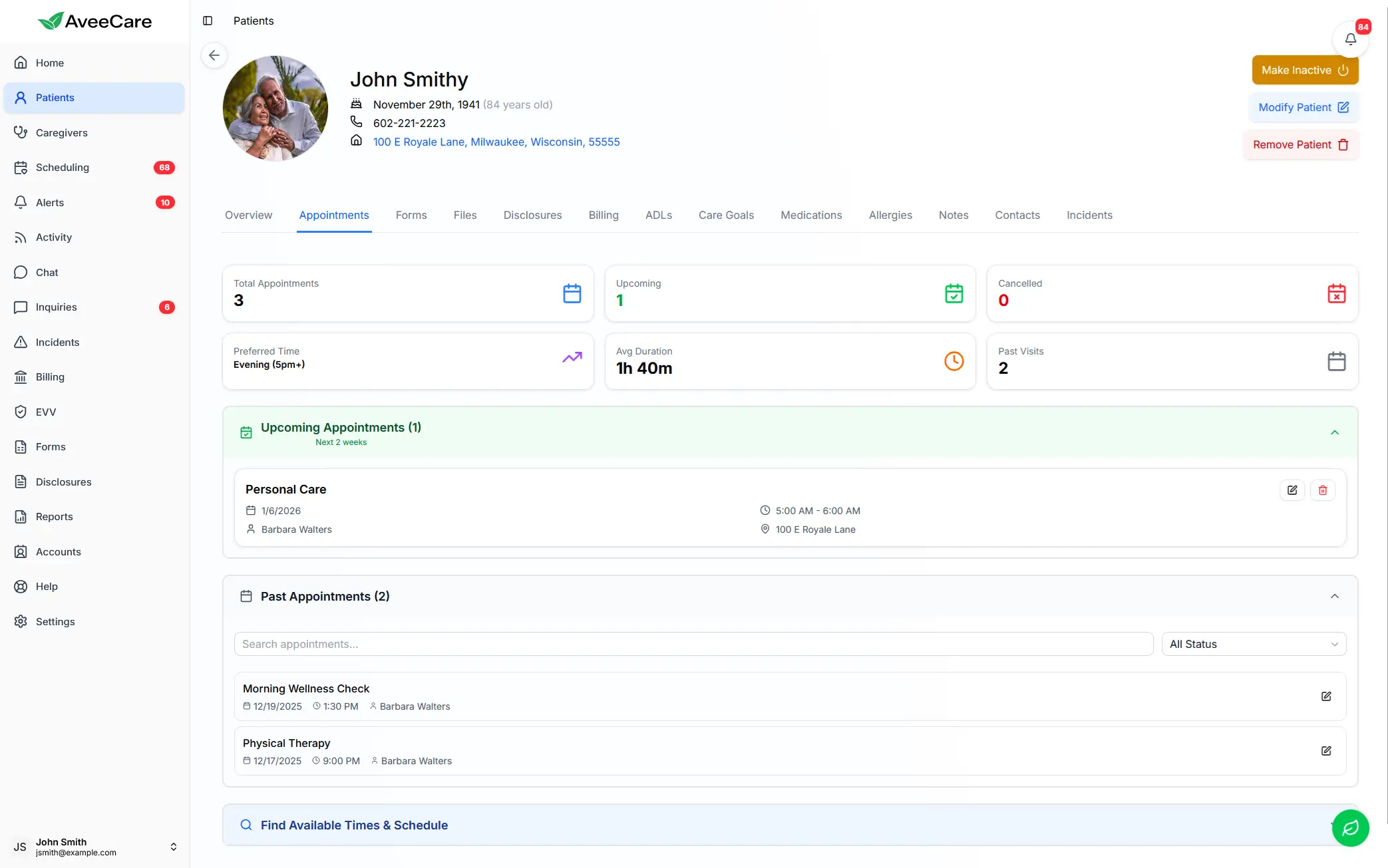
AveeCare helps Kentucky home care agencies manage patient appointments and caregiver schedules
Marketing Channel Comparison for Kentucky
| Channel | Cost | Time to Results | Best For |
|---|---|---|---|
| Google Ads | $$ | Immediate | Quick leads in Louisville & Lexington |
| SEO / Website | $ | 3-6 months | Long-term organic leads statewide |
| Facebook Ads | $-$$ | 1-2 weeks | Rural awareness & caregiver recruiting |
| Church/Community Partnerships | Free | 1-3 months | Trust in Appalachian & rural KY |
| Hospital / Physician Referrals | Free | 1-3 months | High-intent medical referrals |
| Rural Health Clinic Outreach | Free | 1-3 months | Appalachian & rural community clients |
| Opioid Recovery Partnerships | Free | Ongoing | Behavioral health & specialized care |
Kentucky marketing tip: In Kentucky, relationships are everything. In Louisville and Lexington, pair strong digital marketing with hospital discharge planner outreach. In Northern Kentucky, leverage the Cincinnati metro overlap for cross-border visibility. In Appalachian eastern Kentucky, show up in person at community events, partner with local churches and FQHCs, and let word of mouth work for you. Earn trust one family at a time and build a reputation that spreads across Kentucky's tight-knit communities.
12Frequently Asked Questions
Common questions about starting a home care agency in Kentucky
Yes. Kentucky requires a Personal Services Agency (PSA) license from the Cabinet for Health and Family Services (CHFS), Office of Inspector General (OIG) to operate a non-medical home care agency. Unlike some states that do not license non-medical agencies, Kentucky regulates both non-medical personal care agencies and skilled home health agencies. You must submit an application to CHFS/OIG, pass an initial survey, and maintain ongoing compliance with Kentucky Administrative Regulations (902 KAR 20:036).
Starting a non-medical Personal Services Agency in Kentucky typically costs between $20,000 and $55,000, covering PSA license fees, business formation, occupational license taxes, insurance, initial marketing, office setup, and 3 to 6 months of working capital. Kentucky has a below-average cost of living, which keeps startup expenses lower than the national average. A licensed Home Health Agency with skilled services costs significantly more, typically $100,000 to $250,000 or higher due to CHFS/OIG licensing and Medicare certification requirements.
In Kentucky, a Personal Services Agency (PSA) provides non-medical personal care services including bathing, dressing, grooming, meal preparation, light housekeeping, and companion care. A Home Health Agency (HHA) provides skilled medical services including nursing, physical therapy, occupational therapy, and speech therapy. Both require licensure from CHFS/OIG, but the requirements for a Home Health Agency are more extensive, including mandatory clinical supervision by a registered nurse. This is the most important distinction when deciding what kind of agency to start in Kentucky.
Yes. Kentucky requires background checks for caregivers working at licensed Personal Services Agencies and Home Health Agencies. Checks must be conducted through the Kentucky State Police (KSP) and include a state criminal records check, a national criminal background check via FBI fingerprinting, and verification against the Kentucky Nurse Aide Registry and the Cabinet for Health and Family Services abuse/neglect registry. The Kentucky Caregiver Misconduct Registry must also be checked before hiring any direct care worker.
Occupational license taxes are a tax unique to Kentucky that is levied by most cities and counties on wages, salaries, and net profits of businesses operating within their jurisdictions. Louisville Metro charges approximately 2.2% and Lexington-Fayette charges approximately 2.25% on gross wages. These taxes apply to both employer net profits and employee wages, and must be withheld from caregiver paychecks. This is a significant additional cost that is unique to Kentucky and must be factored into your financial planning when starting a home care business.
Starting a Personal Services Agency in Kentucky typically takes 2 to 4 months, including business formation, CHFS/OIG PSA license application, initial survey preparation, insurance procurement, and hiring staff. A Home Health Agency license takes longer, typically 4 to 8 months or more, especially if pursuing Medicare certification. Building a client base and referral network in Kentucky typically takes an additional 3 to 6 months after launch.
Yes, but you must first enroll as a Medicaid provider through the Kentucky Department for Medicaid Services (DMS) under the Cabinet for Health and Family Services. Kentucky expanded Medicaid under the ACA, creating a larger pool of eligible beneficiaries. You must also credential with the Medicaid managed care organizations (MCOs) operating in Kentucky. The state uses HHAeXchange (Netsmart) for Electronic Visit Verification (EVV) compliance. Kentucky offers several HCBS waivers including the HCB waiver, Michelle P waiver, Supports for Community Living (SCL) waiver, and Acquired Brain Injury (ABI) waiver.
13Sources and Resources
Official Kentucky state agency links and resources
Ready to manage your Kentucky home care agency?
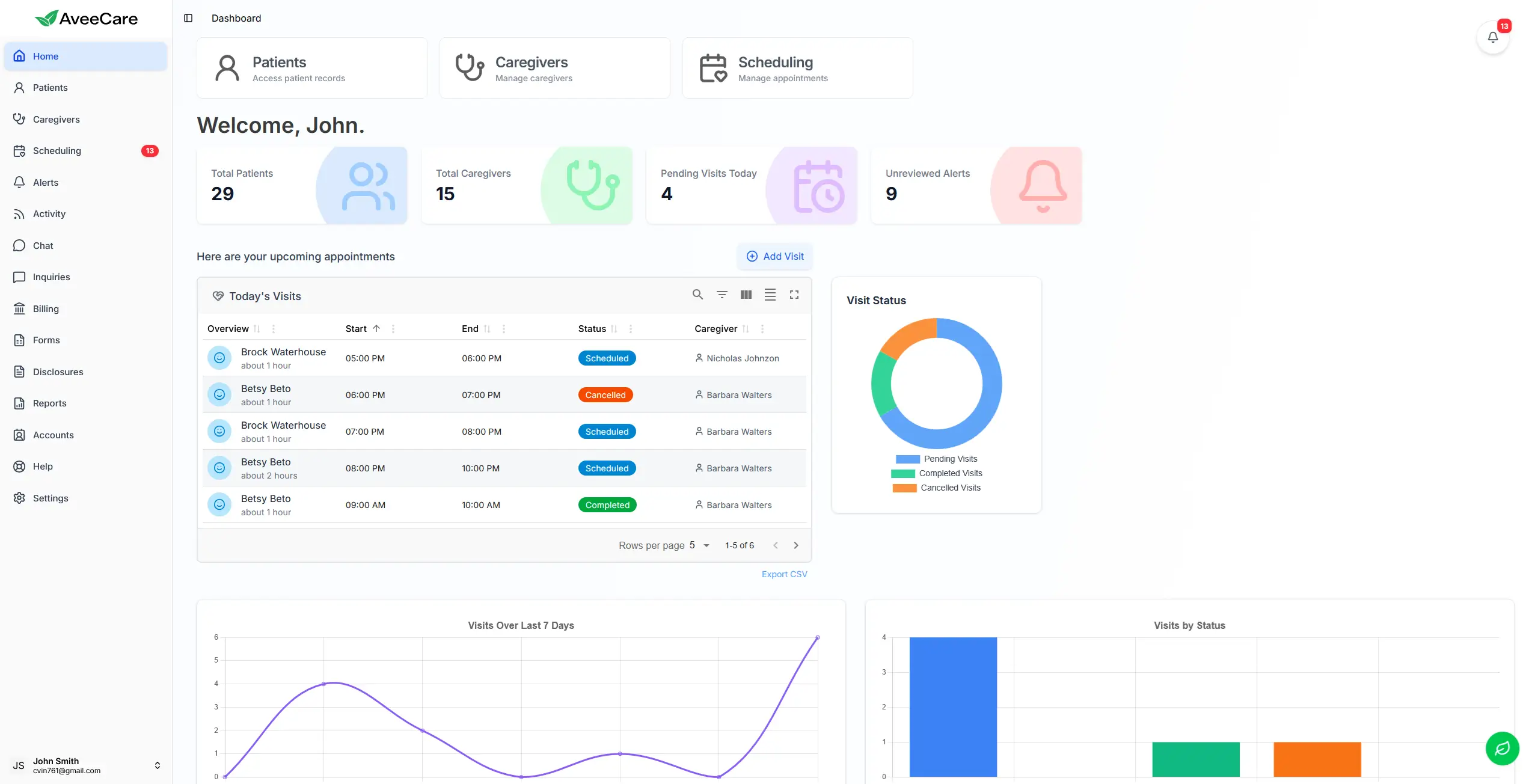
You do not need software on day one. But when you are ready, AveeCare starts at $6/client/month with no contracts, no mandatory demos, and a free trial. Scheduling, care plans, billing, caregiver management, and real-time alerts in one platform built for simplicity, whether you serve Louisville, Lexington, or Appalachian eastern Kentucky.
Disclaimer
This guide is for informational purposes only and does not constitute legal, financial, or professional advice. While we strive to keep this information accurate and up to date, Kentucky laws, regulations, fees, and requirements may change. Always verify current requirements directly with the relevant Kentucky state agencies, including the Cabinet for Health and Family Services (CHFS), Office of Inspector General (OIG), Kentucky Secretary of State, and Kentucky Department of Revenue, before making business decisions. Consult with a qualified attorney and accountant in Kentucky before starting your home care business. AveeCare is not affiliated with the Kentucky Cabinet for Health and Family Services or any Kentucky state agency. Published April 4, 2026.