How to Start a Home Care Agency in Florida
Your complete 2026 guide to launching a home care business in the Sunshine State. From AHCA licensing to navigating Florida's massive retiree market with no state income tax and the nation's largest 65+ population growth.
Published April 4, 2026 · 30 min read
TLDR — Florida at a Glance
Depends on services — AHCA license for home health & nurse registries; companion/homemaker services exempt.
Agency for Health Care Administration (AHCA)
$30,000 – $75,000 (non-medical)
$100,000 – $250,000+ (home health)
4 – 8 weeks (companion) | 2 – 4 months (nurse registry) | 4 – 8 months (home health)
No state income tax! Major advantage for agency owners and employees.
1Florida Market Overview
The #1 retiree destination and one of the fastest-growing home care markets in the US
Florida is the #1 retiree destination in the United States and the third largest state by population with over 22 million residents. Starting a home care agency in Florida means entering one of the most favorable markets in the nation: a massive and rapidly growing senior population, no state income tax for you or your employees, year-round demand (boosted by seasonal snowbird populations), and an enormous network of 55+ communities, retirement villages, and assisted living facilities. The home care business opportunity in Florida is exceptional, and the state's regulatory environment is more accessible than many large states.
Florida's home care demand is driven by the state's status as America's top retirement destination. Over 4.6 million Floridians are aged 65 or older, representing roughly 21% of the population, the highest percentage of any large state. The state gains approximately 1,000 new residents per day, many of them retirees relocating from the Northeast, Midwest, and abroad. Florida's massive network of 55+ communities, from The Villages in Central Florida (the largest retirement community in the world) to countless developments across the Gulf Coast and Atlantic Coast, creates concentrated pockets of demand for home care services. For a national overview of the startup process, see our complete guide to starting a home care agency and our state-by-state licensing requirements.
Regional Market Breakdown
South Florida / Miami-Dade
The most densely populated region with 6M+ residents across Miami-Dade, Broward, and Palm Beach counties. Extremely diverse with large Hispanic/Latino, Caribbean, and Haitian populations. Bilingual (English/Spanish) services are essential. High demand, strong competition, and the most expensive operating costs in the state.
Tampa Bay / Central West FL
Tampa, St. Petersburg, Clearwater, and surrounding counties form Florida's second largest metro. Strong retiree population, growing healthcare infrastructure, and more moderate costs than South Florida. BayCare Health System and AdventHealth are major referral partners.
Orlando / Central FL
One of the fastest-growing metros in the US. The Villages retirement community (in Sumter/Lake counties) is the largest in the world with 130,000+ residents. Strong private pay demand, growing Medicare market, and moderate operating costs.
Jacksonville / North FL
Jacksonville is the largest city by area in the US with a growing senior population. Lower cost of living, less competition, and strong referral relationships with Baptist Health and Mayo Clinic Jacksonville. The best startup cost-to-opportunity ratio in Florida.
Gulf Coast / Southwest FL
Naples, Fort Myers, Sarasota, and the entire Gulf Coast corridor have some of the highest concentrations of retirees in the nation. Affluent communities with strong private pay demand. Seasonal snowbird population creates surges from October through April.
Florida Panhandle
Pensacola, Tallahassee, and Panama City represent an underserved market with the lowest operating costs in Florida. Growing retirement population, less competition, and significant military/veteran presence (Pensacola NAS, Eglin AFB) creating VA referral opportunities.
Why Start a Home Care Agency in Florida
2Home Care vs. Home Health in Florida
Three distinct paths: Companion/Homemaker, Nurse Registry, and Home Health Agency
Florida is unique. Unlike most states, Florida has three distinct business models for home care providers, each with different licensing requirements. Understanding the difference between a Companion/Homemaker service, a Nurse Registry, and a Home Health Agency is the most important decision you will make. Your choice determines your licensing costs, employment model, and service scope.
Companion / Homemaker
- Companionship and socialization
- Light housekeeping and errands
- Meal preparation
- Transportation
No AHCA license required
Exempt if not referring CNAs or licensed professionals.
Nurse Registry
- Refer CNAs, HHAs, and nurses
- Independent contractor model
- Personal care and companionship
- Staffing and referral services
AHCA Nurse Registry license required
Workers are independent contractors, not W-2 employees.
Home Health Agency
- Skilled nursing care
- Physical/occupational therapy
- Personal care (W-2 employees)
- Medication administration
AHCA Home Health Agency license required
Workers are W-2 employees. Medicare certification available.
3Business Formation in Florida
Register your home care business with the Sunshine State

Florida has no state income tax! This is one of the biggest advantages of starting a home care agency in Florida. You keep more of your business profits, your employees take home more of their wages, and payroll administration is simpler without state income tax withholding. Florida is one of only nine states with no state income tax, making it a top destination for business owners and retirees alike.
Choose Your Business Structure
Most Florida home care agencies register as an LLC (Limited Liability Company) for liability protection and tax flexibility. A Florida LLC costs $125 to file Articles of Organization with the Division of Corporations (Sunbiz). Corporations are also an option. Florida has no state income tax, but does have a 5.5% corporate income tax on C-corporations (LLCs are pass-through entities and avoid this).
Register with Sunbiz (Division of Corporations)
File your Articles of Organization (LLC) or Articles of Incorporation with the Florida Division of Corporations at sunbiz.org. You must also designate a registered agent with a Florida street address. Annual reports ($139 for LLCs) are due by May 1 each year.
Florida SunbizObtain Your EIN
Apply for a free Employer Identification Number (EIN) from the IRS at irs.gov. You need this for bank accounts, payroll, and tax filings. It takes minutes to obtain online.
Florida Sales Tax Registration
While most home care services are not subject to Florida's 6% sales tax, you may need to register with the Florida Department of Revenue if you sell taxable goods or services. Register at floridarevenue.com. You must also register for reemployment tax (Florida's unemployment insurance).
FL Department of RevenueLocal Business Tax Receipt
Florida counties and cities require a local business tax receipt (formerly called an occupational license). Requirements and fees vary by location. Miami-Dade, Broward, Hillsborough, Orange, and other counties each have their own application process. Contact your county tax collector's office.
Open a Business Bank Account
Open a dedicated business checking account to separate personal and business finances. You will need your EIN, Articles of Organization, and local business tax receipt. Many Florida banks and credit unions offer small business accounts with no monthly fees.
4Licensing Requirements
AHCA licenses home health agencies and nurse registries; companion services are exempt
Home Health Agency License — AHCA
The Agency for Health Care Administration (AHCA) licenses all Home Health Agencies in Florida. An AHCA Home Health Agency license is required if you plan to provide skilled nursing, physical therapy, occupational therapy, speech therapy, or other medical services. Home health agencies employ their workers as W-2 employees and can also provide non-medical personal care services. This license also allows you to pursue Medicare certification for federal reimbursement. Requirements include:
- Submit Home Health Agency license application to AHCA
- Designate a qualified administrator and director of nursing
- All owners, operators, and staff must pass Level 2 background screening
- Maintain comprehensive policies, quality assurance, and documentation
- Pass AHCA on-site survey/inspection
- Renew license biennially and maintain compliance
Nurse Registry License — AHCA
A Nurse Registry in Florida operates as a referral and staffing service that connects independent contractor nurses, CNAs, and home health aides with clients. Unlike a Home Health Agency, a Nurse Registry does not employ its workers directly; they are independent contractors (1099). This model has lower overhead and regulatory burden, but the independent contractor classification must be properly maintained to avoid IRS and state labor law issues. Requirements include:
- Submit Nurse Registry license application to AHCA
- All owners and operators must pass Level 2 background screening
- All referred caregivers must pass Level 2 background screening
- Verify credentials, licenses, and certifications for all referrals
- Maintain proper independent contractor agreements and documentation
Companion & Homemaker Services — Exempt
Florida does NOT require a state license for purely non-medical companion and homemaker services, as long as you are not referring or employing CNAs, home health aides, or licensed nursing professionals. This means you can start a companion/homemaker service with lower startup costs and faster time-to-market. However, if you hire or refer CNAs, you will need a Nurse Registry license. Services covered under this exemption typically include:
- Companionship, conversation, and socialization
- Light housekeeping and laundry
- Meal preparation and grocery shopping
- Transportation and errands
- Medication reminders (not administration)
Important: Even though companion/homemaker services are exempt from AHCA licensing, you still need a business registration with Sunbiz, local business tax receipts, general liability insurance, and should conduct your own background checks on all employees for due diligence and client trust.
Level 2 Background Screening
Florida requires Level 2 background screening for all home health agency employees and nurse registry referrals. This is administered through AHCA and the Florida Department of Law Enforcement (FDLE). Level 2 screening includes:
- Statewide criminal records check through FDLE
- National criminal history check through FBI using fingerprints
- Employees cannot begin providing care until screening clears
- Applies to all direct care workers, administrators, and anyone with patient access
- Screening results are valid for 5 years (rescreening required)
Medicare Certification
Medicare certification is a separate process from state licensure. To bill Medicare, your Home Health Agency must first hold an AHCA license, then apply through the Centers for Medicare & Medicaid Services (CMS), pass a federal survey, and meet all Medicare Conditions of Participation. In Florida, AHCA serves as the state survey agency for CMS. Given Florida's enormous Medicare beneficiary population (4.6M+ seniors), Medicare certification is highly valuable and opens a major revenue stream.
5Insurance Requirements
Workers' comp required for 4+ employees; hurricane considerations apply
General Liability
$2,000 - $5,000/yrCovers bodily injury and property damage claims. Recommended minimum: $1M per occurrence / $2M aggregate. Florida premiums are moderate, though coastal areas may see slightly higher rates.
Professional Liability (E&O)
$1,500 - $4,000/yrCovers errors, omissions, and negligence claims related to care services. Essential for any home care agency in Florida. Protects your business against malpractice and duty-of-care claims.
Workers' Compensation
$3,000 - $10,000/yrFlorida requires workers' compensation for employers with 4 or more employees (1 or more for construction). This covers medical expenses and lost wages for employees injured on the job. Most home care agencies reach the 4-employee threshold quickly.
Hurricane / Windstorm Coverage
$500 - $2,000/yrFlorida is uniquely vulnerable to hurricanes. If you lease office space, verify your landlord's windstorm coverage and consider additional protection. Develop a hurricane preparedness plan for staff and clients as part of your business continuity strategy.
Workers' comp threshold: Florida requires workers' compensation insurance for employers with 4 or more employees (1 or more for construction). Since most home care agencies hire 4+ caregivers almost immediately, plan to obtain workers' comp coverage before hiring your first batch of employees. The Florida Division of Workers' Compensation under the Department of Financial Services enforces compliance.
6Staffing and Hiring in Florida
Level 2 screening, bilingual hiring, and competitive wages with no state income tax
Recruiting and retaining caregivers in Florida requires understanding the state's unique workforce landscape. Florida's $14.00/hour minimum wage (2026, increasing $1 per year under Amendment 2 until it reaches $15.00 in 2026) is competitive but manageable. The absence of state income tax means your employees take home more of their paycheck compared to caregivers in high-tax states, which is a powerful recruitment advantage. In South Florida especially, bilingual (English/Spanish) hiring is not optional but essential, as a significant portion of clients and their families are Spanish-speaking.
Level 2 Background Screening
Florida requires FDLE Level 2 background screening for all home health and nurse registry workers. This includes fingerprint-based checks through both FDLE (state) and FBI (national). Workers cannot begin providing care until their screening clears. Budget 1 to 3 weeks for processing through AHCA's background screening clearinghouse.
Training & CNA Programs
Florida has extensive CNA training programs through community colleges, vocational schools, and the Florida Board of Nursing. Home health aides must complete 75 hours of training including supervised clinical hours under federal requirements. Many community colleges across Florida (Miami Dade College, Valencia College, Hillsborough Community College) offer affordable CNA certification programs that serve as a direct pipeline for your caregiver recruitment.
Where to Find Caregivers in Florida
Miami Dade, Valencia, HCC, Palm Beach State, and more
Essential for South FL; Spanish-language job postings
Florida Association for Home Health Agencies
Wages and Labor Laws in Florida
Florida's minimum wage is $14.00/hour (2026), increasing by $1 per year under Amendment 2 approved by voters in 2020. To attract quality caregivers, most agencies pay between $15 and $20 per hour for personal care aides and $18 to $28 per hour for CNAs and home health aides, with South Florida rates at the higher end. Florida follows federal overtime rules (1.5x after 40 hours per week) and does not have daily overtime requirements.
No state income tax advantage: Because Florida has no state income tax, your employees keep more of every dollar earned. A caregiver earning $17/hour in Florida takes home more than a caregiver earning $17/hour in New York, California, or Illinois. This is a powerful recruitment and retention advantage that you should highlight in your job postings and hiring materials.
7Medicaid and Medicare in Florida
AHCA Medicaid, SMMC, HHAeXchange EVV, and HCBS waivers
Florida Medicaid
Florida Medicaid is administered by the Agency for Health Care Administration (AHCA), the same agency that licenses home health agencies and nurse registries. Florida operates the Statewide Medicaid Managed Care (SMMC) program, which includes the SMMC Long-Term Care (LTC) program for home and community-based services. Most Florida Medicaid beneficiaries receiving home care services are enrolled in managed care plans that contract with home health agencies and nurse registries. To serve Medicaid clients, you must enroll as a Florida Medicaid provider through AHCA and contract with the managed care plans operating in your region.
AHCA Florida MedicaidHHAeXchange — Electronic Visit Verification
Florida uses HHAeXchange as its state-designated Electronic Visit Verification (EVV) system. HHAeXchange replaced Netsmart/Tellus on October 1, 2024 for fee-for-service (FFS) providers. Florida operates an open model, meaning providers can use alternative EVV vendors as long as they integrate with HHAeXchange as the state aggregator. Under the 21st Century Cures Act, EVV is required for all Medicaid-funded personal care and home health services.
SMMC Long-Term Care & HCBS Waivers
- Statewide Medicaid Managed Care (SMMC) LTC program
- Home and Community-Based Services (HCBS) waivers
- Aged/Disabled Adult Waiver
- Contract with SMMC managed care plans (Humana, UnitedHealthcare, Sunshine Health, Molina)
Medicare Certification
Florida has one of the largest Medicare beneficiary populations in the nation with over 4.6 million seniors. To bill Medicare, your home health agency must hold an AHCA license and then obtain CMS certification. AHCA serves as the state survey agency for CMS. Expect 3 to 6 months for the certification process after obtaining your state license.
8Startup Cost Estimator
Florida-specific startup cost breakdown (no state income tax keeps costs lower)
Florida cost advantage: With no state income tax, no mandatory franchise tax for LLCs, and moderate insurance premiums, Florida offers a more affordable startup environment than many large states. South Florida (Miami-Dade, Broward) has the highest costs in the state, while North Florida and the Panhandle offer the lowest. The Gulf Coast and Central Florida fall in between.
Business Formation
$1,289 – $4,464Filing Articles of Organization with Division of Corporations
Required annually by May 1 for Florida LLCs
Varies by county; Miami-Dade, Broward, Hillsborough each differ
Attorney review, CPA setup (moderate FL rates)
Licensing
$11,050 – $27,650Initial license fee plus application costs
If operating as referral/staffing model
Per person; AHCA/FDLE fingerprinting (LiveScan)
Survey prep, policies, consulting (if applicable)
Insurance (Annual)
$7,000 – $21,000$1M per occurrence / $2M aggregate
Errors and omissions coverage
Required for 4+ employees in FL (not construction)
Office property protection; varies by coastal proximity
Office & Equipment
$4,300 – $14,000Moderate FL rents; South FL higher, Panhandle lower
Laptops, smartphones, scheduling software
Desk, chairs, printer, supplies
Marketing & Initial Growth
$3,700 – $12,800Professional site with local SEO for FL market
Google Ads, social media, retirement community outreach
Brochures, flyers, bilingual materials
Working Capital (3-6 Months)
$14,000 – $42,000FL wages ($14-$20/hr avg), no state income tax simplifies payroll
Rent, utilities, software, fuel, insurance
Estimated Total Startup Cost (All Categories)
$41,339 – $121,914
Costs are estimates based on typical Florida home care agency startups and vary significantly by region. South Florida (Miami-Dade, Broward, Palm Beach) is at the high end; North Florida and the Panhandle are more affordable. No state income tax and no franchise tax for LLCs keep overall costs competitive compared to states like California and New York.
9Compliance Checklist
Track your progress across all Florida requirements
Business Formation
0/7Licensing
0/7Insurance
0/5Staffing
0/7Medicaid & Medicare
0/3Operations
0/5Marketing
0/510Building Your Referral Network
Key referral sources in Florida for your home care agency
Florida's massive healthcare infrastructure and concentration of senior living communities create abundant referral opportunities. Building relationships with major health systems, Area Agencies on Aging, the Department of Elder Affairs (DOEA), managed care plans, and retirement communities is essential for growing your client base in the Sunshine State's home care market.
Major Florida Health Systems
HCA Healthcare (the largest health system in the US, headquartered in Nashville but with massive Florida operations), AdventHealth, Baptist Health, BayCare Health System, and Memorial Healthcare System have extensive discharge planning departments. Connect with their case managers for patient referrals.
Area Agencies on Aging (AAAs)
Florida has 11 Area Agencies on Aging under the Florida Department of Elder Affairs (DOEA) that serve as local hubs for senior services. AAAs connect seniors with home care resources, manage waitlists, and can refer clients to your agency. The DOEA Elder Helpline (1-800-963-5337) is a major referral source.
FAHHA (Industry Association)
The Florida Association for Home Health Agencies (FAHHA) is the leading trade association for home health providers in Florida. Membership provides networking, advocacy, education, and industry connections. FAHHA conferences and regional events are prime opportunities to build your referral network.
SMMC Managed Care Plans
Most Florida Medicaid long-term care beneficiaries are enrolled in SMMC managed care plans like Humana, UnitedHealthcare Community Plan, Sunshine Health, and Molina Healthcare. Contracting with these plans gives you access to their member referral pipelines for home care services.
DOEA (Department of Elder Affairs)
The Florida Department of Elder Affairs oversees senior services statewide. DOEA administers programs like the Community Care for the Elderly (CCE) and Home Care for the Elderly (HCE) programs. Building a relationship with DOEA and its local Aging and Disability Resource Centers (ADRCs) opens valuable referral channels.
Physicians and Geriatric Practices
Florida has one of the largest concentrations of geriatricians and primary care physicians treating elderly patients in the nation. Build referral relationships with physician offices near retirement communities, 55+ developments, and assisted living facilities for a steady stream of private pay and Medicare referrals.
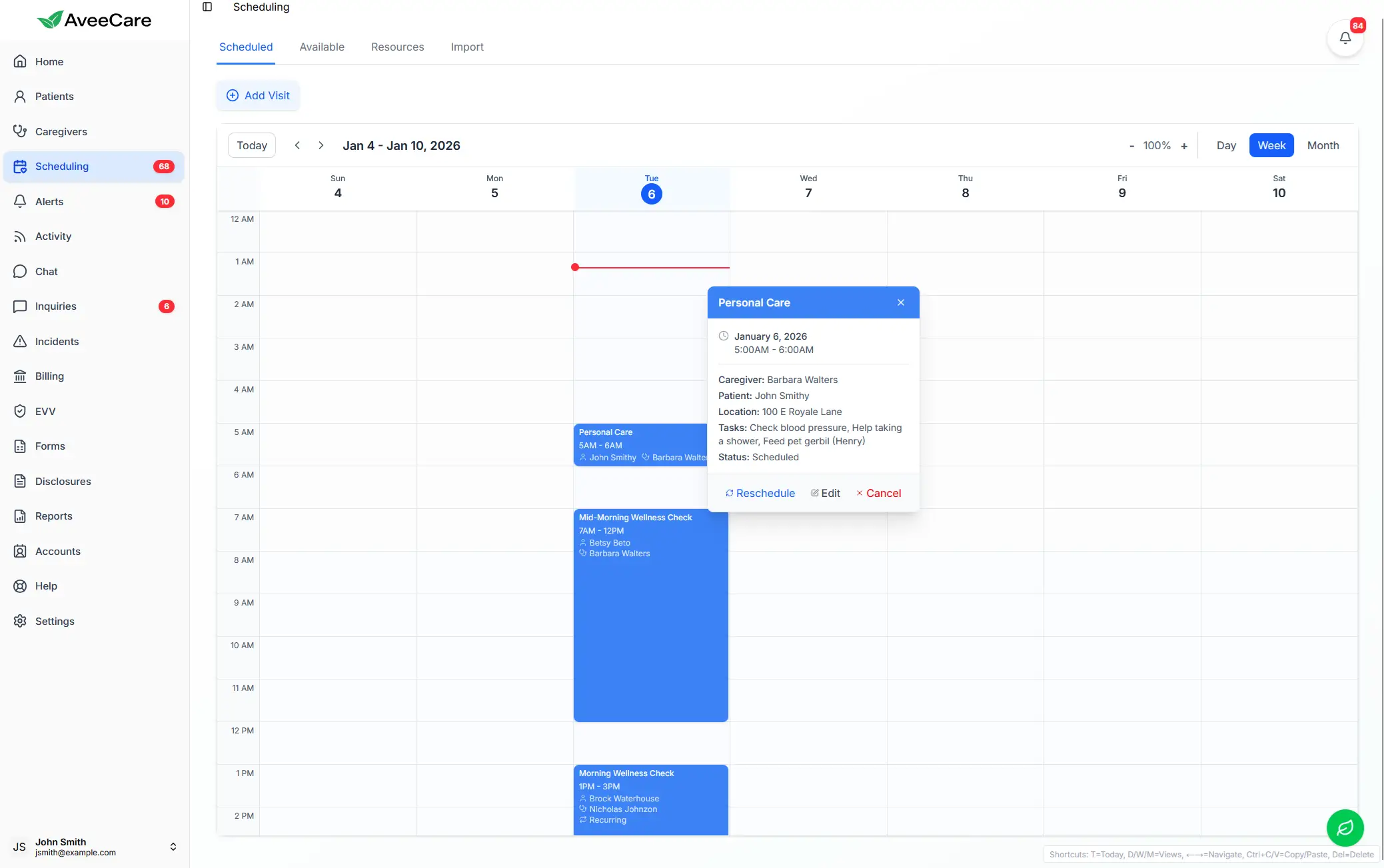
Efficient scheduling is critical for managing Florida's seasonal demand and multi-location agencies
Differentiation tip: In Florida's competitive market, bilingual services (English/Spanish), hurricane preparedness planning for clients, technology-driven scheduling with real-time tracking, and strong relationships with retirement communities and 55+ developments are your biggest differentiators. Agencies that can handle seasonal snowbird surges while maintaining year-round staff will dominate their markets.
11Marketing & Client Acquisition
How to market your home care business and attract clients in the Sunshine State
Marketing a home care agency in Florida requires understanding the state's unique demographics: millions of retirees concentrated in 55+ communities, seasonal snowbird populations that swell from October through April, a deeply bilingual market (especially South Florida), and an extensive network of assisted living facilities and retirement villages. Whether you are building a companion care agency, a nurse registry, or a skilled home health business, combining digital marketing with community outreach and healthcare referral relationships is essential for growth in the Florida home care market.
Retirement Community & 55+ Marketing
Florida has the largest concentration of 55+ communities and retirement villages in the United States. These communities are goldmines for home care client acquisition because residents are already aged into your target demographic and often have the financial resources for private pay services. Key strategies for reaching this audience:
The Villages & Large 55+ Communities
The Villages in Central Florida is the world's largest retirement community with 130,000+ residents. But Florida has hundreds of other 55+ communities across the state. Post on community bulletin boards, sponsor community events, and build relationships with HOA boards and community center directors.
Retirement Community Newsletters
Many 55+ communities publish monthly newsletters and directories. Advertise your home care services in these publications. They reach a highly targeted audience of potential clients and their family members. The cost per impression is extremely low compared to digital advertising.
Assisted Living Facility Partnerships
Florida has over 3,000 assisted living facilities (ALFs). Many ALF residents need supplemental private duty care beyond what the facility provides. Build relationships with ALF administrators and activity directors. Offer to provide supplemental companion and personal care services.
Senior Expos & Health Fairs
Florida hosts dozens of senior expos and health fairs annually, from large events like the South Florida Senior Expo to local health fairs at community centers and churches. Set up a booth, offer free blood pressure screenings (if licensed), and collect leads. These events attract hundreds of seniors and their family caregivers.
Snowbird & Seasonal Marketing
Florida's snowbird population adds millions of seasonal residents from October through April. These part-time residents often need home care services during their Florida stay but may not have established relationships with local providers. This creates a unique seasonal marketing opportunity:
Pre-Season Outreach (August-September)
Begin marketing to snowbird communities before the season starts. Send direct mail to known seasonal addresses, advertise in snowbird-oriented publications, and post on community Facebook groups for seasonal residents. Many families arrange home care before their parents arrive in Florida.
Seasonal Care Packages
Offer flexible seasonal care packages (3-month, 6-month) designed specifically for snowbirds. Highlight services like home setup before arrival, regular check-ins during their stay, and home closure after departure. This flexibility attracts clients who do not need year-round service.
Northern State Partnerships
Build referral relationships with home care agencies in states that send the most snowbirds to Florida (New York, New Jersey, Michigan, Ohio, Pennsylvania). Offer reciprocal referral agreements: they refer their clients to you for winter months, you refer clients to them for summer months.
Bilingual Marketing (English/Spanish)
Bilingual marketing is essential in South Florida and increasingly important across Central Florida and the I-4 corridor. Miami-Dade County is approximately 70% Hispanic/Latino, and Broward, Palm Beach, Orange, and Osceola counties all have significant Spanish-speaking populations. Agencies that market in both English and Spanish capture a much larger share of the home care market in Florida.
Spanish-Language Website & Materials
Create a fully bilingual website with Spanish-language landing pages, not just Google Translate output. Produce bilingual brochures, business cards, and social media content. Have Spanish-speaking staff answer phones and respond to inquiries.
Hispanic Media & Community
Advertise on Spanish-language radio (Radio Caracol, Univision Radio), in Spanish-language newspapers (El Nuevo Herald in Miami, La Prensa in Orlando), and on Univision/Telemundo local programming. Sponsor events at Hispanic community centers, churches, and cultural organizations.
Digital Marketing Strategies
Google Business Profile
Optimize your Google Business Profile for every city and region you serve. Florida's large metros (Miami, Tampa, Orlando, Jacksonville) are highly competitive. Create separate listings for each office location. Aim for 50+ reviews with a 4.7+ rating to stand out in local search results.
Google Ads (English & Spanish)
Run Google Ads campaigns targeting "home care" keywords in English and Spanish. Target specific Florida metros and zip codes. CPCs in Florida range from $10-30 depending on the market. South Florida is the most competitive; North Florida and the Panhandle offer lower ad costs.
SEO & Content Marketing
Build city-specific landing pages for major Florida markets. Create content about Florida-specific topics: hurricane preparedness for seniors, snowbird care transitions, navigating Florida Medicaid, and choosing between assisted living and home care in Florida.
Social Media & Facebook Ads
Use Facebook and Instagram to reach adult children making care decisions for aging parents. Target Florida zip codes near retirement communities and 55+ developments. Share testimonials, caregiver spotlights, and educational content about aging in place in Florida.
Healthcare Referral Relationships
Florida's massive healthcare ecosystem offers abundant referral opportunities for home care agencies. Building relationships with these organizations:
Hospital Discharge Planners
HCA Healthcare, AdventHealth, Baptist Health, BayCare, and Memorial Healthcare System operate hundreds of facilities across Florida. Prioritize discharge planning relationships at hospitals nearest your service area.
Physician Offices & Geriatricians
Build relationships with primary care physicians and geriatricians near retirement communities. Drop off brochures, schedule lunch-and-learns, and offer to be their go-to home care referral when patients need in-home support.
DOEA Elder Helpline Referrals
The Florida Department of Elder Affairs operates the Elder Helpline (1-800-963-5337). Ensure your agency is listed in local DOEA resource directories. Helpline counselors refer thousands of families to home care agencies annually.
Caring.com & AgingCare Listings
Maintain premium profiles on Caring.com, AgingCare.com, and A Place for Mom. These directories receive significant traffic from Florida families researching home care options. Respond to leads within 15 minutes for the highest conversion rates.
Marketing Channel Comparison
| Channel | Cost | Time to Results | Best For |
|---|---|---|---|
| Google Ads (Bilingual) | $$-$$$ | Immediate | Fast leads in competitive FL metros |
| 55+ Community Outreach | $ | 1-3 months | Direct access to retiree clients |
| SEO / Website | $-$$ | 4-8 months | Long-term organic visibility |
| Hospital Referrals | Free | 2-4 months | High-intent medical referrals |
| Senior Expos & Health Fairs | $-$$ | Immediate | Face-to-face lead generation |
| Snowbird Pre-Season Marketing | $$ | 2-3 months | Seasonal client acquisition |
| Caring.com / AgingCare Premium | $$-$$$ | 1-2 months | Families comparing agencies online |
Florida Advertising Considerations
Florida's consumer protection laws under the Florida Deceptive and Unfair Trade Practices Act (FDUTPA) apply to home care advertising. Ensure all marketing materials accurately represent your services and licensing status. Do not advertise services you are not licensed to provide. If you operate a companion/homemaker service, do not imply you offer skilled nursing unless you hold an AHCA Home Health Agency license. If you operate a nurse registry, clearly communicate the independent contractor model to clients.
Florida marketing tip: The combination of retirement community outreach, snowbird seasonal marketing, bilingual advertising, and healthcare referral relationships creates a multi-channel approach uniquely suited to Florida. Start with your local 55+ communities and hospital discharge planners, then layer in digital marketing and online directories as your budget grows. Florida's year-round warm weather means you can attend outdoor senior events and health fairs virtually every month.
12Frequently Asked Questions
Common questions about starting a home care agency in Florida
It depends on your services. Florida requires an AHCA Home Health Agency license for skilled nursing/therapy services, and an AHCA Nurse Registry license if you operate as a staffing/referral service for CNAs, home health aides, or nurses. However, Florida does NOT require a state license for purely non-medical companion and homemaker services that do not involve referring or employing CNAs or licensed professionals. All home health employees must pass Level 2 background screening through AHCA and the Florida Department of Law Enforcement (FDLE).
Starting a non-medical home care agency in Florida typically costs between $30,000 and $75,000, which is below the national average thanks to Florida having no state income tax and moderate insurance costs. This covers Sunbiz registration, AHCA licensing (if applicable), insurance, marketing, office setup, and 3 to 6 months of working capital. A licensed home health agency with skilled nursing services costs $100,000 to $250,000 or more.
A Home Health Agency in Florida employs its caregivers as W-2 employees and provides skilled and non-skilled services directly. A Nurse Registry acts as a referral service connecting independent contractor nurses, CNAs, and home health aides with clients. Both require AHCA licensure. The key difference is the employment model: agencies employ workers directly while registries refer independent contractors. Companion/homemaker providers that do not refer CNAs or licensed professionals may operate without a state license.
Florida requires Level 2 background screening for all home health agency employees and nurse registry referrals. Level 2 screening includes statewide criminal records through FDLE plus national criminal history through the FBI using fingerprints, administered through AHCA and the Florida Department of Law Enforcement. Employees cannot begin providing care until their screening clears. This applies to all direct care workers, administrators, and anyone with patient access.
Florida uses HHAeXchange as its state-designated Electronic Visit Verification system. HHAeXchange replaced Netsmart/Tellus on October 1, 2024 for fee-for-service providers. Florida operates an open model, meaning providers can use alternative EVV vendors as long as they integrate with HHAeXchange as the state aggregator. EVV is required under the 21st Century Cures Act for all Medicaid-funded personal care and home health services.
A non-medical companion/homemaker agency (no AHCA license required) can launch in 4 to 8 weeks. A nurse registry takes 2 to 4 months for AHCA licensure and Level 2 background screening. A fully licensed home health agency takes 4 to 8 months or longer due to the AHCA application, background screenings, and potential Medicare certification. Florida has no state income tax, which simplifies the tax setup compared to most states.
13Sources and Resources
Official Florida state agency links and resources
Ready to manage your Florida home care agency?
You do not need software on day one. But when you are ready, AveeCare starts at $6/client/month with no contracts, no mandatory demos, and a free trial. Scheduling, care plans, billing, caregiver management, real-time tracking, and alerts in one platform built for simplicity. Manage your Florida home care agency from anywhere in the Sunshine State.
Disclaimer
This guide is for informational purposes only and does not constitute legal, financial, or professional advice. While we strive to keep this information accurate and up to date, Florida laws, regulations, fees, and requirements may change. Always verify current requirements directly with the relevant Florida state agencies before making business decisions. Consult with a qualified attorney and accountant in Florida before starting your home care business. AveeCare is not affiliated with the Agency for Health Care Administration, the Florida Department of Law Enforcement, the Florida Division of Corporations, or any Florida state agency. Published April 4, 2026.