Home Care Tax Deductions: What Agencies & Families Can Deduct
Understanding home care tax deductions can save your agency thousands of dollars annually. Whether you are asking "is home care tax deductible" for a family member or looking for home care business deductions, this guide covers everything with interactive eligibility tools.

Understanding Home Care Tax Deductions
Home care tax deductions fall into two main categories: business deductions for agencies and operators, and medical/dependent care deductions for families paying for care. The rules differ significantly depending on your role, the type of care, and how the caregiver is classified. Understanding which tax deductions for caregivers and agencies apply to your situation can result in significant tax savings.
For home care agencies, virtually all ordinary and necessary home care business deductions are available under IRS Section 162. For families, the key question is whether the care qualifies as a medical expense (deductible if it exceeds 7.5% of AGI) or enables you to work (eligible for the Dependent Care Credit). For a broader look at organizing your agency finances, our accounting and bookkeeping guide covers the chart of accounts structure that makes tax time easier.
Tax Year 2026 Note
The IRS standard mileage rate for business use is 67 cents per mile for 2026. The Section 179 expensing limit is $1,220,000. The medical expense AGI threshold remains at 7.5%. Always verify current rates with the IRS or your tax professional.
Tax Deduction Eligibility Checker
Answer a few questions to see which home care tax deductions apply to your specific situation.
What is your role?
What type of care is being provided?
Was the care prescribed by a licensed healthcare practitioner?
Is the care provided so you (or your spouse) can work?
Business Deductions for Home Care Agencies
Home care agencies can deduct all ordinary and necessary home care business deductions under IRS Section 162. Here is a comprehensive breakdown by category. Understanding how these deductions affect your net margin is key -- our profit margins guide shows how expense management translates to bottom-line profitability.
Payroll & Labor
All wages paid to W-2 employee caregivers
Social Security (6.2%), Medicare (1.45%), FUTA, SUTA
Required insurance premiums for caregiver coverage
Health insurance, PTO, retirement contributions
Insurance
Business liability coverage premiums
Errors & omissions coverage
Required by most states for home care licensure
HIPAA breach and data protection coverage
Technology & Software
Monthly/annual SaaS subscriptions (scheduling, billing, etc.)
QuickBooks, Xero, or similar platforms
Phone systems, HIPAA-compliant messaging, video conferencing
Computers, tablets, printers (Section 179 eligible)
Office & Operations
Lease payments for agency headquarters
Electric, internet, phone, water
Paper, ink, postage, and general supplies
If operating from home (simplified: $5/sq ft up to 300 sq ft)
Vehicle & Travel
67 cents per mile for business use (2026 IRS rate)
Tax-free reimbursement to caregivers at IRS rate
Gas, maintenance, insurance for company vehicles
Conferences, training events, industry meetings
Marketing & Growth
Google Ads, Facebook Ads, social media marketing
Hosting, domain, design, and development
Brochures, business cards, direct mail
Payments to referral sources (must be documented)
Training & Compliance
Required and continuing education courses
Home care license, renewals, accreditation
Owner/admin education, certifications, conferences
Employee screening and compliance checks
Tax Deductions & Credits for Families
Families often ask "is home care tax deductible?" The answer depends on the type of care and the reason it is provided. Here are the main options:
Medical Expense Deduction
Deduct qualifying medical care expenses exceeding 7.5% of AGI on Schedule A (itemized deductions).
- Care must be medically necessary
- Prescribed by a licensed healthcare practitioner
- Includes personal care (bathing, dressing, etc.)
- Companion-only services do NOT qualify
Reference: IRS Publication 502
Dependent Care Credit
Tax credit (not deduction) for care expenses that enable you to work. Credits directly reduce your tax bill.
- 20-35% of up to $3,000 per dependent
- Must be to enable you (and spouse) to work
- Dependent must be unable to care for themselves
- Filed on Form 2441
Reference: IRS Publication 503
Agency Deduction Estimator
Estimate your total home care business deductions and potential tax savings. Adjust the values to match your agency.
Estimated Results
Total Estimated Deductions
$372,050
Potential Tax Savings (21% bracket)
$78,131
Potential Tax Savings (24% bracket)
$89,292
Mileage calculated at $0.67/mile (2026 IRS rate)
1099 vs. W-2: Tax Implications for Home Care
Worker classification has significant tax implications for both agencies and caregivers. Misclassification is one of the most common and costly mistakes in home care tax deductions.
W-2 Employees
Most caregivers working under agency direction should be W-2 employees.
- Agency pays employer portion of FICA (7.65%)
- Agency must withhold income tax and employee FICA
- Workers comp and SUTA/FUTA apply
- Employee cannot deduct work expenses (post-TCJA)
- Agency deducts all wages and employer taxes
1099 Independent Contractors
Only appropriate when the worker controls how and when work is done.
- No employer FICA, FUTA, SUTA, or workers comp
- Contractor pays full self-employment tax (15.3%)
- Contractor deducts expenses on Schedule C
- Agency issues 1099-NEC for payments over $600
- Misclassification penalties: back taxes + 100% penalty
State-Specific Tax Credits for Home Care
Several states offer additional tax deductions for caregivers and home care agencies beyond federal deductions:
California
Offers a state-level dependent care credit and allows deductions for caregiver training and certification costs.
New York
Provides a credit for long-term care insurance premiums (20% of premiums) and enhanced dependent care credits.
Oregon
Offers a working family household and dependent care credit for low to moderate income families paying for home care.
Minnesota
Provides a tax credit for elderly and disabled individuals receiving home care, plus a property tax refund for seniors.
Maryland
Offers a dependent care tax credit and an income tax subtraction for caregivers of qualifying relatives.
New Jersey
Provides a deduction for home health aide expenses for qualifying elderly or disabled household members.
State tax credits and deductions change annually. Check with your state revenue department or a CPA licensed in your state for current availability and eligibility requirements.
Tax-Time Document Checklist
Gather these documents before meeting with your tax professional to maximize your home care tax deductions.
Income Records
Payroll Records
Expense Records
Asset Records
Compliance Records
Common Tax Mistakes Home Care Agencies Make
Misclassifying employees as independent contractors
The IRS uses a behavioral, financial, and relationship test. Most caregivers working set schedules under agency direction are W-2 employees. Misclassification triggers penalties plus back taxes.
Not tracking mileage properly
The IRS requires contemporaneous logs with date, destination, business purpose, and miles. Estimates or reconstructed logs are frequently rejected during audits. Use a mileage tracking app.
Missing quarterly estimated tax payments
If you expect to owe $1,000+ in taxes, quarterly payments are required (April 15, June 15, Sept 15, Jan 15). Penalties for underpayment accrue automatically.
Not separating personal and business expenses
Commingling funds creates audit risk and makes deductions harder to prove. Use a dedicated business bank account and credit card for all agency expenses.
Forgetting to depreciate assets
Equipment, vehicles, and software purchased (not subscribed) should be depreciated or expensed under Section 179. Failure to depreciate means missing deductions you are entitled to.
Year-End Tax Planning Tips
Accelerate deductions
Prepay January rent, buy needed supplies, pay outstanding invoices before December 31 to increase current-year deductions.
Defer income (if beneficial)
Hold December invoices for January billing if it moves income to a lower-bracket year. Consult your CPA first.
Maximize retirement contributions
SEP-IRA contributions (up to 25% of net earnings) can be made until the tax filing deadline and reduce taxable income.
Review estimated payments
Calculate your Q4 estimate carefully. Overpayment ties up cash; underpayment triggers penalties.
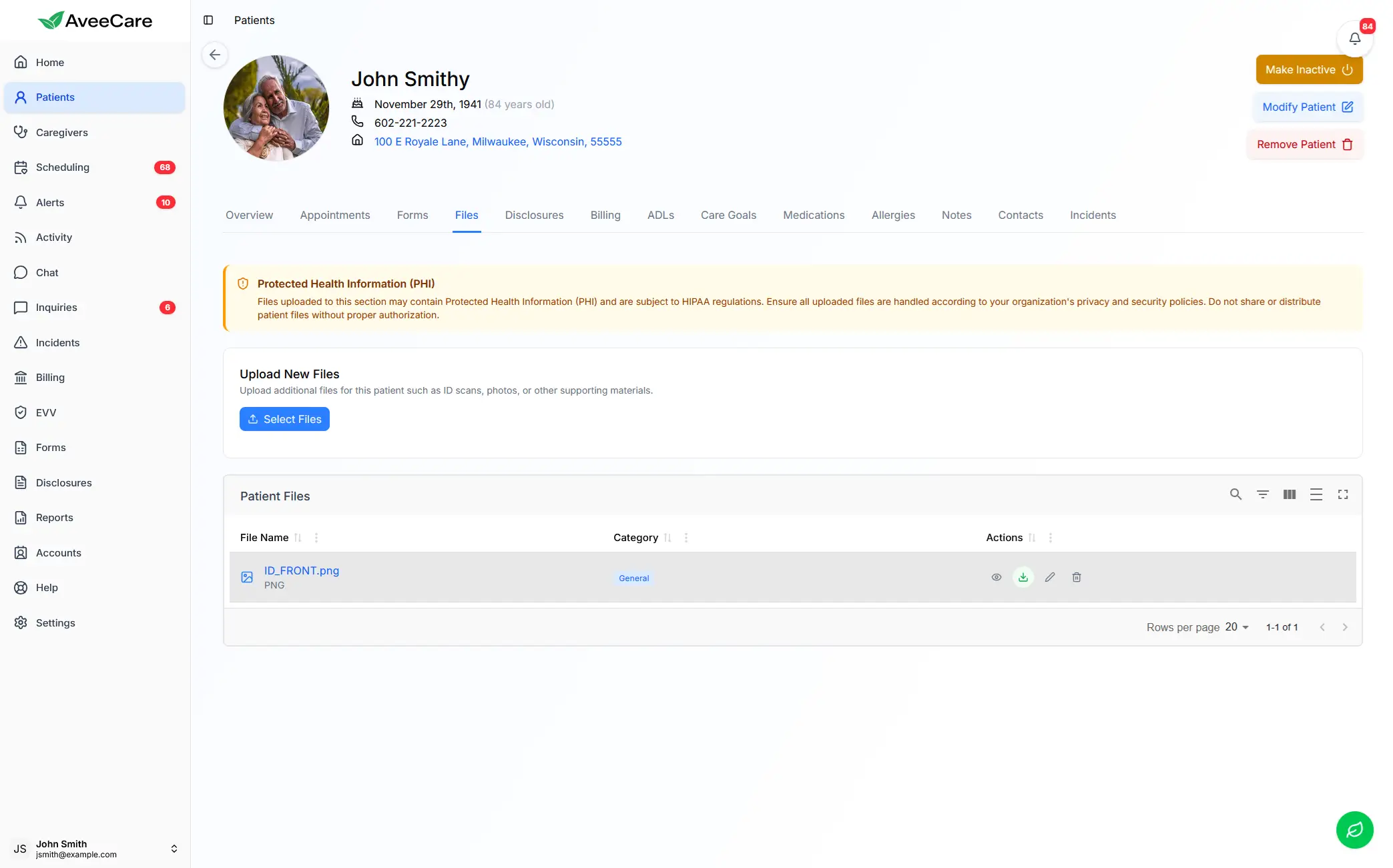
AveeCare's document management helps agencies organize records needed for tax deduction documentation.
Frequently Asked Questions
Home care costs may be tax deductible for families as a medical expense if the care is provided to someone who is chronically ill and the services are prescribed by a licensed healthcare practitioner. Under IRS rules, you can deduct qualifying medical expenses that exceed 7.5% of your adjusted gross income (AGI). This includes personal care services like bathing, dressing, and medication management when medically necessary. Companion care or housekeeping-only services generally do not qualify as medical deductions.
Home care agencies can deduct ordinary and necessary business expenses including: caregiver wages and payroll taxes, workers compensation and liability insurance premiums, office rent and utilities, home care software and technology, marketing and advertising costs, vehicle mileage for business use (67 cents per mile in 2026), professional development and training, uniforms and supplies, professional services (accounting, legal), business insurance, and state licensing fees. All deductions must be documented with receipts and records.
Since the Tax Cuts and Jobs Act of 2017, W-2 employee caregivers can no longer deduct unreimbursed work expenses on their federal tax returns (this provision has been extended). However, independent contractor caregivers (1099 workers) can deduct business expenses including mileage, supplies, training costs, and professional certifications on Schedule C. Some states still allow employee deductions at the state level.
The Child and Dependent Care Credit (Form 2441) allows taxpayers to claim a credit for care expenses paid for a qualifying dependent who is physically or mentally incapable of self-care. For home care, this applies when you pay for care of a spouse or dependent who cannot care for themselves so that you can work or look for work. The credit is 20-35% of up to $3,000 in expenses for one qualifying person or $6,000 for two or more.
Yes, home care software subscription costs are fully tax deductible as an ordinary and necessary business expense under IRS Section 162. Monthly or annual subscription fees for scheduling, billing, compliance, and management software can be deducted in the year they are paid. If you purchase perpetual software licenses, you may need to depreciate the cost over 3 years or use Section 179 to expense it immediately.
Home care agencies should maintain: payroll records (W-4s, timesheets, pay stubs, 941 filings) for at least 4 years, all income and expense receipts for 3-7 years, bank and credit card statements, vehicle mileage logs with dates, destinations, and business purpose, insurance policies and premium statements, client contracts and billing records, caregiver certifications and training records, and year-end financial statements. The IRS generally has 3 years to audit but can go back 6 years if substantial underreporting is suspected.
Sources & References
- IRS — Publication 502: Medical and Dental Expenses
- IRS — Publication 535: Business Expenses
- IRS — Publication 463: Travel, Gift, and Car Expenses
- IRS — Publication 587: Business Use of Your Home
- IRS — Section 179 Deduction
- IRS — Form 2441: Child and Dependent Care Expenses
- IRS — Standard Mileage Rates
Important Disclaimer: Tax laws change frequently and vary by jurisdiction. The information in this guide reflects general federal tax rules as of the 2026 tax year and may not apply to your specific situation. Always consult with a qualified CPA or tax professional before making tax decisions. This guide is for informational purposes only and does not constitute tax, legal, or financial advice.
Keep Your Tax Records Organized with Digital Document Management
AveeCare helps home care agencies store, organize, and retrieve the documentation needed for tax deductions, compliance audits, and financial reporting.