Home Care Service Agreements
A well-drafted home care service agreement protects both the agency and the client. This guide covers essential clauses, state-specific requirements, and provides interactive tools to help you build a compliant home care contract for your agency.
Why a Home Care Service Agreement Matters
A comprehensive home care contract is not just a legal formality. It defines expectations, prevents disputes, and is required by licensing boards in most states. Agencies without proper service agreements face regulatory penalties, insurance claim denials, and costly litigation. Your service agreement should also align with your informed consent policies and documentation requirements.
States Require Written Agreements
The vast majority of states mandate a written client service agreement for home care agencies as a condition of licensure or certification.
Average Dispute Cost
Without a clear home care service agreement, disputes over fees, services, and liability can cost agencies $15,000-$50,000 in legal fees and settlements.
Disputes Preventable
According to legal industry surveys, nearly three-quarters of home care client disputes could be prevented with clearer home care contract language.
Standard Termination Notice
Most state regulations and industry best practices require a minimum 30-day written notice for termination of a client service agreement in home care.
Accept E-Signatures
Under the ESIGN Act and UETA, 47 states accept electronic signatures for home care service agreements, enabling faster onboarding.
Recommended Review Cycle
Best practice is to review and update every home care service contract at least annually, or whenever rates, services, or state regulations change.
Clear Contracts Build Client Confidence
A well-structured home care service agreement demonstrates professionalism and transparency. When clients and families understand exactly what to expect from the home care service contract, they start the relationship with trust and confidence.

Service Agreement Clause Builder
Select the clauses you want to include in your home care service agreement. Required clauses are pre-selected based on industry standards. Click any clause to view sample language for your home care contract template.
Defines exactly what services the agency will and will not provide. Lists specific tasks caregivers are authorized to perform.
Specifies the agreed-upon service schedule including days, times, minimum hours per visit, and the process for requesting changes.
Details hourly rates, overtime rates, holiday rates, billing cycles, payment methods, and late payment penalties.
Defines the notice period for cancelling scheduled visits and any associated charges for late cancellations or no-shows.
Specifies how either party may end the agreement, required notice periods, and any obligations upon termination.
Defines the limits of the agency's liability, insurance coverage disclosure, and mutual indemnification provisions.
Outlines the agency's obligations under HIPAA, how client health information is protected, and authorized disclosures.
Details how emergencies are handled, when 911 is called, notification procedures for family/emergency contacts.
Many states require this document to be included with the service agreement. Lists the client's fundamental rights during care.
Specifies how and when the agency may increase rates, the notice period required, and any caps on annual increases.
Defines the process for resolving disagreements, including mediation, arbitration, or litigation preferences.
Addresses service interruptions due to events beyond either party's control such as natural disasters, pandemics, or government orders.
Authorizes the use of electronic visit verification, GPS tracking, mobile apps, and other technology for care documentation.
Addresses pet safety, caregiver responsibilities regarding pets, and agency liability limitations related to animals in the home.
Defines how caregivers will access the client's home, key management, lockbox usage, and security procedures.
Sets boundaries on gift-giving between clients and caregivers to prevent financial exploitation concerns.
Your Agreement Outline (9 clauses)
- 1.Scope of Servicesrequired
- 2.Schedule & Hoursrequired
- 3.Fees & Payment Termsrequired
- 4.Cancellation Policyrequired
- 5.Termination Clauserequired
- 6.Liability & Indemnificationrequired
- 7.HIPAA & Privacyrequired
- 8.Emergency Proceduresrequired
- 9.Client Bill of Rightsrequired
Managing Agreements Digitally
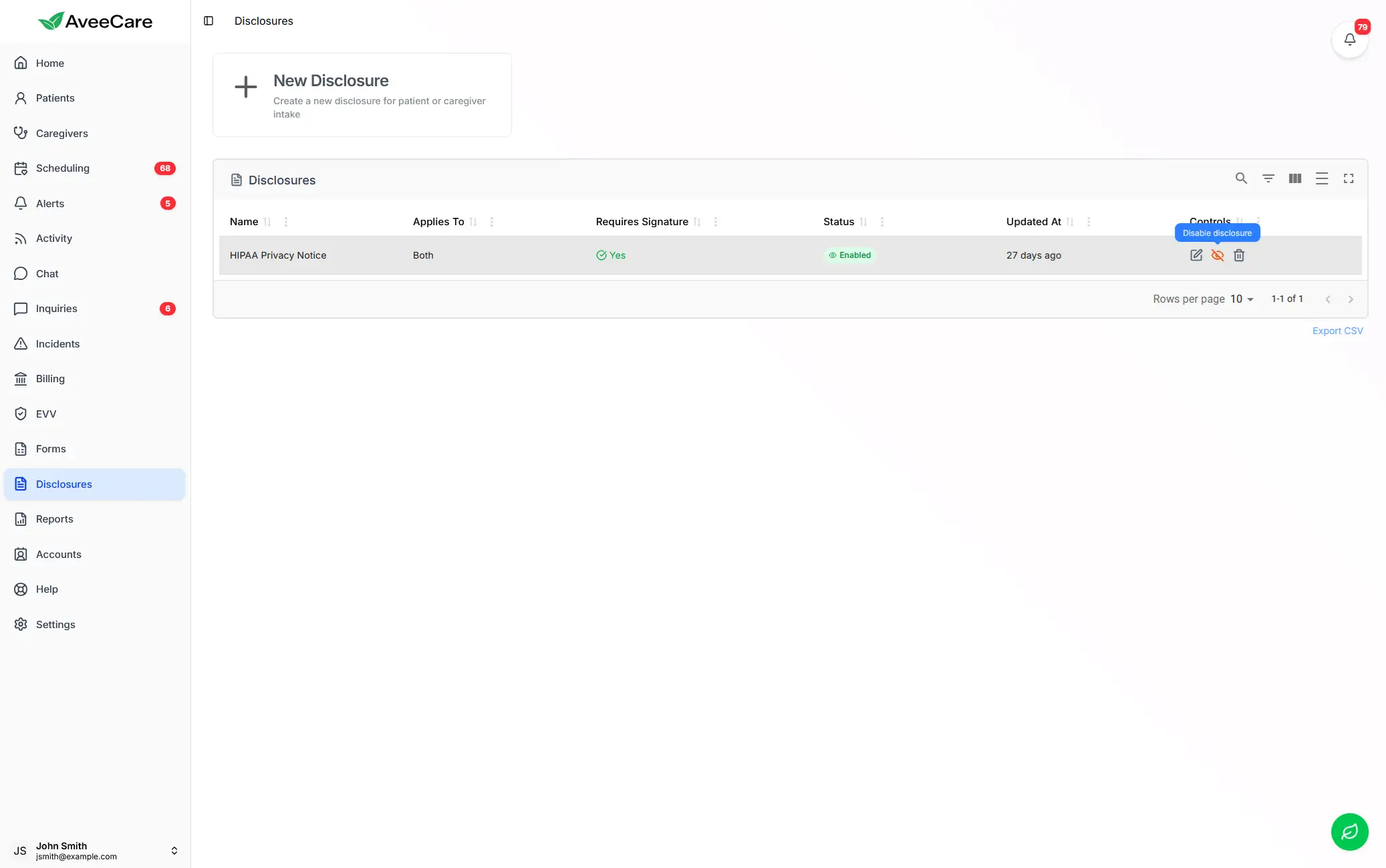
Modern home care software manages service agreements, disclosure forms, and consent documents digitally. Electronic document management ensures every client file is complete, signed, and easily accessible for compliance audits.
State-Specific Service Agreement Requirements
Home care service contract requirements vary significantly by state. Select a state to see its key mandated elements for a home care service agreement. Always verify current requirements with your state licensing board.
California Requirements
- Client Bill of Rights required
- Rate disclosure within 24 hours
- 30-day termination notice
- Abuse reporting disclosure
- Background check disclosure
Note: This is a summary of common requirements. Contact your state licensing board for the complete and current list of mandated service agreement elements.
Private Pay vs. Insurance: Agreement Differences
Home care service agreements differ based on the payer source. Understanding these differences is essential when building a compliant home care service contract template for your agency.
Private Pay Agreements
- Agency sets rates directly with client
- More flexibility in service scope
- Simpler billing and payment terms
- Rate increase provisions are critical
- Minimum hour requirements common
- Cancellation fees more enforceable
- No prior authorization needed
- Deposit or retainer may be required
Insurance/Medicare Agreements
- Rates set by payer or negotiated contracts
- Services limited to authorized plan of care
- Complex billing with claim submission
- Prior authorization usually required
- Physician orders must be on file
- Copay/coinsurance collection required
- Compliance with CMS CoPs mandatory
- Assignment of Benefits (AOB) required
Common Home Care Service Agreement Pitfalls
These mistakes appear in home care contracts across the industry. Avoiding them protects your agency from legal disputes, regulatory penalties, and client dissatisfaction.
Using a generic template without state customization
Home care service agreement templates found online rarely comply with every state's licensing requirements. Each state has unique mandatory clauses, disclosures, and formatting requirements.
Fix: Have an attorney licensed in your state review and customize your home care contract template for state-specific compliance.
Failing to include a clear scope of services
Vague language like "personal care services" without listing specific tasks leads to disagreements about what caregivers will and will not do.
Fix: List every authorized task explicitly: bathing assistance, meal preparation, light housekeeping, medication reminders, etc. Also list tasks caregivers are NOT authorized to perform.
No termination clause or inadequate notice period
Without a clear termination clause, agencies face disputes about final billing, required notice, and transition of care responsibilities.
Fix: Include mutual termination rights with a minimum 30-day notice period, exceptions for safety concerns, and a transition plan requirement.
Not disclosing all fees and rate increase policies
Clients who discover unexpected fees (overtime, holiday surcharges, mileage, supplies) after signing lose trust and are more likely to terminate.
Fix: Create a comprehensive fee schedule attachment that lists every possible charge. Include the rate increase provision with maximum annual increase caps.
Missing HIPAA and privacy language
HIPAA compliance is mandatory for all home care agencies that handle health information. A service agreement without proper privacy language creates legal exposure.
Fix: Include a HIPAA notice reference and provide the full Notice of Privacy Practices as a separate document signed by the client.
Not obtaining signatures from all responsible parties
If the person signing the agreement is not the client (e.g., adult child, POA), and the proper authority is not documented, the agreement may not be enforceable.
Fix: Verify legal authority with documentation (POA, guardianship). Have both the responsible party and the client (if competent) sign the agreement.
When to Involve an Attorney
While templates and guides are valuable starting points, certain situations require professional legal review of your home care service agreement.
Initial agreement creation
Have an attorney draft or review your master home care contract template before using it with clients.
State expansion
When expanding into new states, each requires compliance review for state-specific home care service agreement requirements.
Adding Medicare/Medicaid services
Insurance payer agreements involve regulatory complexity beyond standard private pay contracts.
After a dispute or lawsuit
Review and strengthen your agreement language based on lessons learned from actual disputes.
Regulatory changes
When your state updates home care licensing regulations, existing agreements may need corresponding updates.
Adding arbitration clauses
Arbitration and dispute resolution clauses have specific enforceability requirements that vary by state.
Frequently Asked Questions
Common questions about home care service agreements, contracts, and legal requirements.
A home care service agreement should include the scope of services with specific tasks listed, schedule and hours of care, fee structure and payment terms, cancellation and termination policies, liability limitations, HIPAA privacy notice, emergency procedures, client rights and responsibilities, complaint resolution process, and signatures of all parties. Many states require additional clauses such as a Client Bill of Rights, abuse reporting procedures, and advance directive information.
Yes, most states require home care agencies to have a written service agreement with each client. State licensing regulations typically mandate specific disclosures and clauses. Even in states without explicit requirements, a written home care contract is considered a best practice and is essential for legal protection, insurance compliance, and dispute resolution.
Yes, electronic signatures are legally valid for home care service agreements under the federal ESIGN Act and the Uniform Electronic Transactions Act (UETA), which has been adopted by 47 states. However, some state home care licensing regulations may still require wet (ink) signatures for specific documents. Agencies should verify their state requirements.
Home care service agreements should be reviewed and updated at least annually, or whenever there is a significant change in the client's condition, services, schedule, or rates. Best practice is to review the agreement at every care plan reassessment (typically every 60-90 days). Rate increases should be communicated in writing with 30 days advance notice.
A home care service agreement is a legal contract between the agency and the client that covers business terms such as fees, liability, termination, and general scope of services. A care plan is a clinical document that details the specific care tasks, goals, caregiver instructions, and health monitoring protocols. Both documents are required but serve different purposes.
Sources & References
U.S. Department of Labor
Employment law requirements for home care agencies including wage and hour rules affecting service agreement terms.
National Association for Home Care & Hospice
Industry best practice guidelines for home care service agreements, client rights, and documentation standards.
State Attorney General Consumer Protection
State-specific consumer protection requirements for home care contracts and mandatory disclosures.
AARP Legal Resources
Consumer-facing guidance on home care service agreements that informs best practices for client-friendly contract language.
Centers for Medicare & Medicaid Services
Conditions of Participation for Medicare-certified home health agencies affecting service agreement requirements.
Electronic Signatures in Global & National Commerce Act
Federal law governing the legal validity of electronic signatures for home care service contracts.
Manage Agreements Digitally with AveeCare
AveeCare provides built-in document management for home care service agreements, disclosure forms, and consent documents. Create custom forms, capture electronic signatures, and maintain complete client files in one cloud-based system. Transparent pricing, no long-term contracts, and a free interactive demo.
Disclaimer
This guide provides general information about home care service agreements compiled from publicly available sources including state licensing regulations, NAHC best practices, DOL guidance, and AARP resources. Requirements vary by state, agency type, and payer source.
The sample contract language and interactive tools on this page are for educational purposes only. They do not constitute legal advice and should not be used as a substitute for professional legal counsel. Always have an attorney licensed in your state review your home care service agreement before use.
Last updated: April 2026. AveeCare reviews and updates content annually.