Informed Consent in Home Care: Requirements, Forms & Best Practices
Master the informed consent process for home care with this comprehensive guide covering legal requirements, home care consent forms, capacity assessment, and documentation standards for 2026.

What Is Informed Consent in Home Care?
Informed consent is the foundation of ethical patient care and a core legal requirement for every home care agency.
Informed consent in home care is the process by which a client (or their authorized representative) voluntarily agrees to receive services after being provided with clear, comprehensive information about what those services entail. Unlike a simple signature on a form, informed consent is an ongoing dialogue that ensures patient consent in home care is truly informed, voluntary, and documented.
The three pillars of valid informed consent are: disclosure (providing sufficient information for an informed decision), capacity (the client has the cognitive ability to understand and decide), and voluntariness (the decision is made freely without coercion). Consent is also closely connected to patient rights policies and your broader documentation requirements. When any of these elements is missing, consent documentation may be legally invalid, exposing the agency to liability.
Disclosure
- •Nature of proposed services
- •Expected benefits and risks
- •Alternative options
- •Costs and billing
- •Right to refuse
Capacity
- •Understanding of information
- •Appreciation of situation
- •Rational reasoning ability
- •Consistent expression of choice
Voluntariness
- •Free from coercion
- •Free from undue influence
- •Adequate time to decide
- •Right to withdraw anytime
Legal Requirements for Consent Documentation
Federal and state laws establish specific requirements for informed consent in healthcare, including home care settings.
Federal Requirements
- Medicare Conditions of Participation require patient consent before initiating services
- HIPAA requires written authorization for use and disclosure of protected health information
- Patient Self-Determination Act requires informing patients of their right to make healthcare decisions
- ACA provisions on patient rights and informed decision-making
State Requirements
- Every state has informed consent laws, though specifics vary
- State home care licensing regulations often specify consent form requirements
- Some states require specific consent language for certain services
- State laws govern who can serve as surrogate decision-makers
- Statute of limitations for consent-related claims varies by state
Documentation Standards
- Consent must be obtained before services begin
- Forms must be signed by the client or authorized representative
- A copy must be provided to the client
- Original must be maintained in the client record
- Re-consent required when services change significantly
- Annual re-consent is a best practice
Consent Form Template Generator
Select the service types your agency provides to generate a list of required consent elements for your home care consent forms.
Select your service types:
Digital Consent Form Management
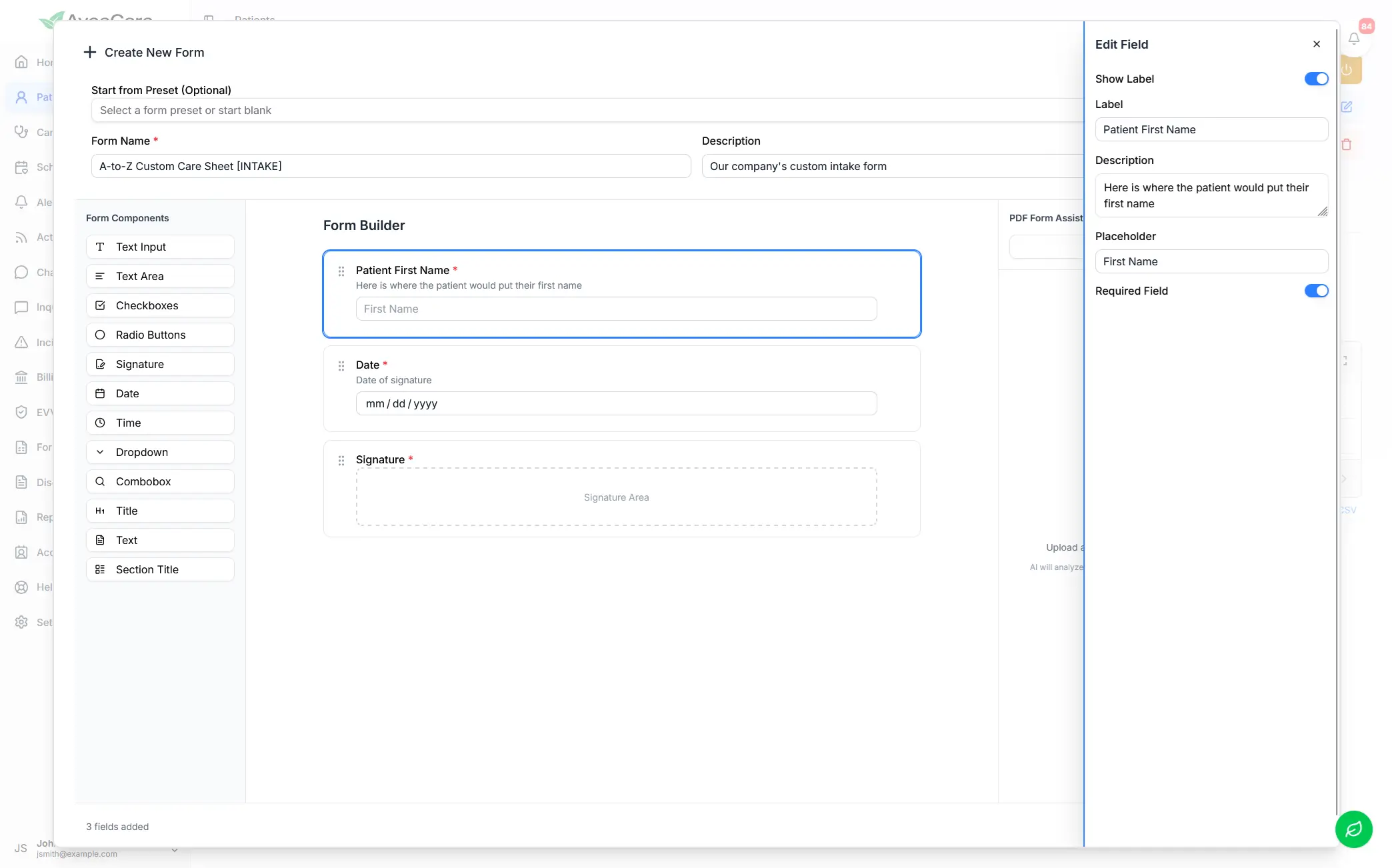
Modern home care software eliminates the challenges of paper-based consent processes. Digital form builders allow you to create customized consent forms, collect electronic signatures, and maintain organized consent documentation that is always accessible and audit-ready.
Capacity Assessment Reference
Assessing decision-making capacity is essential when there is concern about a patient's ability to provide valid informed consent.
Understanding
Can the person comprehend the information being provided about the proposed services, including the nature, purpose, risks, and benefits?
Assessment Questions
- Can the client explain the proposed services in their own words?
- Do they understand why the services are being recommended?
- Can they describe the potential risks and benefits?
Appreciation
Can the person recognize how the information applies to their own situation and acknowledge the potential consequences of accepting or refusing care?
Assessment Questions
- Does the client acknowledge their condition or care needs?
- Do they understand how the services would affect their daily life?
- Can they recognize potential consequences of refusing care?
Reasoning
Can the person engage in a rational process of weighing options, considering alternatives, and reaching a logical conclusion about their care?
Assessment Questions
- Can the client compare the pros and cons of different options?
- Is their reasoning consistent and logical?
- Do they consider both short-term and long-term consequences?
Expression of Choice
Can the person clearly and consistently communicate a decision about their care, and does that decision remain relatively stable over time?
Assessment Questions
- Can the client state a clear preference?
- Is their choice consistent when asked at different times?
- Can they explain the reasons for their choice?
Consent Process Checklist
Use this interactive checklist to ensure your patient consent process in home care meets all requirements.
Pre-Consent Preparation
Information Disclosure
Client Understanding
Voluntary Decision
Documentation
Surrogate Decision-Makers
When a client lacks capacity to provide informed consent, a legally authorized surrogate must make decisions on their behalf.
Hierarchy of Surrogate Decision-Makers
Most states follow a similar hierarchy when no advance directive designates a specific surrogate. Always verify your state’s specific statutes.
Has legal authority granted by a court. Overrides all other surrogates for decisions within the scope of the guardianship.
Designated by the client in an advance directive while they had capacity. Activated when the client loses decision-making capacity.
First in the default surrogate hierarchy in most states. Must be legally married or in a recognized domestic partnership.
Next in hierarchy. If multiple adult children, many states require majority agreement or the eldest to serve as default.
If no spouse or adult children are available. Applicable particularly for younger adults who lack capacity.
After parents in the hierarchy. Same majority/eldest default rules often apply.
Some states allow other individuals who have demonstrated a close relationship and knowledge of the client's wishes.
Cultural Sensitivity & Language Access
Valid informed consent requires that clients understand the information, which means addressing cultural and language barriers.
Language Access Requirements
- Consent forms must be available in the client's primary language
- Qualified interpreters required (family members are not ideal)
- Translated documents should be back-translated for accuracy
- Telephonic interpretation services for less common languages
- Document which language and interpretation method was used
- Title VI of the Civil Rights Act requires language access for federally funded programs
Cultural Considerations
- Respect cultural norms around family involvement in decisions
- Some cultures may defer to family elders for healthcare decisions
- Health literacy varies across cultural groups
- Religious beliefs may affect consent for certain services
- Gender preferences for caregivers should be discussed and documented
- Dietary and personal care customs should be incorporated into consent
Electronic Consent
Electronic signatures and digital consent processes are legally valid and increasingly standard in home care.
Requirements for Valid Electronic Consent
Signer Consent
The signer must agree to conduct business electronically before using e-signatures.
Attributability
The electronic signature must be uniquely linked to and capable of identifying the signer.
Record Retention
Electronic records must be retained and accurately reproducible for the required retention period.
HIPAA Compliance
Electronic consent systems must meet HIPAA security requirements for ePHI.
Withdrawal Option
Signers must be able to withdraw consent to electronic transactions.
Hardware/Software Info
Signers must be informed of hardware and software requirements for accessing records.
Special Situations
Certain circumstances require additional considerations in the informed consent process.
Dementia & Cognitive Impairment
- Capacity may fluctuate; assess at optimal times
- Use simple language and visual aids
- Involve surrogate early in planning
- Advance directives from earlier capacity are valid
- Respect previously expressed preferences
Minors
- Parent or legal guardian must consent
- Mature minor doctrine in some states
- Assent from the minor when developmentally appropriate
- Divorced parents: check custody agreements
- Emancipated minors can consent independently
Emergency Situations
- Implied consent for life-threatening emergencies
- Document the emergency circumstances
- Obtain formal consent as soon as feasible
- Contact surrogate decision-maker promptly
- Follow agency emergency protocols
Revoking Consent
- Can be revoked verbally or in writing
- Takes effect immediately upon revocation
- Document revocation date and circumstances
- Explain potential consequences
- Offer alternative services or referrals
Frequently Asked Questions
Common questions about informed consent in home care, consent forms, and documentation.
Informed consent in home care is the process by which a client (or their legal representative) voluntarily agrees to receive home care services after being provided with clear information about the nature and scope of services, expected benefits and potential risks, alternative options, the right to refuse or withdraw, costs, privacy practices, and caregiver qualifications. It is both an ethical obligation and a legal requirement.
Consent can be given by the adult client if they have decision-making capacity, a court-appointed legal guardian, an individual designated in a durable power of attorney for healthcare, a healthcare surrogate designated under state law, or for minors, a parent or legal guardian. If a client lacks capacity and has no advance directive, most states have a default surrogate hierarchy.
Capacity assessment evaluates four key abilities: Understanding (can they comprehend the information), Appreciation (can they recognize how it applies to them), Reasoning (can they weigh options), and Expression of Choice (can they communicate a consistent decision). Capacity is decision-specific and can fluctuate. A formal assessment should be performed by a qualified healthcare provider and documented.
Yes, electronic consent is generally valid under the federal E-SIGN Act and the Uniform Electronic Transactions Act (UETA), adopted in 47 states. Requirements include: the signer must consent to doing business electronically, the signature must be attributable to the person, the record must be retained and reproducible, and HIPAA requirements must be met. Home care software with electronic signature capabilities streamlines this process.
Yes, patients have the absolute right to withdraw consent at any time. Withdrawal can be verbal or written and takes effect immediately. The agency must stop the covered services, document the withdrawal, explain potential consequences, offer alternatives, and retain documentation. Continuing services after consent is withdrawn could constitute battery or violation of patient rights.
Sources & References
Legal and ethical guidelines referenced in this guide.
- AMA Code of Medical Ethics — Opinion 2.1.1: Informed Consent
- HHS — Patient Rights and Informed Consent (45 CFR Part 164)
- HIPAA Privacy Rule — Authorization Requirements (45 CFR 164.508)
- Uniform Health-Care Decisions Act (UHCDA) — Surrogate decision-making framework
- E-SIGN Act (15 U.S.C. 7001) — Federal electronic signature law
- Uniform Electronic Transactions Act (UETA) — State-level e-signature law
- ABA Commission on Law and Aging — Capacity assessment resources
- CMS Medicare Conditions of Participation — Patient rights requirements (42 CFR 484)
- Patient Self-Determination Act (42 U.S.C. 1395cc(f)) — Advance directive rights
Disclaimer
This guide is provided for educational and informational purposes only. It does not constitute legal or medical advice. Informed consent requirements vary by state and service type. Always consult with qualified legal counsel when developing your agency’s consent forms and procedures. The interactive tools generate general guidance and should not replace professional legal review of your consent documents.
Simplify Consent with AveeCare’s Form Builder
AveeCare’s home care software includes a powerful form builder for creating custom home care consent forms, collecting electronic signatures, and maintaining audit-ready consent documentation — all within a HIPAA-compliant platform.