Home Care Payer Mix Optimization: Revenue Diversification Strategies
A diversified payer mix is the foundation of a financially resilient home care agency. This guide provides interactive tools to analyze your current payer mix, calculate revenue stability, compare payer sources, and build a roadmap for home care revenue diversification.

What Is Payer Mix in Home Care?
Payer mix describes the distribution of revenue across all the funding sources that pay for your home care services. For most agencies, home care payer sources include private pay clients, Medicare, Medicaid, long-term care insurance (LTCI), Veterans Affairs (VA) benefits, and workers' compensation. Understanding your payer mix is the first step toward effective payer mix optimization.
Why does payer mix matter? Because each payer source has different reimbursement rates, payment timelines, documentation requirements, and margin profiles. An agency that receives 80% of revenue from a single payer faces enormous risk if that payer reduces rates, changes eligibility rules, or delays payments. Home care revenue diversification protects against these disruptions and creates more predictable cash flow. For a detailed walkthrough of how different payer types affect your billing workflow, our home care billing guide is a helpful companion resource.
Industry Rule of Thumb
No single payer should account for more than 40-50% of your total revenue. Agencies with 4 or more active payer sources report significantly more stable cash flow and lower financial stress during industry changes.
Current Industry Averages for Home Care Payer Mix
Based on 2025-2026 data from the National Association for Home Care & Hospice (NAHC) and CMS reports, the average payer mix for home care agencies across the United States breaks down approximately as follows:
35%
Avg. margin: 32%
22%
Avg. margin: 18%
20%
Avg. margin: 10%
12%
Avg. margin: 22%
6%
Avg. margin: 15%
5%
Avg. margin: 28%
Payer Mix Analyzer
Enter your agency's current revenue percentages by payer source. The analyzer will generate a visual breakdown and actionable recommendations for payer mix optimization.
Your Revenue by Payer Source (%)
Revenue Stability Score Calculator
Assess how resilient your agency's revenue streams are against market disruptions. A higher score means stronger financial stability for your home care payer sources.
Good
Good foundation, but there is room to strengthen your payer mix.
Payer Source Comparison
Compare key metrics across all home care payer sources to make informed decisions about your revenue diversification strategy.
| Payer Source | Avg. Margin | Days in A/R | Admin Burden | Volume Potential |
|---|---|---|---|---|
Private Pay | 32% | 5 days | Low | Medium |
Medicare | 18% | 28 days | Medium | High |
Medicaid | 10% | 42 days | High | High |
Long-Term Care Insurance | 22% | 35 days | Medium | Medium |
VA Benefits | 15% | 30 days | Medium | Low-Med |
Workers' Compensation | 28% | 25 days | Medium | Low-Med |
Private Pay
Clients or families paying directly for home care services without insurance involvement.
Medicare
Federal health insurance for adults 65+ and those with qualifying disabilities. Covers skilled home health services.
Medicaid
Joint federal-state program covering low-income individuals. Rates and services vary significantly by state.
Long-Term Care Insurance
Private insurance policies specifically designed to cover long-term care services including home care.
VA Benefits
Department of Veterans Affairs programs including Aid & Attendance, Veteran Directed Care, and community care.
Workers' Compensation
Insurance covering employees injured on the job who require home care during recovery.
Private Pay Growth Strategies for Revenue Diversification
Private pay is the highest-margin component of most agencies' home care revenue diversification strategy. These clients pay directly, meaning faster collections, no claim denials, and no reimbursement caps. For a complete breakdown of how to structure and manage private pay billing, see our private pay billing guide. Here are proven strategies to grow your private pay census:
Premium service tiers
Offer bronze, silver, and gold packages with increasing levels of service. Families willing to pay privately often value flexibility and premium options like 24/7 on-call support or dedicated care coordinators.
Referral partnerships
Build relationships with elder law attorneys, financial advisors, discharge planners, and geriatric care managers. These professionals regularly advise families on home care and can drive a steady stream of private pay referrals.
Digital marketing and SEO
Invest in local SEO, Google Ads, and social media to reach adult children researching home care for their parents. Private pay families typically start their search online, and visibility drives conversions.
Specialized programs
Develop niche programs such as dementia care, post-surgical recovery, or hospital-to-home transition services. Specialization commands premium rates and differentiates your agency from generalist providers.
Transparent pricing
Families choosing private pay value clarity. Publish your rates online and provide detailed cost estimates upfront to build trust and reduce friction in the sales process.
Optimizing Government Payer Revenue
Medicare and Medicaid represent significant volume opportunities in your payer mix home care strategy, but require careful management to maintain acceptable margins.
Medicare Optimization
- Maximize PDGM case-mix weight through accurate OASIS scoring
- Reduce LUPA (Low Utilization Payment Adjustment) episodes
- Improve face-to-face encounter documentation
- Monitor 30-day readmission rates (impacts VBP adjustments)
- Submit claims within 5 days of episode completion
Medicaid Considerations
- Research HCBS waiver programs in your state
- Negotiate MCO contracts for better rates
- Implement EVV compliance for cost avoidance
- Track authorization utilization to prevent underbilling
- Automate documentation to reduce cost-per-claim
LTCI Growth
- Partner with LTCI brokers and agents for referrals
- Streamline claims with carrier-specific templates
- Train intake staff on benefit verification procedures
- Track elimination periods proactively
VA Benefits Expansion
- Enroll as a VA Community Care provider
- Partner with VA Medical Centers and Vet Centers
- Educate veterans on Aid & Attendance eligibility
- Connect with veteran service organizations
12-Month Revenue Diversification Roadmap
Shifting your payer mix optimization strategy takes time. Here is a practical roadmap to diversify your home care payer sources over 12 months:
Assess & Plan
- Analyze current payer mix with the tool above
- Identify 2-3 target payer sources for growth
- Research credentialing requirements for new payers
- Set quarterly revenue targets by payer source
Build Infrastructure
- Complete provider enrollment for new payer sources
- Train billing staff on new payer claim requirements
- Implement tracking dashboards for payer-level metrics
- Launch private pay marketing campaigns
Execute & Refine
- Begin accepting clients from new payer sources
- Monitor claim acceptance rates and payment timelines
- Adjust marketing spend based on client acquisition cost
- Negotiate rate improvements with existing payers
Optimize & Scale
- Review payer mix against targets
- Identify underperforming payer relationships
- Plan Year 2 diversification goals
- Celebrate revenue stability improvements
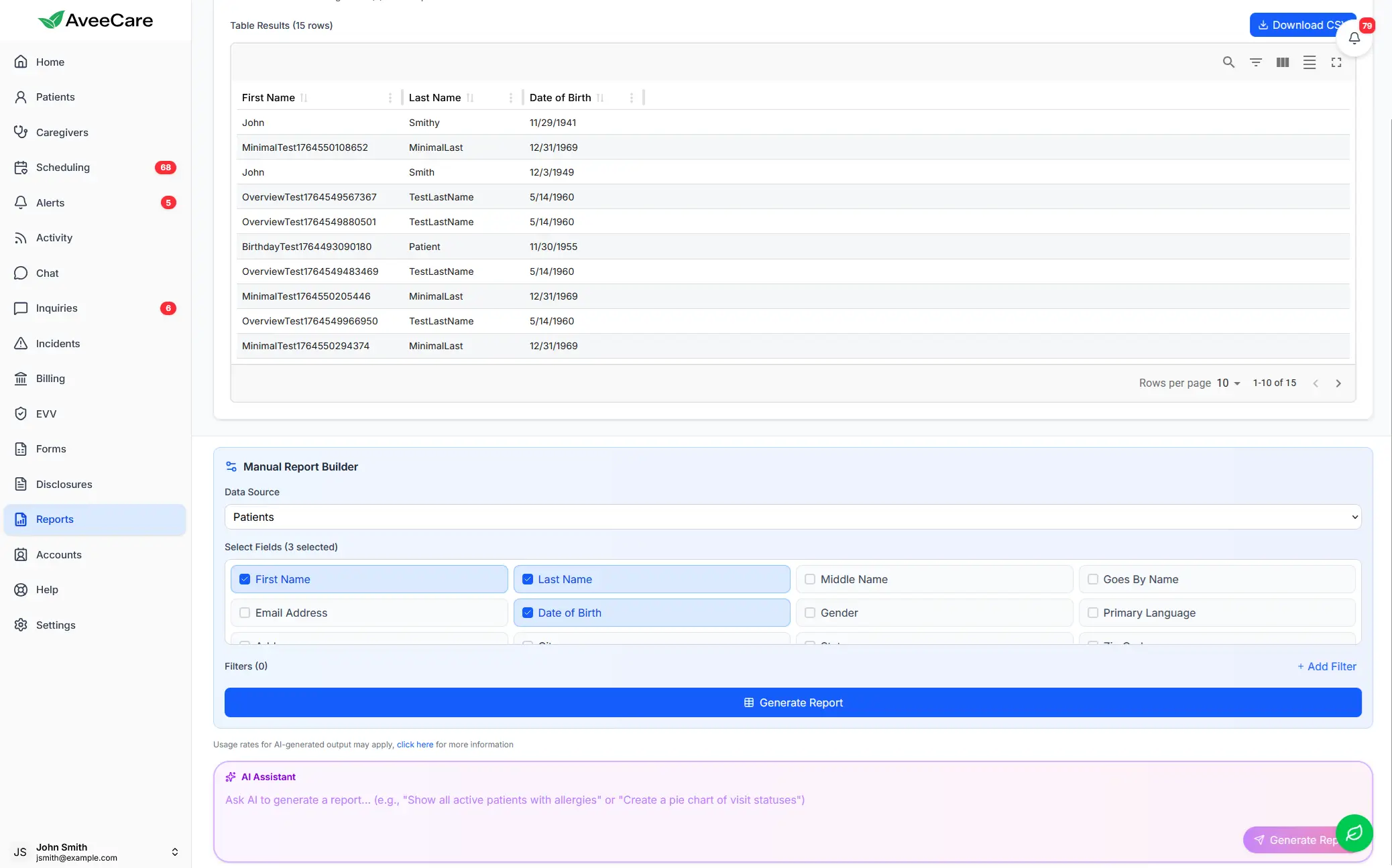
AveeCare's reporting tools help agencies track revenue by payer source in real time.
Frequently Asked Questions
Payer mix refers to the proportion of revenue a home care agency receives from each funding source, including private pay, Medicare, Medicaid, long-term care insurance, VA benefits, and workers compensation. It matters because over-reliance on any single payer creates financial vulnerability. If a dominant payer changes reimbursement rates, delays payments, or adjusts eligibility criteria, an agency with a concentrated payer mix could face severe revenue disruption. A diversified payer mix provides financial stability and more predictable cash flow.
There is no single ideal payer mix, as it depends on agency size, location, services offered, and market conditions. However, industry best practices suggest no single payer should account for more than 40-50% of total revenue. A balanced mix might include 30-40% private pay, 20-30% Medicare, 15-25% Medicaid (where applicable), 10-15% long-term care insurance, and 5-10% from other sources like VA benefits. The goal is to balance higher-margin payers like private pay with stable volume from government programs.
Agencies can increase private pay revenue by offering premium service packages with additional amenities, implementing tiered pricing structures, marketing directly to families and adult children of seniors, building referral relationships with elder law attorneys and financial advisors, offering specialized services like dementia care or post-surgical recovery, and maintaining a strong online presence. Private pay clients typically generate higher margins since there are no insurance-related administrative costs or reimbursement rate caps.
A revenue stability score measures how diversified and resilient an agency's income streams are. It considers factors like payer concentration (whether any single payer exceeds 50% of revenue), the number of active payer sources, the mix of government versus private funding, days in accounts receivable by payer, and historical payment reliability. A higher score indicates better protection against payer-related financial disruptions. Agencies should aim for a stability score above 70 out of 100.
Medicare reimbursement rates for home health services are typically 15-30% lower than private pay rates, though they provide consistent volume and predictable payment schedules. In 2026, Medicare home health rates average $55-75 per visit depending on the service type and geographic region, while private pay rates average $28-35 per hour (or $85-120 per visit equivalent). Medicare offers higher patient volume and longer care episodes, while private pay offers higher per-unit margins but may require more marketing investment.
Home care software optimizes payer mix by providing real-time revenue dashboards broken down by payer source, automated eligibility verification to prevent claim denials, billing analytics that track reimbursement rates and payment timelines by payer, financial forecasting tools that model revenue scenarios under different payer mixes, and reporting that identifies underperforming payer relationships. Software like AveeCare consolidates billing across all payer types into a single platform, making it easier to analyze and adjust your payer strategy.
Sources & References
- National Association for Home Care & Hospice (NAHC) — Industry Statistics & Data
- CMS — Medicare Home Health Agency Utilization & Payment Data
- Bureau of Labor Statistics — Home Health and Personal Care Aides
- Medicaid.gov — Home & Community-Based Services
- CMS — Medicare Home Health Prospective Payment System (CY 2026)
- VA — Geriatrics and Extended Care Services
- American Association for Long-Term Care Insurance (AALTCI)
Important Disclaimer: Payer reimbursement rates, program eligibility, and policy details change frequently. The data presented in this guide reflects 2025-2026 industry averages and may not represent your specific market or payer contracts. Always verify current rates and requirements directly with payers before making financial decisions. This guide is for informational purposes only and does not constitute financial, legal, or business advice. Consult with qualified professionals for guidance specific to your agency.
Track Your Payer Mix with Real-Time Revenue Dashboards
AveeCare helps home care agencies monitor revenue by payer source, track payment timelines, and generate financial reports that support smarter payer mix optimization decisions.