Home Care Employee Handbook: Essential Policies & Templates
A comprehensive home care employee handbook protects your agency, sets clear expectations for caregivers, and ensures compliance with federal and state regulations. It should reference your state-specific training requirements and align with your onboarding process. Use our interactive policy checklist and section builder to create or audit your caregiver handbook.
Published April 3, 2026

Required vs. Recommended Home Care Policies
Not all home care agency policies carry equal legal weight. Understanding the difference between legally required, strongly recommended, and optional policies helps you prioritize your caregiver handbook development.
Required
Legally mandated by federal or state law. Absence exposes your agency to lawsuits, fines, and licensing issues.
10
policies in this category
Recommended
Not always legally required, but considered industry best practice. Protects your agency in disputes and improves operations.
10
policies in this category
Optional
Nice-to-haves that enhance your handbook and demonstrate a professional, employee-focused culture.
6
policies in this category
Home Care Policy Checklist
Check off which policies your home care employee handbook already includes. This audit tool helps you identify gaps in your caregiver handbook coverage.
Caregiver Handbook Section Builder
Expand each section below to see recommended content for your home care employee handbook. Use this as a template outline when building or auditing your caregiver policy manual.
Set the tone for your agency. This section communicates your mission, values, and what makes your organization special.
Recommended Content
- Welcome letter from the owner or director
- Agency mission statement and core values
- Brief history and overview of your agency
- Commitment to quality care and employee well-being
- Agency philosophy and care approach
HIPAA Policies for Home Care Handbooks
HIPAA compliance is non-negotiable in home care. Your caregiver handbook must include comprehensive policies covering these areas to protect client privacy and shield your agency from violations.
PHI Definition & Handling
- Define what constitutes Protected Health Information (PHI)
- Explain 18 HIPAA identifiers in plain language
- Distinguish between verbal, written, and electronic PHI
- Provide examples specific to home care scenarios
Permitted Uses & Disclosures
- Explain treatment, payment, and operations (TPO) exceptions
- Clarify when caregiver-to-caregiver communication is permitted
- Define what information can be shared with client families
- Explain when law enforcement or court orders override privacy
Electronic Safeguards
- Require use of agency-approved secure messaging only
- Prohibit texting client information on personal phones without encryption
- Mandate strong passwords and device lock screens
- Require immediate reporting of lost or stolen devices
Social Media & Photography
- Absolutely no photographs of clients or their homes
- No posting about client care experiences on social media
- No identifying clients by name, location, or condition online
- Clear consequences for social media HIPAA violations
Breach Notification
- Define what constitutes a breach of PHI
- Outline the internal reporting process (who, when, how)
- Explain the 60-day notification requirement
- Describe the investigation and remediation process
Training & Enforcement
- Require annual HIPAA training for all employees
- Document training completion and store records
- Define consequences: verbal warning through termination
- Explain that HIPAA violations can result in personal criminal liability
Technology Use Policy for Home Care
As home care agencies adopt mobile scheduling, digital documentation, and secure messaging, your caregiver handbook needs a clear technology use policy that balances productivity with compliance.
Agency-Approved Apps Only
Caregivers should only use approved scheduling, documentation, and messaging platforms for client-related communication. No personal texting about clients.
Personal Phone Use During Visits
Set clear rules: personal calls are limited to breaks, phones should be on silent during care, and no social media during client visits.
Data Security Requirements
Mandate device passwords, automatic screen lock, and encrypted messaging. Define what happens if a phone with client data is lost.
Photography & Recording Prohibition
Caregivers must never photograph clients, their homes, medications, or care documents unless explicitly authorized by the care plan.
Software Training Requirements
All caregivers must complete training on agency software during onboarding. Document completion and provide quick-reference guides.
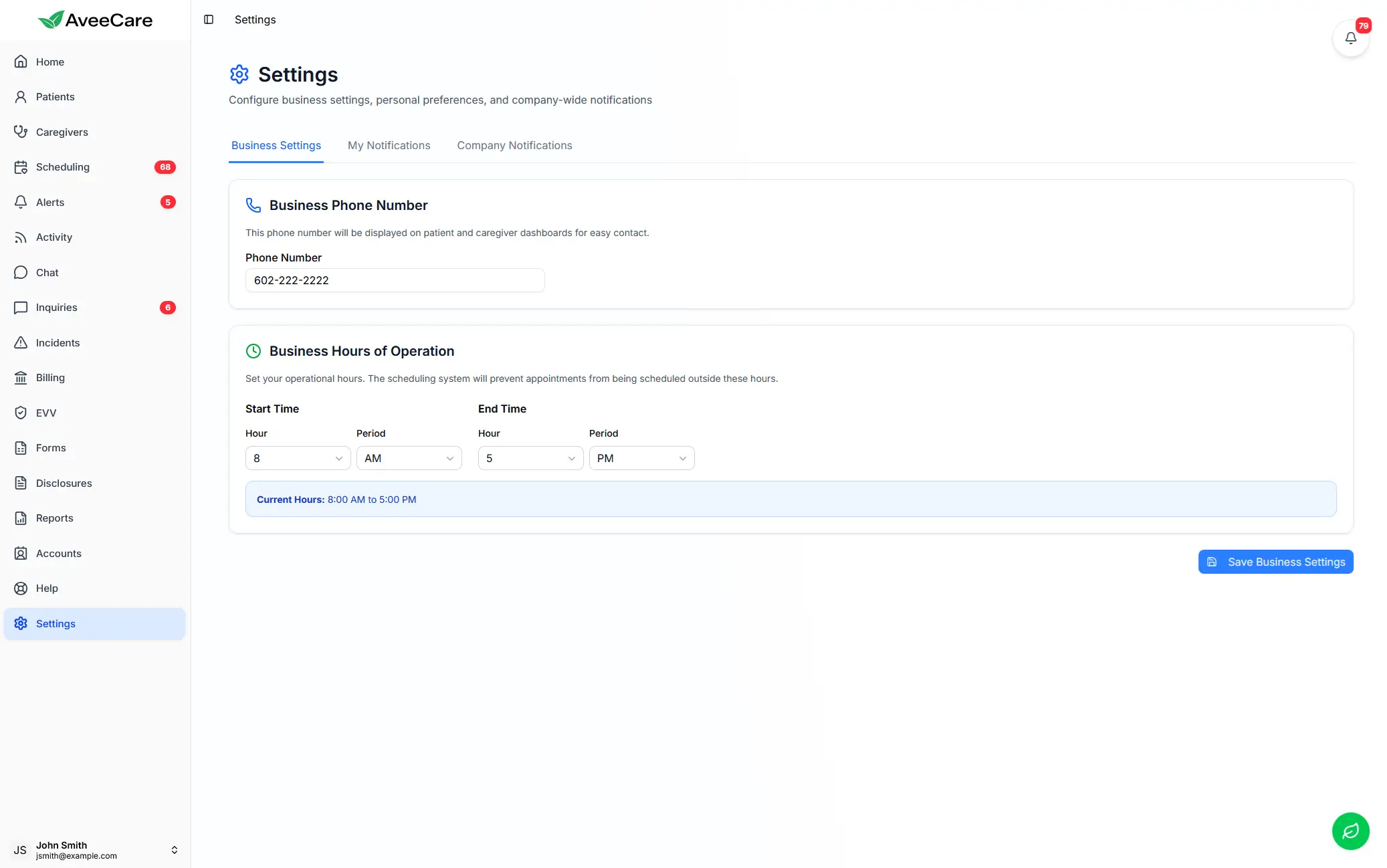
AveeCare's business settings for configuring agency-wide policies
State-Specific Handbook Requirements
Home care agency policies must comply with state-specific regulations that go beyond federal minimums. These vary significantly and change frequently. Always consult local employment counsel.
Paid Sick Leave Laws
Over 20 states and many cities now mandate paid sick leave with specific accrual rates, usage rules, and notice requirements. Your handbook must reflect the laws of every state where you operate.
Key states: CA, NY, WA, OR, AZ, CO, NJ, CT, and more
Anti-Harassment Training
Some states require annual anti-harassment training for all employees with specific content requirements and documentation standards.
Key states: CA, NY, IL, CT, DE, ME
Meal & Rest Break Requirements
State laws vary widely on required meal and rest breaks for caregivers on shifts of varying lengths. Some require paid breaks, others unpaid.
Key states: CA, WA, OR, CO, NY, and others
Salary Transparency
An increasing number of states require salary ranges in job postings and/or prohibit asking about salary history during hiring.
Key states: CA, CO, NY, WA, CT, MD, NV, RI
Background Check Restrictions
Ban-the-box laws, fair chance hiring regulations, and restrictions on using arrest records vary significantly by state.
Key states: Over 35 states have some form of restriction
Home Care Licensing Standards
State licensing requirements often mandate specific policies that must appear in your employee handbook as a condition of licensure.
Key states: Requirements vary by state licensing authority
Important Legal Note
Employment laws change frequently. This guide provides general information, not legal advice. Before finalizing your home care employee handbook, have it reviewed by an employment attorney licensed in your state. Multi-state agencies should have policies reviewed for each state of operation.
Frequently Asked Questions About Home Care Employee Handbooks
While no federal law requires an employee handbook, it is strongly recommended and effectively essential for home care agencies. Several states require written notice of certain policies (anti-harassment, paid leave, at-will status). Beyond legal requirements, a handbook protects agencies in disputes, sets clear expectations, demonstrates HIPAA compliance, and satisfies many state licensing requirements.
Essential policies include: at-will employment statement, EEO policy, anti-harassment policy, HIPAA confidentiality policy, attendance and punctuality, scheduling and overtime rules, dress code, client interaction guidelines, safety and infection control, incident reporting, drug-free workplace, grievance procedures, and disciplinary process. State-specific policies (paid sick leave, meal breaks) must also be included.
Review and update at least annually, and immediately when employment laws change. Key triggers: new state or federal labor laws, HIPAA or OSHA regulation changes, new company policies, court rulings affecting employment, state licensing requirement changes, and lessons from incidents or disputes. Redistribute with new acknowledgment signatures after every update.
Yes, every caregiver must sign an acknowledgment confirming they received, read, and understood the handbook. This is critical legal protection. The acknowledgment should state the handbook is not a contract, that policies may change, and that the employee is responsible for understanding its contents. Digital acknowledgments are legally valid and easier to track.
HIPAA policies must cover: PHI definition, permitted uses and disclosures, client privacy rights, electronic and paper record safeguards, mobile device and secure messaging requirements, prohibition on photographing clients or sharing info on social media, breach notification procedures, violation consequences, and annual training requirements.
Home care software streamlines handbook management through digital distribution, acknowledgment tracking, automated reminders for unsigned employees, secure storage for compliance audits, policy update distribution with new acknowledgment requirements, and an always-accessible digital copy caregivers can reference from mobile devices.
Simplify Handbook Management
AveeCare's built-in policy distribution and digital acknowledgments make home care employee handbook management effortless. Distribute, track, and update your policies from one platform.
Disclaimer: This article is provided for informational and educational purposes only and does not constitute legal, HR, or compliance advice. Home care employee handbook requirements vary by state and are subject to federal, state, and local regulations that change frequently. The policies, templates, and checklists presented here are general guidelines and may not reflect the specific requirements of your jurisdiction. Always consult with a qualified employment attorney before creating or modifying your employee handbook. AveeCare is a home care management software company and does not provide legal advisory services.