AI-Powered Documentation for Home Care: Automating Notes, Reports & Compliance
AI documentation in home care is transforming how agencies handle clinical notes, compliance reports, and administrative paperwork. From voice-to-text transcription to automated compliance checks, AI home care notes technology can reduce charting time by 40-60% while improving accuracy and consistency. This guide covers every type of AI documentation tool, calculates your potential savings, and provides a step-by-step implementation plan for automated charting in home care. For a broader look at how artificial intelligence is reshaping the industry, see our comprehensive AI in home care guide.
The Documentation Burden in Home Care
Documentation is the single largest administrative burden in home care. Studies show that home care clinicians spend 25-40% of their working time on documentation tasks -- writing visit notes, completing assessments, filling out forms, and ensuring compliance with CMS and payer requirements. This time spent on AI documentation in home care could otherwise be spent on direct patient care. Our care plan documentation guide details exactly what those documentation standards require.
The problem compounds as regulations grow more complex. CMS documentation requirements, OASIS assessments, EVV records, care plan updates, and payer-specific formatting rules create a documentation maze that leads to caregiver burnout, increased errors, and claim denials. Artificial intelligence home care documentation tools are emerging as the most effective solution to this growing challenge, with AI home care notes technology reducing charting time dramatically.

How AI Documentation Works in Home Care
AI documentation in home care leverages natural language processing (NLP), machine learning, and large language models to automate various aspects of the documentation workflow. Here is how the technology fits into a typical home care visit cycle.
During the Visit
Caregiver uses voice-to-text or quick-entry forms on their mobile device. AI recognizes medical terminology, structures inputs, and suggests relevant observations based on the patient's care plan and history.
Auto-Completion & Structuring
As notes are entered, AI auto-completes common phrases, structures free-text into required clinical formats, and populates fields based on visit type and patient context.
Compliance Review
Before submission, AI checks documentation against CMS requirements, payer rules, and agency policies. Missing fields, inconsistencies, and compliance gaps are flagged for the caregiver to address.
Summary & Reporting
AI generates visit summaries, updates care plans, and feeds data into reporting systems. Automated charting in home care ensures all stakeholders receive consistent, accurate information.
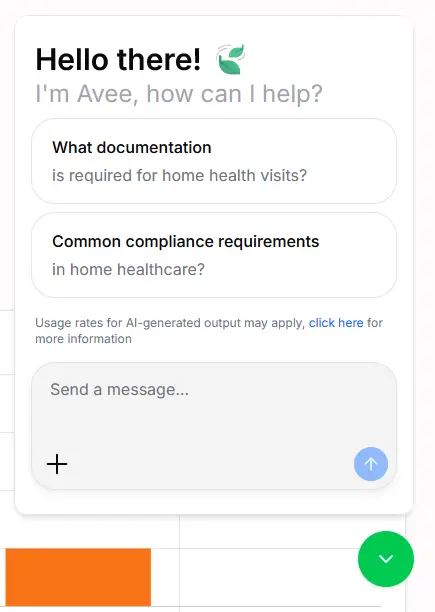
AveeCare AI assistant for documentation
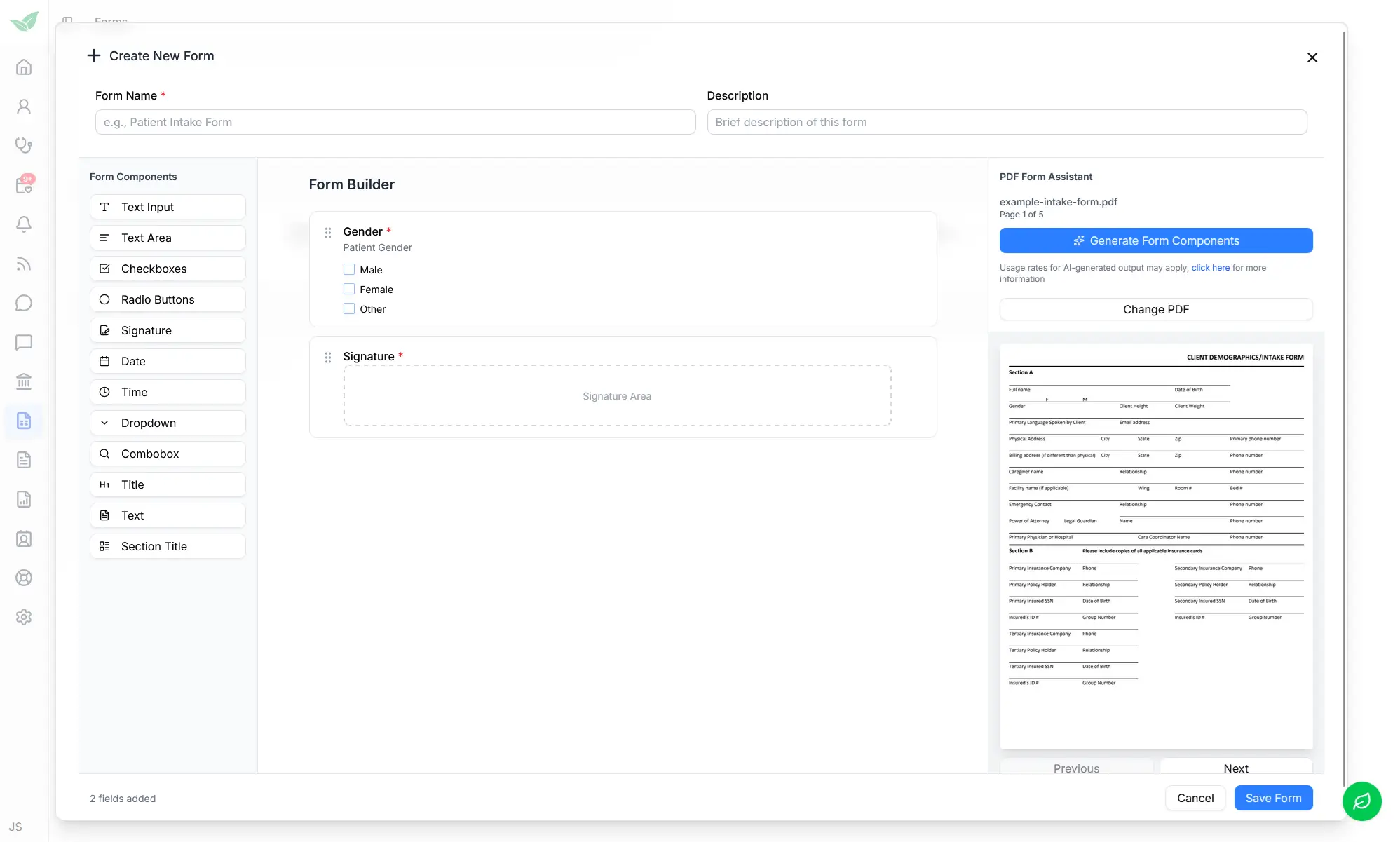
AI-assisted form builder
AI Documentation Feature Comparison
Not all AI documentation tools for home care are created equal. Compare the key features by category to understand which capabilities matter most for your agency. Filter by category to focus on specific areas of automated charting in home care.
Voice-to-Text Transcription
Caregivers dictate notes verbally and AI converts speech to structured clinical text, recognizing medical terminology and abbreviations
Smart Auto-Completion
AI predicts and suggests text as caregivers type, based on patient history, previous notes, and clinical context
Intelligent Templates
AI-powered templates that adapt fields and prompts based on patient conditions, visit type, and care plan requirements
Automated Compliance Checks
AI reviews completed documentation against CMS, state, and payer requirements, flagging gaps before submission
Narrative Generation
AI generates clinical narratives from structured data inputs such as checkboxes and dropdowns, creating natural-language notes
AI Form Builder
AI assists in creating custom intake forms, assessments, and checklists tailored to agency-specific workflows
Visit Summary Generation
AI auto-generates visit summaries from EVV data, caregiver inputs, and ADL tracking, reducing post-visit documentation time
Smart Coding Suggestions
AI suggests appropriate ICD-10, CPT, and HCPCS codes based on documentation content, reducing coding errors and claim denials
AI Documentation Savings Calculator
Enter your agency details to estimate how much time and money AI documentation in home care could save you. Based on an average 50% reduction in documentation time.
Estimated Savings with AI Documentation
Based on a 50% documentation time reduction (industry average for AI documentation tools). Actual savings vary based on current workflows and AI tool quality.
HIPAA Compliance with AI Documentation
When implementing AI documentation in home care, HIPAA compliance is non-negotiable. AI systems process protected health information (PHI) and must meet the same security standards as any other health IT system. Here are the key requirements and best practices for maintaining compliance while leveraging artificial intelligence for home care documentation.
Required Safeguards
- Signed BAA with AI vendor
- Data encrypted in transit (TLS 1.2+) and at rest (AES-256)
- SOC 2 Type II certification
- Access controls and role-based permissions
- Complete audit logs of AI interactions
Voice Data Security
- Voice recordings processed in real-time, not stored
- If stored, encrypted and auto-deleted within 24 hours
- No training on client voice data without consent
- On-device processing option for sensitive environments
Common Compliance Risks
- Using consumer-grade AI tools not designed for healthcare
- Staff copying PHI into non-compliant AI chatbots
- Failing to include AI vendors in risk assessments
- No policies for AI-generated documentation review
- Lacking audit trails for AI-assisted charting
Implementation Timeline Builder
Toggle phases on or off to build your custom AI documentation implementation timeline. Click a phase to expand or collapse its tasks.
- Define documentation pain points and goals
- Evaluate AI documentation vendors
- Assess current documentation workflows
- Establish success metrics and KPIs
- Configure AI tools for agency-specific terminology
- Set up HIPAA-compliant AI processing
- Pilot with 3-5 tech-savvy caregivers
- Collect feedback and adjust settings
- Train all caregivers in small groups
- Provide quick-reference guides and support
- Roll out to 50% of staff, then 100%
- Monitor adoption rates and support issues
- Analyze documentation quality metrics
- Refine AI configurations based on real data
- Address edge cases and special workflows
- Calculate and report ROI to leadership
Estimated total timeline: 10 weeks with 4 phases active
Quality Assurance for AI-Generated Documentation
AI home care notes must be accurate and clinically valid. Establishing quality assurance processes ensures that automated charting in home care enhances rather than compromises documentation quality. Here are the essential QA practices.
Human Review Mandate
All AI-generated notes must be reviewed and signed off by the caregiver before submission. AI assists -- it does not replace clinical judgment.
Regular Accuracy Audits
Conduct monthly audits comparing AI-generated documentation to manual notes. Track accuracy rates and identify systematic errors.
Error Reporting Workflow
Create a simple process for caregivers to flag AI errors. Use this feedback to improve AI performance and identify training needs.
Clinical Validation Rules
Set up rules that flag clinically implausible AI suggestions (e.g., contradictory observations, impossible vital signs) before they reach the record.
Frequently Asked Questions
AI documentation uses natural language processing and machine learning to assist with clinical note creation. Caregivers can dictate notes using voice-to-text, and the AI structures information into compliant formats, fills in codes, checks for missing fields, and suggests improvements. Some systems auto-generate visit summaries from EVV data and pre-populate recurring information.
AI documentation can reduce charting time by 40-60% per caregiver. For a typical caregiver spending 45-60 minutes daily on documentation, this means 20-35 minutes saved per day. For an agency with 50 caregivers, that represents approximately 85-145 hours saved weekly, equivalent to 2-3 full-time employees of documentation time.
AI documentation can be HIPAA compliant when properly implemented. Requirements include a signed BAA with the vendor, data encryption in transit and at rest, secure processing of voice recordings, access controls, and audit logs. Verify your vendor meets SOC 2 Type II and HITRUST certification standards.
Available tools include voice-to-text transcription, smart auto-completion, adaptive templates, compliance checking, narrative generation from structured data, AI form builders for custom assessments, and smart coding suggestion tools that recommend appropriate billing codes.
Implementation typically takes 4-12 weeks: vendor selection and configuration (weeks 1-2), pilot testing with a small group (weeks 3-4), broader rollout with training (weeks 5-8), and optimization (weeks 9-12). Platforms with built-in AI like AveeCare can accelerate this timeline.
Key risks include AI hallucinations (generating plausible but incorrect information), over-reliance without human review, potential bias in suggestions, privacy risks with voice data, and regulatory uncertainty. Mitigation includes mandatory human review, regular accuracy audits, and choosing vendors with transparent AI models.
Sources & References
Regulatory & Standards
Industry Resources
AI Documentation Built Into AveeCare
Meet Avee, our AI assistant that helps with documentation, form building, and report generation. AveeCare brings AI documentation capabilities into a single, affordable platform -- no separate AI tools needed.
Transparent pricing. No mandatory demos. Trusted across all 50 states.
Disclaimer: This article is for informational purposes only and does not constitute legal, medical, or compliance advice. AI documentation tools are assistive technologies and do not replace clinical judgment. All AI-generated documentation must be reviewed by qualified clinicians before use. Savings estimates are based on industry averages and actual results may vary. Published April 3, 2026.