Caregiver Certification & Training Requirements by State
The definitive 2026 guide to caregiver certification requirements across all 50 states. Look up CNA certification requirements, home health aide certification hours, training costs, and renewal periods for every state.
In This Guide
Caregiver Certification: What You Need to Know in 2026
Caregiver certification and training requirements form the foundation of quality home care across the United States. Whether you are an aspiring caregiver seeking your first certification, an agency owner ensuring compliance, or a career professional exploring home health aide certification pathways, understanding your state's specific caregiver training requirements is essential.
The certification landscape in 2026 continues to evolve as states respond to the growing demand for home care services. The Bureau of Labor Statistics projects that home health and personal care aide positions will grow by 21% from 2023 to 2033, making these among the fastest-growing occupations in the country. With approximately 4.7 million projected positions by 2033, caregiver certification requirements directly shape the pipeline of qualified workers entering the field.
Federal law establishes baseline caregiver training requirements through CMS regulations, but states have significant latitude to set their own standards. This creates a patchwork of requirements where CNA certification requirements range from 75 hours in some states to 180 hours in others. Home health aide certification similarly varies, and personal care aide training spans from no formal requirement at all to 80+ hours of mandatory coursework. For a detailed breakdown of what each state mandates, explore our state-by-state caregiver training requirements resource.

Federal Caregiver Training Requirements
The Centers for Medicare & Medicaid Services (CMS) establishes minimum caregiver training requirements that apply nationwide. These federal standards serve as the floor for state regulations, and many states exceed these minimums substantially.
Home Health Aide (HHA)
- 75 hours of training minimum (42 CFR 484.80)
- 16 hours of supervised practical training
- Competency evaluation (written + skills test)
- 12 hours of in-service training annually
- Must work under RN supervision
- Applies to Medicare/Medicaid-certified agencies
Certified Nursing Assistant (CNA)
- 75 hours minimum training (OBRA 1987)
- Must include clinical/practical component
- State-administered competency exam required
- Listed on state Nurse Aide Registry
- Background check required in all states
- Must demonstrate 8 hrs work within renewal period
Personal Care Aide (PCA)
- No federal training requirement exists
- Requirements set entirely by state law
- Range from 0 to 120+ hours by state
- Often employer-provided on-the-job training
- May require background check depending on state
- Growing number of states adding formal requirements
Background Check Requirements
- CMS requires checks for Medicare/Medicaid workers
- FBI fingerprint check in most states
- State criminal history check required
- OIG exclusion list verification
- Sex offender registry check
- Some states require checks every 2-5 years
State-by-State Caregiver Certification Lookup
Search and filter caregiver training requirements by state. This interactive table covers CNA certification requirements, home health aide certification hours, personal care aide training, renewal periods, and approximate costs for all 50 states plus DC.
| State | CNA Hours | HHA Hours | PCA Hours | Renewal | Cost Range |
|---|---|---|---|---|---|
| Alabama (AL) | 75 hrs | 75 hrs | None required | 2 years | $400-$1,200 |
| Alaska (AK) | 140 hrs | 75 hrs | 2 hrs orientation | 2 years | $600-$1,800 |
| Arizona (AZ) | 120 hrs | 75 hrs | Agency-specific | 2 years | $500-$1,500 |
| Arkansas (AR) | 90 hrs | 75 hrs | 40 | 2 years | $400-$1,200 |
| California (CA) | 150 hrs | 120 hrs | 5 hrs + 40 hrs on-the-job | 2 years | $800-$2,500 |
| Colorado (CO) | 80 hrs | 75 hrs | None required | 2 years | $500-$1,500 |
| Connecticut (CT) | 100 hrs | 75 hrs | Agency training | 2 years | $600-$1,800 |
| Delaware (DE) | 150 hrs | 75 hrs | 40 | 2 years | $600-$1,600 |
| District of Columbia (DC) | 120 hrs | 75 hrs | 40 | 2 years | $600-$1,800 |
| Florida (FL) | 120 hrs | 75 hrs | 40 + competency test | 2 years | $500-$1,500 |
| Georgia (GA) | 85 hrs | 75 hrs | 16 | 2 years | $400-$1,200 |
| Hawaii (HI) | 100 hrs | 75 hrs | Agency-specific | 2 years | $700-$2,000 |
| Idaho (ID) | 120 hrs | 75 hrs | None required | 2 years | $400-$1,200 |
| Illinois (IL) | 120 hrs | 75 hrs | 8 hrs orientation | 2 years | $500-$1,500 |
| Indiana (IN) | 105 hrs | 75 hrs | Agency-specific | 2 years | $400-$1,300 |
| Iowa (IA) | 75 hrs | 75 hrs | None required | 2 years | $300-$1,000 |
| Kansas (KS) | 90 hrs | 75 hrs | Agency-specific | 2 years | $400-$1,100 |
| Kentucky (KY) | 75 hrs | 75 hrs | 24 | 2 years | $400-$1,100 |
| Louisiana (LA) | 80 hrs | 75 hrs | 40 | 2 years | $400-$1,200 |
| Maine (ME) | 180 hrs | 75 hrs | 50 | 2 years | $700-$2,200 |
| Maryland (MD) | 100 hrs | 75 hrs | Agency-specific | 2 years | $500-$1,500 |
| Massachusetts (MA) | 100 hrs | 75 hrs | None required | 2 years | $600-$1,800 |
| Michigan (MI) | 75 hrs | 75 hrs | Agency-specific | 2 years | $400-$1,200 |
| Minnesota (MN) | 75 hrs | 75 hrs | Varies by service | 2 years | $400-$1,200 |
| Mississippi (MS) | 130 hrs | 75 hrs | Agency-specific | 2 years | $400-$1,100 |
| Missouri (MO) | 175 hrs | 75 hrs | None required | 2 years | $500-$1,500 |
| Montana (MT) | 75 hrs | 75 hrs | Agency-specific | 2 years | $400-$1,100 |
| Nebraska (NE) | 75 hrs | 75 hrs | Agency-specific | 2 years | $400-$1,100 |
| Nevada (NV) | 75 hrs | 75 hrs | Agency-specific | 2 years | $500-$1,300 |
| New Hampshire (NH) | 100 hrs | 75 hrs | Agency-specific | 2 years | $500-$1,400 |
| New Jersey (NJ) | 90 hrs | 76 hrs | Agency-specific | 2 years | $500-$1,500 |
| New Mexico (NM) | 80 hrs | 75 hrs | Agency-specific | 2 years | $400-$1,200 |
| New York (NY) | 100 hrs | 76 hrs | 40 | 2 years | $600-$2,000 |
| North Carolina (NC) | 75 hrs | 75 hrs | 80 | 2 years | $400-$1,200 |
| North Dakota (ND) | 75 hrs | 75 hrs | Agency-specific | 2 years | $300-$1,000 |
| Ohio (OH) | 75 hrs | 75 hrs | Agency-specific | 2 years | $400-$1,200 |
| Oklahoma (OK) | 75 hrs | 75 hrs | Agency-specific | 2 years | $400-$1,100 |
| Oregon (OR) | 155 hrs | 75 hrs | 8 hrs orientation | 2 years | $600-$1,800 |
| Pennsylvania (PA) | 80 hrs | 75 hrs | 40 | 2 years | $500-$1,400 |
| Rhode Island (RI) | 100 hrs | 75 hrs | Agency-specific | 2 years | $500-$1,400 |
| South Carolina (SC) | 100 hrs | 75 hrs | Agency-specific | 2 years | $400-$1,200 |
| South Dakota (SD) | 75 hrs | 75 hrs | Agency-specific | 2 years | $300-$1,000 |
| Tennessee (TN) | 75 hrs | 75 hrs | 40 | 2 years | $400-$1,100 |
| Texas (TX) | 100 hrs | 75 hrs | Agency-specific | 2 years | $500-$1,500 |
| Utah (UT) | 80 hrs | 75 hrs | Agency-specific | 2 years | $400-$1,200 |
| Vermont (VT) | 100 hrs | 75 hrs | Agency-specific | 2 years | $500-$1,400 |
| Virginia (VA) | 120 hrs | 75 hrs | 40 | 2 years | $500-$1,500 |
| Washington (WA) | 85 hrs | 75 hrs | 75 + specialty | 1 year | $500-$1,500 |
| West Virginia (WV) | 120 hrs | 75 hrs | Agency-specific | 2 years | $400-$1,200 |
| Wisconsin (WI) | 120 hrs | 75 hrs | Agency-specific | 2 years | $500-$1,400 |
| Wyoming (WY) | 75 hrs | 75 hrs | Agency-specific | 2 years | $400-$1,100 |
Showing 51 of 51 states. Click column headers to sort. Data based on CMS and state health department requirements as of April 2026.
CNA vs HHA vs Personal Care Aide: Understanding the Differences
Choosing between CNA certification, home health aide certification, and personal care aide training depends on your career goals, state requirements, and the type of care you want to provide. Each caregiver certification pathway opens different doors.
Certified Nursing Assistant (CNA)
Home Health Aide (HHA)
Personal Care Aide (PCA)
The Caregiver Certification Process: Step by Step
Understanding the caregiver certification process from start to finish helps you plan your timeline and budget. Here is what to expect when pursuing CNA certification, home health aide certification, or personal care aide training. Once certified, new caregivers benefit from a structured introduction to your agency -- see our caregiver onboarding best practices for a proven framework.
Research Your State Requirements
Check your state health department or board of nursing website for current caregiver training requirements. Requirements can change annually, so always verify with official sources.
Choose an Approved Training Program
Select a state-approved training program at a community college, vocational school, or healthcare facility. Verify the program meets your state CNA or HHA certification requirements.
Complete Background Check
Most states require a criminal background check before or during training. This typically includes fingerprinting, state criminal history, and federal OIG exclusion list checks.
Finish Classroom and Clinical Training
Complete all required classroom instruction hours and hands-on clinical practice. Programs combine lecture, lab skills practice, and supervised clinical experience with real patients.
Pass the Competency Examination
Take and pass the state competency exam, which typically includes a written (or oral) knowledge test and a hands-on clinical skills demonstration evaluated by a registered nurse.
Apply for State Certification
Submit your application, exam results, and any required documentation to your state registry. Once approved, you will be listed on the state nurse aide or caregiver registry.
Maintain Your Certification
Track your renewal date (every 1-2 years), complete required continuing education hours, and maintain employment documentation to keep your certification active.
Caregiver Certification Cost Analysis
The cost of caregiver certification varies considerably based on the certification type, state, and training provider. Here is a comprehensive breakdown of what to budget.
CNA Program Costs
Ways to Reduce Costs
- Employer-sponsored training - Many agencies cover certification costs in exchange for a work commitment
- Medicaid waiver programs - Some states fund CNA training for Medicaid-eligible workers
- Workforce development grants - State and federal programs often subsidize healthcare training
- Community college financial aid - FAFSA and Pell Grants may cover program tuition
- Scholarship programs - Organizations like the National Network of Career Nursing Assistants offer grants
- VA benefits - Veterans may use education benefits for CNA/HHA training programs
Continuing Education for Caregivers
Maintaining caregiver certification requires ongoing education. CNA certification renewal typically mandates 12-48 hours of continuing education per renewal cycle, while HHA certification requires 12 hours of in-service training annually under federal Medicare standards.
Continuing education topics commonly required or recommended include infection control and prevention, patient rights and abuse recognition, emergency procedures and safety, dementia and Alzheimer's care, medication management and documentation, body mechanics and fall prevention, cultural competency, and communication skills.
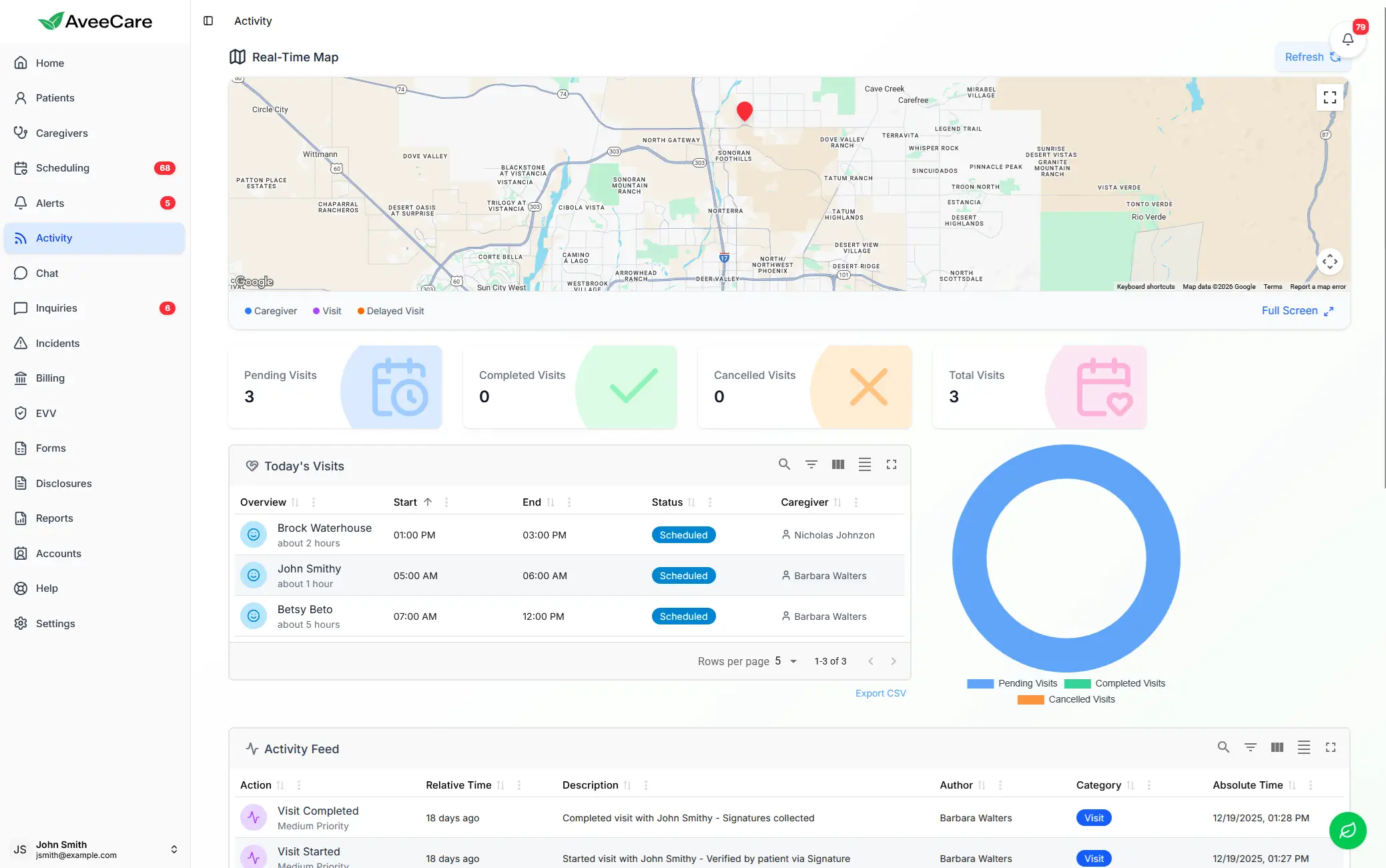
AveeCare's activity tracking helps agencies monitor caregiver training completion and certification status.
Online vs In-Person Caregiver Training
The growth of online learning has expanded access to caregiver training programs. However, the hands-on nature of caregiving means that most certification programs require at least some in-person clinical hours.
Online Training
Note: Online-only programs cannot fulfill the clinical/practical hours required for CNA or HHA certification. Most online programs are hybrid, with in-person lab components.
In-Person Training
Recommended: In-person training is preferred for initial certification. Online is ideal for continuing education and renewal requirements.
Career Advancement Paths for Certified Caregivers
Caregiver certification is often the first step in a rewarding healthcare career. Here are the most common advancement pathways from an entry-level caregiver training certificate.
Personal Care Aide
Start with basic PCA training. Provide companionship, meal prep, light housekeeping.
Home Health Aide (HHA)
Complete 75+ hour HHA program. Add personal care and basic health monitoring skills.
Certified Nursing Assistant (CNA)
Complete 75-180 hour CNA program. Broader scope including vitals, catheter care, clinical skills.
Medication Aide / QMA
Add medication administration certification. Available in approximately 30 states.
Licensed Practical Nurse (LPN)
LPN bridge programs for experienced CNAs. Significantly expanded scope of practice.
Registered Nurse (RN)
ADN or BSN degree. Full nursing scope including assessments, care plans, and supervision.
Frequently Asked Questions About Caregiver Certification
A Certified Nursing Assistant (CNA) typically requires 75-180 hours of state-approved training and can perform clinical tasks like taking vital signs and assisting with medical devices. A Home Health Aide (HHA) requires 75 hours of training under federal standards and focuses on personal care in home settings. CNAs generally have broader scope and higher earning potential, while HHAs specialize in home-based care.
Caregiver certification timelines vary by type and state. Personal care aide training can take as little as 1-2 weeks (8-40 hours). HHA certification typically takes 2-4 weeks (75+ hours). CNA certification requires 4-12 weeks (75-180 hours depending on the state). After training, you must pass a competency exam, which adds 1-2 weeks for scheduling and results.
Caregiver certification costs range widely by state and type. Personal care aide training may cost $0-$500. HHA programs typically cost $200-$1,500. CNA programs range from $500-$2,500 at community colleges, though some employers and Medicaid waiver programs cover costs. Additional expenses include exam fees ($50-$150), background checks ($30-$100), and CPR certification ($30-$75).
Not all states require certification for every type of caregiver. Federal rules mandate that home health aides working for Medicare-certified agencies complete 75 hours of training. However, personal care aides in non-medical home care may have minimal or no state requirements in some states. Requirements vary significantly - some states require as few as 8 hours of initial training while others mandate 120+ hours.
CNA certification reciprocity varies by state. Many states offer reciprocity agreements that allow CNAs to transfer their certification, but you typically must apply to the new state registry, pass a background check, and sometimes complete additional training hours. HHA and personal care aide certifications generally do not transfer between states.
CNA certification typically needs renewal every 1-2 years depending on the state, with most states requiring proof of employment (usually 8+ hours of paid nursing services) and 12-48 hours of continuing education. HHA certifications under Medicare require 12 hours of in-service training annually. Personal care aide renewal requirements vary widely by state.
Sources & References
- CMS State Operations Manual - Nurse Aide Training Requirements
- Bureau of Labor Statistics - Home Health and Personal Care Aides (SOC 31-1120)
- Code of Federal Regulations - 42 CFR 484.80 (HHA Training)
- PHI - State Policy: Training Standards for Direct Care Workers
- National Council of State Boards of Nursing - Nurse Aide Information
Track Caregiver Certifications and Training Compliance Automatically
AveeCare helps home care agencies monitor certification status, track training completion, and stay ahead of renewal deadlines - so nothing falls through the cracks.
Disclaimer: This guide is provided for informational purposes only and does not constitute legal, regulatory, or professional advice. Caregiver certification requirements vary by state and change frequently. Always verify current requirements with your state health department, board of nursing, or relevant licensing authority before making training or employment decisions. The data presented here is compiled from publicly available federal and state sources as of April 2026 and may not reflect the most recent regulatory changes. AveeCare is not a certification body and does not grant caregiver certifications.