Home Care Fraud Prevention: Compliance Strategies & Red Flags
Protect your home care agency from fraud exposure with this comprehensive guide to home care compliance, fraud prevention strategies, and the regulatory red flags every agency must recognize in 2026.

The Home Care Fraud Landscape
Healthcare fraud costs the United States over $100 billion annually, and home care is one of the most targeted sectors.
Home care fraud prevention is not optional. The Office of Inspector General (OIG) has made home health and personal care services a top enforcement priority in its annual work plan. Federal and state agencies are using advanced data analytics, predictive modeling, and coordinated strike forces to identify and prosecute fraudulent billing patterns in home care.
The consequences of Medicaid fraud in home care extend beyond financial penalties. Agencies found liable under the False Claims Act face treble damages, per-claim penalties, exclusion from federal programs, loss of state licensure, and potential criminal prosecution of individual owners and managers. Even unintentional errors in your billing workflows, when they result from systemic failures in home care compliance, can trigger significant liability. A structured compliance audit program is the best way to catch these issues before regulators do.
Common Fraud Schemes in Home Care
Understanding common fraud schemes is the first step in preventing home care fraud and building an effective compliance program.
Phantom Visits
CriticalBilling for home care visits that never occurred. Caregivers may clock in remotely without visiting the client, or agencies may fabricate entire visit records. EVV systems are the primary defense against phantom visit fraud.
Upcoding & Unbundling
CriticalBilling for a higher level of service than was provided (upcoding) or billing separately for services that should be bundled (unbundling). Common examples include billing skilled nursing rates for personal care visits.
Kickback Schemes
CriticalPaying or receiving anything of value in exchange for patient referrals to or from a home care agency. This includes cash payments, free services, excessive entertainment, and inflated consulting fees paid to referral sources.
Identity Fraud
HighUsing patient identities without their knowledge to bill for services, enrolling fictitious patients, or using stolen Medicaid numbers. Some schemes involve paying patients a portion of fraudulent billings for the use of their information.
Documentation Fraud
HighFalsifying clinical documentation to justify services, copying previous visit notes without changes, or creating documentation for visits that never occurred. Includes falsifying plan of care documents.
Employing Excluded Individuals
HighHiring or contracting with individuals who have been excluded from federal healthcare programs (listed on OIG LEIE). Billing federal programs for services rendered by excluded individuals results in automatic liability.
Fraud Risk Assessment
Evaluate your agency's vulnerability to fraud with this 10-question assessment. Answer honestly to identify compliance gaps.
1. Does your agency have a designated compliance officer?
2. Do you conduct regular internal audits of billing and documentation?
3. Do you have written policies and procedures for billing compliance?
4. Do employees receive fraud and compliance training?
5. Does your agency have an anonymous reporting mechanism (hotline, email)?
6. Do you use Electronic Visit Verification (EVV) for all applicable visits?
7. Do you verify caregiver credentials and exclude individuals on the OIG exclusion list?
8. Do you reconcile billed services against visit documentation?
9. Do you have a process for investigating and responding to compliance concerns?
10. Do you have disciplinary standards for compliance violations?
Red Flag Identifier
Select a scenario to see the risk level, required actions, and applicable regulations for preventing home care fraud.
Legal Framework for Home Care Compliance
Understanding the federal and state laws governing home care fraud is essential for every agency owner and compliance officer.
False Claims Act (31 U.S.C. 3729-3733)
The primary federal tool for combating healthcare fraud. Imposes civil liability on anyone who knowingly submits false claims for government payment. Penalties include treble damages plus $13,508-$27,018 per claim (2026 adjusted). The qui tam (whistleblower) provision allows private individuals to file lawsuits on behalf of the government and receive 15-30% of any recovery. Over 70% of DOJ healthcare fraud cases originate from whistleblower complaints.
Anti-Kickback Statute (42 U.S.C. 1320a-7b(b))
Prohibits offering, paying, soliciting, or receiving anything of value to induce or reward referrals for services covered by federal healthcare programs. Criminal penalties include fines up to $100,000 and imprisonment up to 10 years per offense. Each violation also constitutes a false claim under the ACA. Safe harbors exist but are narrowly defined and require strict compliance with all conditions.
Stark Law (42 U.S.C. 1395nn)
Prohibits physicians from referring Medicare or Medicaid patients for designated health services to entities with which they (or an immediate family member) have a financial relationship, unless an exception applies. Unlike the Anti-Kickback Statute, the Stark Law is a strict liability statute, meaning no intent to violate is required. Violations result in denial of payment, refund obligations, civil monetary penalties, and potential program exclusion.
Civil Monetary Penalties Law (42 U.S.C. 1320a-7a)
Authorizes the OIG to impose penalties for various forms of fraud including false claims, kickback arrangements, employing excluded individuals, and failure to report and return overpayments. Penalties range from $10,000 to $100,000 per violation plus treble damages and program exclusion.
7-Element Compliance Program Checklist
The OIG recommends these seven elements as the foundation of an effective home care compliance program. Track your progress below.
Written Policies & Procedures
Develop and maintain written standards of conduct and compliance policies that address specific risk areas in home care billing, documentation, referrals, and operations.
Compliance Officer & Committee
Designate a compliance officer with authority and resources to implement the compliance program, supported by a compliance committee.
Training & Education
Provide effective compliance training to all employees, with role-specific training for billing, clinical, and management staff.
Communication & Reporting
Establish open lines of communication for reporting compliance concerns, including an anonymous mechanism with non-retaliation protections.
Enforcement & Discipline
Develop and publicize consistent disciplinary guidelines for compliance violations, applied fairly regardless of position.
Internal Monitoring & Auditing
Conduct regular internal audits and monitoring to verify compliance and identify potential issues before they become violations.
Response & Corrective Action
Promptly investigate detected problems, take corrective action, and implement measures to prevent recurrence. Self-disclose when appropriate.
EVV as a Fraud Prevention Tool
Electronic Visit Verification is the most effective technology-based defense against home care fraud, particularly phantom visits and time theft.
The 21st Century Cures Act mandates EVV for all Medicaid-funded personal care services (effective January 2020) and home health services (effective January 2023). Beyond mere compliance, EVV serves as a powerful fraud prevention tool that creates an auditable digital trail of every visit.
Modern EVV systems capture six required data elements: type of service, individual receiving service, date of service, location of service delivery, individual providing service, and time the service begins and ends. GPS-based EVV adds geolocation verification that confirms the caregiver was physically present at the client location.
Internal Monitoring & Auditing
Proactive monitoring is the cornerstone of preventing home care fraud. Regular audits identify issues before they become enforcement actions.
Claims Auditing
MonthlyReview a random sample of 5-10% of claims monthly. Compare billed services against visit documentation, EVV records, and care plans. Flag discrepancies for investigation.
OIG Exclusion Screening
MonthlyScreen all employees, contractors, and vendors against the OIG LEIE and SAM exclusion databases. Document screening dates and results. Billing for services by excluded individuals triggers automatic liability.
Documentation Quality Reviews
QuarterlyAudit care documentation for completeness, accuracy, and compliance with payer requirements. Identify patterns of copy-paste notes, missing signatures, or insufficient clinical justification.
Referral Pattern Analysis
QuarterlyMonitor referral sources for unusual patterns, volume concentrations, or relationships that could suggest kickback arrangements. Verify all referral relationships comply with safe harbor provisions.
Self-Disclosure Protocol
When internal monitoring reveals potential fraud, the OIG Self-Disclosure Protocol offers a path to cooperative resolution with reduced penalties.
When to Consider Self-Disclosure
Self-Disclosure Steps
Preserve Evidence
Immediately secure all relevant documents, electronic records, EVV data, and communications. Implement a litigation hold to prevent routine deletion.
Engage Legal Counsel
Retain healthcare fraud defense counsel experienced in OIG matters. Attorney-client privilege protects the investigation findings.
Conduct Internal Investigation
Thoroughly investigate the scope, duration, and financial impact of the issue. Quantify overpayments and identify responsible individuals.
Calculate Financial Impact
Determine the total amount of overpayments or false claims. Include interest calculations from the date of the improper payment.
Submit Self-Disclosure
File a disclosure with the OIG following their Self-Disclosure Protocol. Include a description of the conduct, financial analysis, and corrective actions taken.
Implement Corrective Actions
Implement and document all corrective measures, enhanced training, policy updates, and monitoring improvements to prevent recurrence.
Frequently Asked Questions
Common questions about home care fraud prevention, compliance programs, and regulatory enforcement.
The most common types of home care fraud include phantom visits (billing for services never rendered), upcoding (billing for more complex or longer services than actually provided), kickback schemes (paying or receiving referral fees in exchange for patient referrals), patient identity theft, falsifying caregiver credentials, billing for services provided by unlicensed or excluded staff, and duplicate billing. The OIG estimates that improper payments in home health care exceed $5 billion annually, with phantom visits and upcoding being the largest categories.
The False Claims Act (31 U.S.C. 3729-3733) imposes liability on anyone who knowingly submits false claims for payment to the government. In home care, this applies to agencies billing Medicare, Medicaid, or other federal programs for services not rendered, medically unnecessary services, or services not meeting quality standards. Penalties include treble damages (three times the false claim amount) plus per-claim penalties of $13,508 to $27,018 (2026 adjusted). The qui tam provision allows whistleblowers to file lawsuits on behalf of the government and receive 15-30% of recovery.
The OIG identifies seven elements: (1) Written policies, procedures, and standards of conduct; (2) Designated compliance officer and compliance committee; (3) Effective training and education for all staff; (4) Effective lines of communication including anonymous reporting; (5) Enforcement through well-publicized disciplinary guidelines; (6) Internal monitoring and auditing; (7) Prompt response to detected offenses including corrective action and voluntary self-disclosure when appropriate.
EVV prevents fraud by electronically verifying the date, time, location, type of service, caregiver identity, and patient identity for each home care visit. It eliminates phantom visits through GPS or telephony confirmation, prevents time theft with exact clock-in/out recording, creates auditable digital trails, and flags discrepancies between scheduled and actual visits. The 21st Century Cures Act mandates EVV for all Medicaid-funded personal care and home health services.
Penalties vary by severity. Criminal penalties include fines up to $250,000 and imprisonment up to 10 years per offense under federal healthcare fraud statutes (18 U.S.C. 1347). Civil penalties under the False Claims Act include treble damages plus $13,508-$27,018 per false claim. Administrative penalties include exclusion from all federal healthcare programs, loss of state licensure, and corporate integrity agreements. State Medicaid fraud penalties often include additional fines, license revocation, and criminal prosecution.
The agency should immediately preserve all relevant documents and electronic records, conduct a thorough internal investigation (often with outside counsel), quantify the scope and financial impact, take corrective action including disciplinary measures, consider voluntary self-disclosure to the OIG (which can significantly reduce penalties), repay identified overpayments within 60 days as required by the ACA, and implement enhanced compliance measures. The OIG Self-Disclosure Protocol provides a formal process for cooperative resolution.
Sources & References
Data and regulations referenced in this guide.
- OIG Work Plan — FY 2025-2026 Home Health and Home Care Focus Areas
- DOJ — Health Care Fraud and Abuse Control Program Annual Report (2024-2025)
- CMS — Compliance Program Guidance for Home Health Agencies (OIG)
- False Claims Act (31 U.S.C. 3729-3733) — Current penalties and enforcement data
- Anti-Kickback Statute (42 U.S.C. 1320a-7b) — Safe harbor regulations (42 CFR 1001.952)
- Stark Law (42 U.S.C. 1395nn) — Physician self-referral prohibition and exceptions
- 21st Century Cures Act — Section 12006, EVV requirements for Medicaid
- CMS — Medicare Fee-for-Service Improper Payment Rate Reports (2024-2025)
- OIG Self-Disclosure Protocol — Updated 2024 guidance and procedures
- GAO — Home Health Care: CMS Needs to Better Target Known Fraud Risks (GAO-25-106)
Disclaimer
This guide is provided for educational and informational purposes only. It does not constitute legal, compliance, or professional advice. Fraud prevention regulations, enforcement priorities, and penalty amounts change periodically. Always consult with qualified healthcare compliance attorneys and compliance professionals when developing your agency’s compliance program. The interactive tools on this page provide general guidance and should not replace professional legal consultation.
Prevent Fraud with AveeCare’s Compliance Features
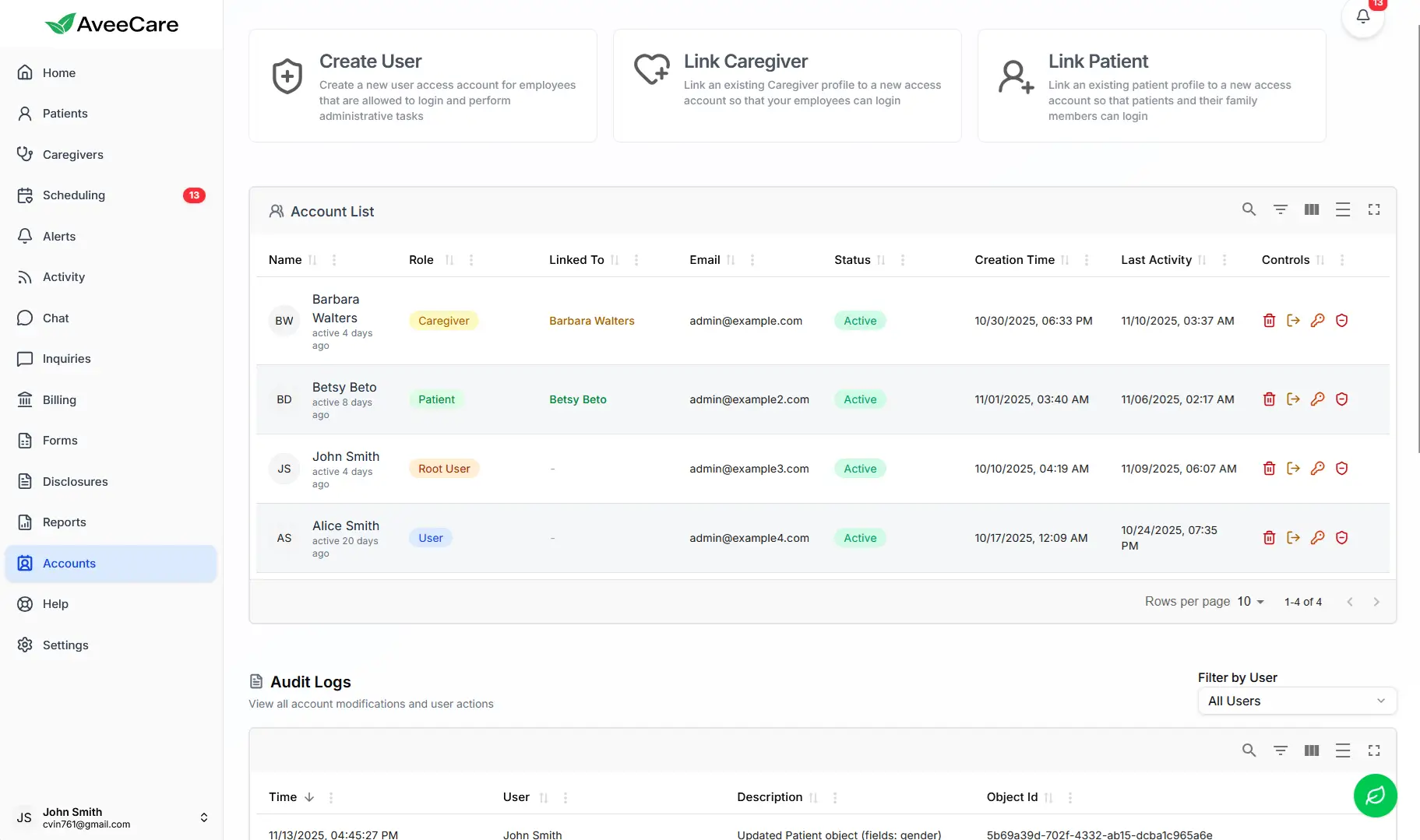
AveeCare’s home care software includes GPS-based EVV, automated visit verification, real-time alerts for scheduling anomalies, secure access controls, and comprehensive audit trails — giving your home care compliance program the technology backbone it needs.